Sunday, December 1, 2019

Advent in the swamp

Hieronymus Bosch, Hell 2
Happy First Sunday in Advent, which is equivalent to New Year's Day on the church calendar, only without the hangover.

To honor the season, I recommend listening to Leonard Cohen's "Anthem."

And when you've finished weeping--if you're wondering what Advent is all about, or if you just want a refresher on why Advent is a particularly good idea--read this NYT op-ed piece by the Rev. Tish Harrison Warren: "Want to Get into the Christmas Spirit? Face the Darkness."

Many of us in the U.S. are struggling through a three-year Advent (and counting) as the swamp is systematically drained of truth, respect, honor, and compassion. With repulsive swamp creatures surfacing one by one, and sometimes in whole flotillas, it's only natural to want to flee the darkness.

But Advent is about looking directly into the darkness.

It's about living in Narnia under the white witch's domination, where it's "always winter but never Christmas." It's about the wars that will be fought again, the holy dove that will be caught again, bought and sold and bought again. It's about crying out with the souls under the altar, “How long, Sovereign Lord, holy and true, until you judge the inhabitants of the earth and avenge our blood?” (Revelation 6:10).

It's about reality.

Strangely, Advent is also about hope. Not the hope provided by Santa and eggnog and presents under a tree, lovely as those things are. The hope they provide is a momentary distraction that goes out to the curb with the Christmas tree, leaving us with bleak January.

Advent hope, by contrast, plumbs the dark depths and yet still sees light breaking through--faint, perhaps sporadic, but persistent.

That too is reality.
And though the last lights off the black West went
Oh, morning, at the brown brink eastward, springs — 
Because the Holy Ghost over the bent
World broods with warm breast and with ah! bright wings.
--Gerard Manley Hopkins

Friday, September 13, 2019

The Amazing Disappearing Woman

CNN politics reporter and editor-at-large Chris Cillizza just posted his analysis of winners and losers from the third Democratic presidential debate. He made some interesting points, but his most amazing assertion was this paragraph under "Losers":
*Elizabeth Warren: The Massachusetts senator wasn't bad -- she just wasn't super involved in the debate, which is weird given that she is widely seen as the strongest challenger to Biden at the moment. For a chunk of the first hour of the debate, Warren sort of disappeared. Some of that is a function of not getting questions from the moderators. But Warren also needs to find ways into conversations -- especially given how centrally located she was on the stage. When she got questions, Warren was solid, particularly when talking about teachers and her own personal narrative. But she didn't get enough questions.
We women know that it's easy to be overlooked and ignored when men are in the room, though Ms. Warren, standing at center stage in her red jacket, was plainly visible. Apparently, however, she was inaudible to Mr. Cillizza (did he wonder why her lips were moving?) Here's how often she actually spoke, and on what topics:


The graph may not be legible on your phone. You can look it up here, but if you're short of time, here's what it shows: Joe Biden spoke for 17 minutes and 22 seconds; Elizabeth Warren spoke for 16 minutes and 37 seconds. The other eight candidates spoke significantly less.

And here's something else you should have noticed, Mr. Cillizza. While Mr. Biden bumbled through many of his minutes (as even you acknowledged, despite declaring him the winner), Ms. Warren was focused and articulate throughout. If she had found her way into conversations even more than she did, would you have accused her of dominating the debate?

Tuesday, August 6, 2019

Mr Trump, did you just condemn yourself?

Presidents Trump and Obama both responded firmly and with dignity to the two mass shootings last weekend.

President Trump, August 5, 10:08 a.m.: In one voice, our nation must condemn racism, bigotry, and white supremacy. These sinister ideologies must be defeated. Hate has no place in America. Hatred warps the mind, ravages the heart, and devours the soul.

President Obama, August 5, 3:01 p.m.: All of us have to send a clarion call and behave with the values of tolerance and diversity that should be the hallmark of our democracy. We should soundly reject language coming out of the mouths of any of our leaders that feeds a climate of fear and hatred or normalizes racist sentiments; leaders who demonize those who don’t look like us, or suggest that other people, including immigrants, threaten our way of life, or refer to other people as sub-human, or imply that America belongs to just one certain type of people....It’s time for the overwhelming majority of Americans of goodwill, of every race and faith and political party, to say as much – clearly and unequivocally.

Wait - do you two guys agree?

President Trump, August 6, 6:47 a.m.: Did George Bush ever condemn President Obama after Sandy Hook. President Obama had 32 mass shootings during his reign [sic]. Not many people said Obama is out of Control. Mass shootings were happening before the President even thought about running for Pres.

Oh, I guess you don't. And now I'm confused. Mr Trump, could you help me understand?

1. Didn't you and President Obama say essentially the same thing on August 5? Did you understand the words you read?

2. President Obama never mentioned your name or your office. What makes you think he was talking about you when he called on American leaders to reject racist language in all its forms? Are you acknowledging that his description fits you?

3. Do you have any idea of the extent to which mass shootings have multiplied since you took office?

Here, let me explain the data. I'll keep it simple. Try to focus.

Yes, there were indeed 32 mass shootings during President Obama's two terms in office, if your criterion is that at least four people are killed per incident. During your two-and-a-half years in office so far, there have been 17 mass shootings. (The raw data is here.) Let's look at what that means.

During Mr Obama's presidency, there was a mass shooting every 91 days.
During your presidency so far, there has been a mass shooting every 55 days.

During Mr Obama's presidency, there were, on average, 4 mass shootings per year.
During your presidency so far, there have been, on average, nearly 7 mass shootings per year.

During Mr Obama's presidency, 295 people died in mass shootings. That's about one death every 10 days.
During your presidency so far, 215 people have died in mass shootings. That's about one death every 4 days.

During Mr Obama's presidency, 275 people were wounded in mass shootings. That's about one person wounded every 11 days.
During your presidency so far, 704 people have been wounded in mass shootings. That's about one person wounded every 32 hours--not even a day and a half.

Comparing your presidency, Mr Trump, to Mr Obama's,

  • the number of mass shootings per year has increased by 67%.
  • the number of deaths per week in mass shootings has increased by 129%.
  • the number of people wounded per week in mass shootings has increased by 706%.


You're right that mass shootings have happened during previous administrations, but mass shootings are vastly increasing under yours.

President Obama did not condemn you by name or by office. You condemned yourself - both by recognizing who best fits his description, and by doing the very things that cause mass shootings (and all kinds of other despicable actions) to proliferate.

Shame.

Sunday, August 4, 2019

USA violence: don't blame mental illness. Blame hatred, corruption, and lies.

Last Tuesday I wrote a blog post asking, Are Americans 10 times more deranged than Norwegians? I was suggesting that the United States' appalling homicide rate--10 times that of Norway, more than 5 times that of Western European countries as a whole--must be due to something more than mental illness.

Three and a half days later, someone murdered 20 people and wounded 26 others in an El Paso, Texas, Walmart. Fifteen hours after that, someone murdered 9 people and wounded at least 26 others in a Dayton, Ohio, nightlife district.

There is no agreed-upon definition of a mass shooting. If you use the FBI's definition of 4 or more killed, not including the shooter, we have had 22 mass shootings in the nearly 31 weeks (so far) this year. If you use the Gun Violence Archive's definition of 4 or more killed or wounded, not including the shooter, we've had 251 mass shootings in 216 days.

Are mass shooters mentally ill, or are they just reeking with hatred? Are legislators who refuse to even consider approaches that have reduced gun violence in other countries mentally ill, or just incredibly corrupt? Are people who keep voting for NRA shills and fomenters of hate mentally ill, or just dangerously deceived? Are people who are genuinely mentally ill getting a bad rap by association with these other people?

Jesus wept.

Tuesday, July 30, 2019

Are Americans really 10 times more deranged than Norwegians?

In the past 72 hours, 104 people in the United States were murdered by guns.

On an average day in 2017 in the United States, 47 people were murdered. About 2/3 of them were killed by firearms.

On an average day in 2017 in Western Europe--an area whose population is greater than that of the U.S.--11 people were murdered. Most of them were not killed by firearms.

The United States homicide rate (number of people killed for every 100,000 residents) is nearly 5 1/2 times greater than the Western European homicide rate.

You're 10 times more likely to be murdered in the U.S. than in Norway.

If, as some argue, the problem is not access to guns but rather violent mental illness or just plain badness, are we Americans really 10 times sicker than Norwegians?

Maybe. Every one of the Western European countries has better access to health care than the United States. Every one of them pays a lot less for it, too. (But save us from socialism, right?)

Though maybe America's flood of firearms does have something to do with our homicide rate. Every one of the Western European countries regulates gun ownership more strictly than does the U.S. (But golly, we need a well-regulated militia, right?)

I don't know if Americans are more than 5 times more deranged than Western Europeans. It's easy to think, though, that we're more than 5 times more ignorant. There are proven ways to save a lot of American lives. We could study how other countries reduce violence. Our corrupt leaders, however, don't want us to do that. After all, there's a lot of money to be made in guns and overpriced healthcare. 
P.S. I wrote this several days before the mass shootings in El Paso and Dayton. Here's a link to what I posted the day after those horrific events.
In case you'd like to see how the U.S. homicide rate compares with the homicide rates of 17 European countries, I made this chart.


All data is from 2017. Follow these links if you want to check the figures on homicides, 
European population, and U.S. population.

Thursday, June 6, 2019

Need good healthcare? Need it now? Short on cash? Be Icelandic.

Today on Facebook I posted a link to this article: "An American In Iceland Found A Lump On Her Body And Her Viral Twitter Thread Shows How Much Better Their Healthcare Is." If you've ever encountered the U.S. healthcare system, you might want to read the article too.

A reliably and sometimes knee-jerk conservative friend of mine left this comment on my post:

"Iceland has a population of 338,349, with practically no illegal (excuse me, undocumented) immigration. The Personal Income Tax Rate in Iceland stands at 46.30 percent. In addition, according to the Trip Savvy website, "VAT in Iceland is charged at two rates: the standard rate of 24 percent and the reduced rate of 11 percent on certain products. Since 2015, the 24-percent standard rate has been applied for almost all goods, whereas the 11-percent reduced rate is applied to things such as accommodations; books, newspapers, and magazines; and food and alcohol." One imagines it might be possible for the United States government to fund all sorts of things under a similar tax regime, not including state and local taxes. How much LIVING the average American would be able to do, however, is another question."

I'm not sure what he's saying there. If we had fewer immigrants, our healthcare system would be as good as Iceland's? If we paid more taxes, our lives would somehow be impoverished?

My friend is right, of course, that the U.S. has a much larger population than Iceland. He is also right that the U.S. has a higher percentage of immigrants: the U.S. population is 15.3% immigrant, whereas Iceland's is 12.5%. I don't know how many of those are undocumented; I do know that many economists have found that immigration (documented or un) is mostly beneficial. A report from the Wharton School (President Trump's alma mater) concludes, "Economists generally agree that the effects of immigration on the U.S. economy are broadly positive."

But let's look at some countries with a higher percentage of immigrants than the U.S. and see how they fare with regard to health and happiness. Here are seven. Ireland: 16.9%. Sweden: 17.6%. Austria, 19.0%. Canada, 21.5%. New Zealand, 22.7%. Australia, 28.8%. Switzerland, 29.6%. Golly, their healthcare costs must be enormous!

Well, no. The per capita yearly healthcare cost in those seven countries averaged $5,352 in 2017, or about half the per capita yearly healthcare cost in the United States, which was $10,209. The costs ranged from $3,683 (New Zealand) to $8,009 (Switzerland). (Iceland's cost was $4,581.)

Ah, but the U.S. has better healthcare, right? Maybe not. Interestingly, people in these seven countries have significantly longer lifespans than people in the United States. U.S. residents' average lifespan is 79.772 years. People in the other seven countries, on average, live three years longer, ranging from 81.884 years to 83.706 years (In Iceland, the average resident lives to 83.152 years). And if you think residents of those countries have to wait longer for healthcare, read the comments on the Iceland article.

But sheesh, those taxes! Yes, U.S. residents pay less tax and have more disposable income than residents of those other seven countries, on average. But the difference is not as great as it might appear, partly because those taxes pay for things that U.S. residents pay for out of pocket, and partly because the U.S. has much more inequality (multibillionaires have a way of skewing the averages). The Gini Index ranks 157 countries from #1--the most unequal--to #157, the most nearly equal. On their list, you want a high number. The U.S. is #39. The other seven countries range from #88 to #152 (Iceland is #141).

So how much LIVING can people in these seven countries do, compared with the average American? Well, with enormous healthcare costs and huge educational debt, life can be rough for average Americans. And when you and your neighbors are poor in a country run by obscenely rich people, you may not feel so good either. Maybe that's why Americans aren't as happy as people from those other seven countries. The U.S. took 19th place in the yearly happiness index. The other seven countries ranked at place 16 (Ireland), 11 (Australia), 10 (Austria), 9 (Canada), 8 (New Zealand), 7 (Sweden), and 6 (Switzerland). (Iceland came in at 4th place.)

Summary: Immigrants are not the reason for high healthcare costs. High costs are not a predictor of good care or good results. Low taxes are not a predictor of happiness.

If you want to terrify Europeans, just suggest replacing their healthcare system with one that resembles the U.S. system. President Trump didn't realize that a few days ago when he went to the U.K. and made comments that worried supporters of Britain's National Health System, but the strong blowback made him quickly change his tune.

America deserves a healthcare system that covers more people, costs less, and produces better results. I wonder why more Americans don't pay attention to systems that are already doing that.

Friday, March 22, 2019

Fact-Checking Only One of Trump's Lies This Week

From yesterday's interview on Fox News:
“I had one of the greatest election victories in history, wouldn’t you say that’s right?” [Trump] then asked host Maria Bartiromo, who nodded her head and responded “Yes, absolutely.”
I suppose that depends on how you define "great." Even Trump knows that he lost the popular vote. Let's compare his percentage of the Electoral College vote with those of all the other presidents in his lifetime, shall we?


Six of those presidents had a lower Electoral College percentage than Trump's (though five of them, unlike him, won the popular vote). Eleven of those presidents had a higher Electoral College percentage than Trump's (and they all won the popular vote).

The average Electoral College percentage of all seventeen of those presidents - those with lower as well as those with higher percentages than Trump's - is 71.87%. Trump's percentage, an unimpressive 57.25%, lowers the average.

Apparently Trump has only one possible definition of "one of the greatest election victories in history": He thinks it was great because he won. And his Fox News interviewer "absolutely" agrees with him. 

In related news this week, George Conway, referring to the diagnostic criteria for narcissistic personality disorder, nailed it.


Thursday, January 3, 2019

5 favorites from my 2018 reading list

The dreaded question: "So, what are you reading?"

The panicked response: [totally blank mind, even if I put down a book just minutes before]

The workaround: Mentioning one of my favorite authors of detective fiction (Louise Penny, Michael Connelly, Donna Leon).

The somewhat more effective solution: Keeping a list of books read; reviewing it before social engagements where the dreaded question might be asked.

So for each of the last 22 years, I've kept such a list. At the end of each year, I look at the list, cringe at my lowbrow tastes, and marvel at how few of the books were memorable. In fact, some of the titles always look so unfamiliar that I have to google them to make sure there's no mistake.

But some books are outstanding, and here are my favorites of 2018 ... apart from those already mentioned detective series by Penny, Connelly, and Leon. And also Alexander McCall Smith, Martin Walker, Ian Rankin, Laura Lippman, Ann Cleeves, Peter Lovesey... 

As I look at my favorites, I realize that each one--in spite of their stories of pain, suffering, and downright evil--is ultimately hopeful.

Two favorite novels:


Stephen McCauley, My Ex-Life, 2018

A comedy of manners that is not Jane Austen, though I also adore Jane. Funny, wistful, compassionate.


Octavia E. Butler, Kindred, 2004

Two parallel stories, maybe 150 years apart, with some of the same characters. Suspend disbelief: it's worth it.


Three favorite books of nonfiction:


Kate Bowler, Everything Happens for a Reason: And Other Lies I've Loved, 2018

An excellent memoir by a youngish professor of religion who is living with stage 4 cancer. The book was published in February; she wrote this op-ed piece in the New York Times last week.


Isabel Wilkerson, The Warmth of Other Suns: The Epic Story of America's Great Migration, 2010

A classic. Big. Full of stories. So interesting you might not notice how much you're learning.


Michelle Obama, Becoming, 2018

Fascinating on so many levels, and not only because she's America's most admired woman this year. And hey, this is President Obama's favorite book of 2018!


Enjoy! There are still 362 reading days in 2019. 

Friday, November 23, 2018

THE WARMTH OF OTHER SUNS by Isabel Wilkerson - a book well-intentioned white people should read

I just finished reading a powerful book: Isabel Wilkerson's The Warmth of Other Suns. Wilkerson, a Pulitzer Prize-winning journalist, profiles three African Americans born in the South in the second decade of the 20th century. All three moved away: one to New York, one to Chicago, one to Los Angeles. The men died in the 1990s. The woman died in 2004. Unless you are very young, they all lived during your own lifetime. Unless you are a person of color, their experiences may startle you.

I am 70 years old. I was in third grade when Rosa Parks kept her seat in the bus, had just finished high school when LBJ signed the Civil Rights Act, was a college student when race riots broke out all across America, and had just gotten married when Martin Luther King was assassinated. I was appalled by racism without realizing I had spent my life in an extremely white bubble whose privileges were built on a racist past.

As a well-educated white woman, I wanted black people to be able to ride in the front of the bus and eat at lunch counters, of course; but I was completely unaware of the daily hardships, insults, and real dangers that provoked the civil rights movement, in both North and South. And I certainly didn't know the extent to which racism continues to exist.

Nearly five years ago I moved from a county that is 5% African American to a county that is 29% African American. I live walking distance from a city that is 63% African American. From new friends, I have learned something that should have been obvious all along: that as a white woman, I can't begin to imagine what it's like to be a woman of color. Things that happen to my black friends do not happen to me. It's been easy for me to assume they don't happen at all, or at least happen extremely rarely. I had no idea.

I've tried to educate myself by listening, watching, and reading. The more I learn, the more I realize I need to learn. Humility is painful: I will never know what it's like to be black in America. I do know, however, that I learned a lot from The Warmth of Other Suns. It's not a history book, though from it I learned parts of history that were somehow not covered in my undergrad history major. It's not a sociology book, though I couldn't miss seeing how the protagonists' social context affected their lives. It's not a political argument, though politicians show up in its pages from time to time. The book is a carefully researched story of three lives, told mostly in their own words. And it's not fiction.

Thursday, September 27, 2018

REVIVING OPHELIA, Christine Blasey Ford, and what most women know

In 1994 Mary Pipher's book Reviving Ophelia: Saving the Selves of Adolescent Girls was published. On the New York Times bestseller list for three years, it is still selling well almost 25 years later. It's an excellent book, and painfully relevant to today's news.

In less than an hour the Senate Judiciary Committee will start questioning Brett Kavanaugh and Christine Blasey Ford. Whatever they determine and however they vote, I am convinced that any woman who thinks Dr. Ford's story could not possibly be true has lived a sheltered life indeed.

Actually, I lived an incredibly sheltered life myself, and yet something similar - though considerably milder - happened to me when I was 11 and the boy was 12. During the school day. In the teacher's office. When class was in session, but kids were working on projects and the teacher was distracted. And that was in the bucolic 1950s. By the way, I never told my parents, and I'm feeling really conflicted about mentioning it here, nearly 60 years later.

Most women know that these things happen.

Here's a story from Reviving Ophelia about a 15-year-old girl who was assaulted by a classmate in 1993. Her assault was worse than Dr. Ford's, but look at the parallels:

"She'd been invited to a party by a girl in her algebra class whose parents were out of town. The girl was supposed to stay with a friend, but she had worked out a way to be home. The kids could use her parents' hot tub and stereo system.

"Cassie didn't get invited to many parties, so she accepted the invitation. She planned to leave if things got out of control. She told her mother the truth about her plans, except she didn't mention that the parents were gone....

"The party was okay at first--lots of loud music and sick jokes but Cassie was glad to be at a party. A guy from her lunch period asked her to dance. A cheerleader she barely knew asked her to go to the movies that weekend. But by eleven she wanted to go home. The house was packed with crashers and everyone was drinking. Some kids were throwing up, others were having sex or getting rowdy. One boy had knocked a lamp off a desk and another had kicked a hole through a wall.

"Cassie slipped away to the upstairs bedroom for her coat. She didn't notice that a guy followed her into the room. He knew her name and asked for a kiss. She shook her head no and searched for her coat in the pile on the bed. He crept up behind her and put his hands under her shirt. She told him to quit and tried to push him away. Then things happened very fast. He grabbed her and called her a bitch. She struggled to break free, but he pinned her down and covered her mouth. She tried to fight but was not strong or aggressive enough. He was muscular and too drunk to feel pain when she flailed at him. Nobody downstairs heard anything over the music. In ten minutes it was over."

Cassie, unlike Dr. Ford, told her parents, who called the police. Here's why she might have wished she hadn't.

"The guy who sexually assaulted her had been suspended from the track team pending his trial. His friends were furious at her for getting him in trouble. Other kids thought she led him on, that she had asked for it by being at that party."

If you've ever been a high school girl, you know that rejection by your peers can be the unkindest cut of all.

Maybe you believe Judge Kavanaugh, or maybe you think he's lying, or maybe you think he was too drunk to know what he did. Maybe you believe Dr. Ford, or maybe you think she's lying, or maybe you think it was someone else who assaulted her.

But don't ever say the event couldn't have happened just as Dr. Ford describes it. It could have. Similar events often did. And very likely still do.

Saturday, September 8, 2018

One way you can (maybe) help keep Brett Kavanaugh off the Supreme Court

[Collins & Kavanaugh, 8/21/2018]
Have you been keeping up with the campaign to persuade Maine Senator Susan Collins to vote against confirming Brett Kavanaugh? You pledge whatever amount you please--$20.20 is suggested--which will fund her Democratic opponent in 2020 if she votes for confirmation. If she votes against confirmation, you will be charged nothing at all.

I'd heard about the campaign, but I was startled this morning when I learned how much has been raised. Less than a month ago, the organizers were talking about kick-starting an opponent's campaign with, say, $50,000. Last I looked, over $700,000 had been pledged. You can check current totals, read about why a lot of people in Maine oppose BK's nomination, and make your own pledge, if you like, at Crowdpac.

A few things to add, in case you think this is a wonderful or a terrible idea:

  • Remember that she's not up for re-election this year. In 2020 she'll be almost 68. Maybe she won't care if she doesn't get to stay in the Senate until she's 74, who knows? If she does care, maybe she'll think that however much this campaign brings in is a drop in the bucket compared to the more than $6 million she raised to get elected in 2014. Or maybe she'll be so offended by all this pressure that she'll vote for confirmation just to show her independence.
  • On the other hand, this may worry her. She might not want a Democrat to win her seat. If you're a Republican, you might not want that either. But if you're a Democrat, you might think it's a great idea.
  • The media gives a lot of attention to the future of Roe v. Wade. BK might well cast the vote that would reverse that decision. If you think women should choose for themselves, you're no doubt hoping Collins will vote against BK. If you are opposed to legal abortion, you might want BK to be confirmed. 
  • On the other hand, you might realize that BK's nomination is about a lot more than abortion.There are other important reasons to hope BK is not confirmed. Today's New York Times editorial,  "Confirmed: Brett Kavanaugh Can't Be Trusted," gives quite a few. Be sure to scroll past the "Related: More on Brett Kavanaugh" interruption and read the latter half of the article, where several serious concerns are raised. Most damning, in my opinion, is this: "He misstates facts under oath, and Republicans cover for him by making it hard, if not impossible, to get the documents proving it."
  • Susan Collins's vote could make the difference. 

A man who can't be trusted is not a man I want on the Supreme Court, even if he's a really nice guy. Especially since he'd often have the tie-breaking vote. There are already enough people in Washington, DC, who can't be trusted. We don't need their accomplices on the Supreme Court; we need justices who will hold them accountable. That's what separation of powers is all about. And that's why I contributed to the Crowdpac campaign today.

Click this link to make your provisional contribution.

Friday, September 7, 2018

America's Would-Be Sun King

[Louis XIV. Check out amusing parodies
of this painting here and here.]
"Is it treason? ... It's treason," the president said at the Montana rally last night.

He was talking about the New York Times op-ed piece in which an unnamed White House insider criticized the president for his amorality, the basis for at least a dozen other of his listed failings. If you've only read about the op-ed, but haven't read the actual article, you really need to read it now. It's short. And if you're a Republican, never fear: so is the writer of the op-ed piece.

Interestingly, treason is specifically defined in the Constitution, Article III, Section 3:

Treason against the United States, 
shall consist only in levying War against them, 
or in adhering to their Enemies, giving them Aid and Comfort. 

Criticizing the president is not treason. The president is not the United States. France's King Louis XIV may have said "L'État, c'est moi" (I am the state), but divine right kingship, at least so far, has not been popular here. As a New York Times editorial reminds us, "Twenty months into the job, Mr. Trump has yet to grasp that the highest law of this land is the Constitution, not whoever occupies the Oval Office at any given moment."

In fact, this president seems to be waging war on the Constitution, not preserving, protecting, and defending it as he solemnly swore to do when he took the oath of office (which you can read, if you like: it's in the Constitution, Article II, Section 1). He seems particularly upset with the First Amendment.

"There oughta be a law," he frequently grumbles - not only against people who criticize him, but also against newspapers that publish stories he doesn't like, protesters who oppose him, and religious groups he doesn't like. The First Amendment explicitly disagrees:

Congress shall make no law 
respecting an establishment of religion, 
or prohibiting the free exercise thereof; 
or abridging the freedom of speech, 
or of the press; 
or the right of the people peaceably to assemble, 
and to petition the Government for a redress of grievances.

Christian Trump supporters would be wise to consider that a president who attacks every clause in the First Amendment is not protecting freedom of religion, even if he helps some Christians achieve their current pet goals. Evangelicals' "dream president" (according to Jerry Falwell, Jr.) may well turn out to be their worst nightmare.

The First Amendment protects the nation against tyrants. It may seem nice to have a would-be tyrant on your side right now, but beware. White evangelicals are in serious decline - from 23% to 15% of the population in just 11 years. With a weakened First Amendment, a future tyrant  (or even this one) could easily turn on you.

Tuesday, August 28, 2018

Yes, Mr. President, you should fix Google!


Dear President Trump,

Your tweet this morning was absolutely on target--a high percentage of online news reports about you are BAD. You are right in saying that this is a very serious situation (and you didn't even mention that the percentage of bad news may have gotten even worse since Google and Twitter started weeding out disruptive Russian trolls, bots, and political ads, which were mostly in your favor). Believe me, most Americans are glad you are onto this.

The good news is, YOU can singlehandedly fix this problem! Here's how:

1. STOP DOING BAD THINGS.
2. START DOING GOOD THINGS.

If you aren't sure about the difference between BAD and GOOD in any specific situation, you can ask people who read lots of books to advise you.

You'll be surprised at how quickly the news reports change in your favor!

Sincerely,
A friend who wants to make America great again

Saturday, August 25, 2018

On turning 70 and looking for wisdom

A decade ago I published my Top 10 on turning 60. Most of the items on my list are truer now than ever. Septuagenarians are much less likely than sexagenarians to die young, for example.

Still, I'm finding it hard to come up with a new Top 10 list. I don't much care for the biblical description of this decade: "The days of our years are threescore years and ten; and if by reason of strength they be fourscore years, yet is their strength labour and sorrow; for it is soon cut off, and we fly away"(Psalm 90:10).

Some of my friends have already flown.

It's not that I want to relive my 60s. I'm glad to be done with the Great Recession, heart surgery (I hope), retiring, figuring out Social Security and Medicare, moving 750 miles from my home and friends of 33 years, saying goodbye to two sweet dogs, remodeling my new old house, and learning how not to get lost in a state none of whose roads are straight. Good things came out of that tumultuous decade, however: I like my new neighborhood, friends, and small dog, and I'm happy that many of my longtime friends have come to visit.

It would be nice to think that my 70s will be a more peaceful decade than my 60s, but I hear that's highly unlikely. Another recession, most economists say, is just around the corner. Good health may or may not last the decade. Social Security and Medicare are under attack. The house needs a new roof. We'll probably want to move again before 2028. Still, new friendships are likely to increase and deepen, and my new dog, who just turned two, will probably last awhile.

The psalmist advises numbering our days, "that we may apply our hearts unto wisdom" (Psalm 90:12). The Social Security Life Expectancy Calculator numbers my remaining days at 17.4 years, though retirement planners advise making savings last to age 100 or 105, just in case. So what wisdom should I apply to the next 15, 25, 35 years? I'd love to hear your ideas, especially if you've lived even longer than I have.

About leaving comments: Some friends have told me they can't get this site to accept their comments. Others have  no problem. I don't know what the difference is, but Blogger sites sometimes do strange things. Please be patient, because no comment is posted until I've read and approved it. That can take anywhere from a minute to a day. I weed out bots, spammers, and trolls, not good people like you. Blogger will tell you if your comment is awaiting moderation. If your comment simply disappears into the ether with no comment, Blogger is misbehaving again.

Monday, April 16, 2018

What James Comey got wrong

During the interview by George Stephanopoulos broadcast by ABC last night, James Comey spoke with calm dignity about the man who fired him last year. Comey did not call him names. He didn't even call him a liar, though he mentioned numerous occasions when the president told demonstrable lies. That the president lies, of course, is neither news nor opinion: it's verifiable fact. And Comey did express an opinion about that:
A person who sees moral equivalence in Charlottesville, who talks about and treats women like they're pieces of meat, who lies constantly about matters big and small and insists the American people believe it, that person's not fit to be president of the United States, on moral grounds.
Well then, wondered Stephanopoulos, "If you are right, what is the remedy? Should Donald Trump be impeached?"

Surprisingly, Comey said no:
Impeaching and removing Donald Trump from office would let the American people off the hook and have something happen indirectly that I believe they're duty bound to do directly. People in this country need to stand up and go to the voting booth and vote their values.
Perhaps the president should be impeached and removed; perhaps not. There are some problems, however, with Comey's answer.

First, America is not and never has been a direct democracy. We are instead a representative democracy. That is, American citizens do not directly make, enforce, or judge laws: our elected or appointed representatives do. American citizens do not directly elect the president of the United States: our electoral college does.

Second, the people in this country did stand up and go to the voting booth and vote their values in 2016, and the largest number of votes—by a margin of nearly 3 million—were for Hillary Clinton. But our representatives in the electoral college nevertheless gave the election to Donald Trump.

If people in this country are appalled by the president's crude, cruel, immoral, and illegal behavior, do they really need to wait until 2020 to put a stop to it? If the people's representatives in the form of the electoral college got them into this mess, why shouldn't the people's representatives in the form of Congress get them out of it?

Of course they should. The catch is that the people's representatives have been cowed by the playground bully in the White House. James Comey on several occasions should have told the president that his behavior and requests were out of line. He did not. Republican members of Congress on many occasions should have censured or stopped the president rather than attempting to put a good face on his behavior. They did not. And now some Republicans are hoping to energize Republican voters by warning them that, if Democrats take Congress later this year, Trump will be impeached.

I can think of no better reason to vote Democratic in November.

But then, I'm not a conservative. Still, I feel bad for my good, decent, kind, intelligent conservative friends (and they really do exist—probably in much greater numbers than many of us progressives want to admit). Progressives and conservatives need each other. Our country is strengthened when principled legislators with differing perspectives sit down together to craft policy. Conservatives should not be asked to shelve their deepest convictions in order to remove from office someone who violates them.

Comey again:
We owe it to each other to get off the couch and think about what unites us. I think about the people who supported Trump, and continue to support Trump. A lotta them come from families with a proud history of military service. And that's a wonderful thing. What did their fathers and grandfathers fight and die for? Not for immigration policy. Not for a tax policy. Not for Supreme Court justice. They fought and died for a set of ideas. The rule of law. Freedom of speech. Freedom of religion. The truth.
We know our president is not personally interested in military service, the rule of law, freedom of speech, freedom of religion, or the truth. We may soon learn to what extent his business affairs and other foreign entanglements cross the line from fraudulent to criminal.

Is it really a good idea to wait another two-and-a-half years for the people in this country to vote their values? Didn't we already do that in 2016? In a representative democracy, why shouldn't our elected representatives—of both parties—act on the values that unite us and put an end to our national nightmare?
----------------------------------------------
(The portion of the interview aired Sunday night was edited down to fit in a one-hour time slot with lots of commercials. You can read a transcript of the complete interview here.)

Tuesday, April 3, 2018

THE DISCOVERY OF CHOCOLATE by James Runcie, with 2 ways to make chocolate cake as God intended

Five years ago I learned about Cook the Books, an online book club featuring not only books about food, but people who read those books and invent recipes inspired by them. One of those people even wins a prize. What could be more fun?

Back then they asked David and me to judge contributions based on Andrea Camilleri's The Shape of Water (the book, not the current movie by the same name, which bears no relation to it). Here's what we decided, and wrote.

Ever since, I've been reading their bimonthly emails announcing more books and more recipes. In February I noticed that they were featuring The Discovery of Chocolate by James Runcie (author of the books that inspired Grantchester, for you James Norton and Masterpiece fans), so I immediately ordered it. If, in the intervening weeks, I hadn't also acquired a new puppy, had a family reunion, celebrated 50 years of marriage, and survived Easter while being married to a church music director, I might have blogged about The Discovery of Chocolate in time to join their contest.  I liked the book more than any of their contestants did (and I'll tell you why), and I have a couple of killer chocolate recipes.

About the book:
I've read a lot of comments from people who hated it, or were mystified by it, or were bored by it, or thought it should have been written differently. As a former editor who helped authors develop their books in hopes of getting people to buy them, I respect those comments. Runcie's book fits no categories - not even magical realism, which many commenters think it is. It could be a hard sell.

But as a big fan of Voltaire's Candide, I chuckled all the way through Runcie's mash-up of impossible stories.* Candide is a classic and The Discovery of Chocolate is a bit of fluff, but both books are wickedly funny, both authors wink as they toss out allusions for readers to recognize, and both sweetly expose cruelty, pomposity, and hypocrisy through the naïve observations of their credulous protagonists.

Like Candide, Diego voyages throughout the world, having one bizarre adventure after another. Both characters are inspired by love, and both witness actual historical events. Unlike Candide, however, Diego also voyages through time. He's a gourmand, not a philosopher. He ends up at a Día de los Muertos festival, not in a garden. And he has a dog.

Also, the book is about chocolate.

About chocolate:
There's something called red velvet cake that I didn't discover until I moved to Maryland. Apparently it's a Southern thing. They think it's chocolatey. It is not.

There's something called a Texas sheet cake that is slightly more chocolatey, but it's still pretty wimpy.

Chocolate, my friends, can be assertive and even rough. It can be deep and rich and smooth. But it should never be bashful. It should never be milky, for heaven's sake. And it's not about the sugar. Cocoa content of 72% is good, but 85% is better, and 100% is just fine with a bit of coarse salt. That's my story, and I'm sticking to it.

[Flourless chocolate cakelet.
Raspberries and candle are optional.]
Back in 2009, I posted a recipe for a seriously fortified Texas sheet cake. The previous year I posted a recipe for flourless chocolate cakelets, whose chocolate content is even more intense. Both recipes still work. Try them. I can't promise that they'll make you immune to death, like Diego's elixir in The Discovery of Chocolate, but who knows?
______________
*Clarification: I have degrees in French; Runcie earned a first in English from Cambridge University. I'll bet he was thinking, not of Candide (1759), but of Gulliver's Travels (1726). It's possible that Voltaire was thinking of Gulliver's Travels too--he was living in England when it was published. Take your pick. The point is, The Discovery of Chocolate is an 18th-century novel with sly 21st-century allusions. And it's about chocolate.

Friday, March 23, 2018

EVERYTHING HAPPENS FOR A REASON: AND OTHER LIES I'VE LOVED, by Kate Bowler

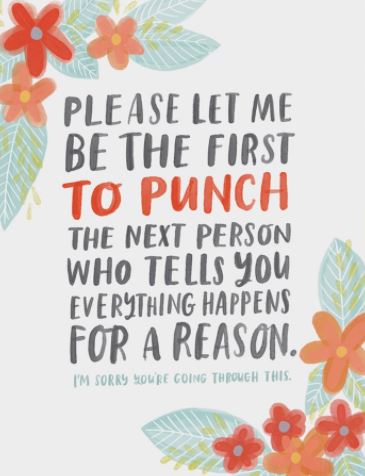
I asked Google to find the cover of the book I'm about to praise. "Everything happens for a reason," I typed, and clicked "images." Instead of the cover, I got a pageful of annoyingly pious memes and posters--and this perfectly wonderful empathy card,


I've never met Kate Bowler, but I heard Terry Gross interview her on "Fresh Air" (which is why I read her book), and I'm pretty sure she would love the card. 

Bowler, who teaches at Duke Divinity School, is the author of Blessed: A History of the American Prosperity Gospel (Oxford, 2013). The prosperity gospel is attractive: God wants you to be healthy and wealthy! And so if you trust God enough, and get rid of the sins that hold you back, and think positively, and (often) donate money to some ministry, God will make you prosper!

Except when he doesn't. Suppose, for example, that, like Bowler, you contract a mysterious neurological impairment that baffles doctors and keeps you from using your hands. Suppose you lose a much-wanted child to miscarriage. Suppose you discover at age 35 that you have stage 4 colon cancer.

Is your suffering your fault? Did you not trust enough, give enough, repent enough? Is God trying to teach you something? Is he using you to teach someone else?

No, says Bowler. These things happen because we're human.

Read this book if you've ever wondered why people suffer--or if you think you already know the reason.

Read it if you've ever wondered what to say to somebody whose has had a sobering diagnosis, or who has lost a loved one, or who is going through some other painful crisis. 

Read it, too, if you've ever wondered what not to say. The two Appendixes alone are worth the price of the book: "Absolutely never say this to people experiencing terrible times: a short list" and "Give this a go, see how it works: a short list."

Read it if you appreciate memoirs that are introspective but not self-absorbed, wise but not preachy, ironic but not unkind, often hilarious but never, ever chirpy.

And read it if you like good writing about what it means to be human that will make you laugh as well as cry.

I went back to Google and asked for "Kate Bowler, Everything Happens for a Reason." Here's what the cover looks like. I hope you read the book.


Wednesday, March 14, 2018

Midlife: the best of all possible ages?

The other day a friend of mine, who is 45, was offended when someone referred to her as middle aged.

This seems odd, since female life expectancy in America is now approximately 81. Or since a woman who has reached the age of 45 can expect to live another 40 years. Or since the ages at which an American is most likely to be employed are between 20 and 61. By all numeric indicators, my friend is clearly middle aged.

People used to think middle age began at 40 and ended at 60 or 65. Even they were somewhat optimistic, but not downright silly like folks who now say that 60 or even 70 is the new middle age.

No, 60 or 70 is not middle-aged, unless you think the middle lane on a three-lane road is the one farthest to the left, in which case I'd rather not drive with you.

But why doesn't my friend want to be middle aged?

After all, middle age is when you might be
  • young enough to be beautiful and old enough to have character
  • young enough to stay up late and old enough not to want to
  • young enough to be stylish and old enough to know what suits you
  • young enough to have a bright future and old enough to have solid experience
  • young enough to have energy and old enough to know what to do with it
  • young enough to feel good and old enough to take care of your health
  • young enough to have strong opinions and old enough to know when to express them
  • young enough to start over and old enough to put down roots
  • young enough to protest and old enough to govern
  • young enough to have living parents and old enough to appreciate them
  • young enough to be smart and old enough to be wise
Oddly, I don't know anyone past 40 who wishes to relive their youth, nor do I know anyone of any age who longs to be old (despite recent research indicating that the older we get, the happier we are). 

Apparently most of us prefer middle age--as long as we can call it something else.

Monday, March 5, 2018

Remains of the Day

A Nor'easter swept through Baltimore on Friday, uprooting trees and downing power lines as it went through.

Our lights went out at 2:30 in the afternoon. The inside temperature began to fall. I put a second down comforter on our bed.

We took the dog and our electronics to our church and spent a warm evening and morning there. And then the power at the church went out.

Fortunately we have a gas stove and a gas water heater. We were still able to shower and cook. This is a picture of our table after Saturday night's dinner (good thing the Christmas candles were still out). It would have been romantic if we hadn't been shivering.

Sunday morning the church temperature was 50 degrees. Most of the faithful bundled up and went to church anyway. After the Eucharistic prayer, the priest faced the congregation and said, "The gifts of God for the people of God." At that exact moment, the lights came on!

Or so they say. Back in my neighborhood, where the new pup and I were vainly trying to keep warm, the power was still out. Most of Baltimore was back on the grid, but badly damaged areas could lack power until midweek, said the newspaper. Several big trees were down near us. I was ready to despair. We packed up the pup and drove to a warm place.

And then good news!


Rejoicing! Merriment! Celebration!

Funny how we take heat and light for granted until they're missing. Funny how grateful we are when they come back.

I suppose that's the point of Lent--a little deprivation makes Easter that much more radiant. Though I confess: I'd rather have bunnies and chocolate all the time.

Thursday, February 1, 2018

THE NATURE OF THE BEAST by Louise Penny: a chilling conversation

I love Louise Penny's novels about Three Pines, Québec: a Brigadoon-like village near the Vermont border full of friendship, good food, warm fires, beautiful scenery--and the occasional murder. Penny can terrify you, though more often she makes you chuckle. With a perspicacious eye for character, she can also amaze you with her insights.

I recently came across this chilling conversation in The Nature of the Beast (2015). Retired Chief Inspector Armand Gamache is questioning a physics professor about a suspect, Gerald Bull. The professor speaks first:
"... no one really worked with Gerald Bull. It might start out that way, but eventually you found yourself working for him."

"Were you working for him when he came up with the plans for the Supergun?"

"No. I left when he began using the Soviets as a back door to sell his arms. He wasn't very smart."

"Is that why you left? Fear you'd get caught?"

"No. I left because it was wrong. ... Gerald Bull was the consummate salesman, and completely without a conscience."

"Why did you just say that he wasn't very smart?" asked Gamache.

"He made some stupid choices, like cozying up to the Soviets. He had an outsized ego that told him he was smarter than other people."

No, Ms Penny is not alluding to Donald Trump.

[Hand-colored woodcut, 1523,
for Martin Luther's New Testament]
She most likely wrote this passage in late 2014 before Trump had begun exploring the possibility of running for president. And, while Trump's connections to Russia had been going on for decades, they were not yet a matter of public speculation.

Penny's stories tend to have literary, not political, themes, and this book is no exception. In it she frequently mentions an image from the biblical book of Revelation, chapters 17 and 18: the great whore who--riding a fearsome seven-headed beast--glorifies herself and lives luxuriously, consorts with kings and merchants, helps them become rich and powerful, and deceives all nations.

But don't feel bad if your first thought was that the passage referred to Trump, not the great whore. Feel bad because the two have so much in common.