Showing posts with label happiness. Show all posts

Thursday, June 6, 2019

Need good healthcare? Need it now? Short on cash? Be Icelandic.

Today on Facebook I posted a link to this article: "An American In Iceland Found A Lump On Her Body And Her Viral Twitter Thread Shows How Much Better Their Healthcare Is." If you've ever encountered the U.S. healthcare system, you might want to read the article too.

A reliably and sometimes knee-jerk conservative friend of mine left this comment on my post:

"Iceland has a population of 338,349, with practically no illegal (excuse me, undocumented) immigration. The Personal Income Tax Rate in Iceland stands at 46.30 percent. In addition, according to the Trip Savvy website, "VAT in Iceland is charged at two rates: the standard rate of 24 percent and the reduced rate of 11 percent on certain products. Since 2015, the 24-percent standard rate has been applied for almost all goods, whereas the 11-percent reduced rate is applied to things such as accommodations; books, newspapers, and magazines; and food and alcohol." One imagines it might be possible for the United States government to fund all sorts of things under a similar tax regime, not including state and local taxes. How much LIVING the average American would be able to do, however, is another question."

I'm not sure what he's saying there. If we had fewer immigrants, our healthcare system would be as good as Iceland's? If we paid more taxes, our lives would somehow be impoverished?

My friend is right, of course, that the U.S. has a much larger population than Iceland. He is also right that the U.S. has a higher percentage of immigrants: the U.S. population is 15.3% immigrant, whereas Iceland's is 12.5%. I don't know how many of those are undocumented; I do know that many economists have found that immigration (documented or un) is mostly beneficial. A report from the Wharton School (President Trump's alma mater) concludes, "Economists generally agree that the effects of immigration on the U.S. economy are broadly positive."

But let's look at some countries with a higher percentage of immigrants than the U.S. and see how they fare with regard to health and happiness. Here are seven. Ireland: 16.9%. Sweden: 17.6%. Austria, 19.0%. Canada, 21.5%. New Zealand, 22.7%. Australia, 28.8%. Switzerland, 29.6%. Golly, their healthcare costs must be enormous!

Well, no. The per capita yearly healthcare cost in those seven countries averaged $5,352 in 2017, or about half the per capita yearly healthcare cost in the United States, which was $10,209. The costs ranged from $3,683 (New Zealand) to $8,009 (Switzerland). (Iceland's cost was $4,581.)

Ah, but the U.S. has better healthcare, right? Maybe not. Interestingly, people in these seven countries have significantly longer lifespans than people in the United States. U.S. residents' average lifespan is 79.772 years. People in the other seven countries, on average, live three years longer, ranging from 81.884 years to 83.706 years (In Iceland, the average resident lives to 83.152 years). And if you think residents of those countries have to wait longer for healthcare, read the comments on the Iceland article.

But sheesh, those taxes! Yes, U.S. residents pay less tax and have more disposable income than residents of those other seven countries, on average. But the difference is not as great as it might appear, partly because those taxes pay for things that U.S. residents pay for out of pocket, and partly because the U.S. has much more inequality (multibillionaires have a way of skewing the averages). The Gini Index ranks 157 countries from #1--the most unequal--to #157, the most nearly equal. On their list, you want a high number. The U.S. is #39. The other seven countries range from #88 to #152 (Iceland is #141).

So how much LIVING can people in these seven countries do, compared with the average American? Well, with enormous healthcare costs and huge educational debt, life can be rough for average Americans. And when you and your neighbors are poor in a country run by obscenely rich people, you may not feel so good either. Maybe that's why Americans aren't as happy as people from those other seven countries. The U.S. took 19th place in the yearly happiness index. The other seven countries ranked at place 16 (Ireland), 11 (Australia), 10 (Austria), 9 (Canada), 8 (New Zealand), 7 (Sweden), and 6 (Switzerland). (Iceland came in at 4th place.)

Summary: Immigrants are not the reason for high healthcare costs. High costs are not a predictor of good care or good results. Low taxes are not a predictor of happiness.

If you want to terrify Europeans, just suggest replacing their healthcare system with one that resembles the U.S. system. President Trump didn't realize that a few days ago when he went to the U.K. and made comments that worried supporters of Britain's National Health System, but the strong blowback made him quickly change his tune.

America deserves a healthcare system that covers more people, costs less, and produces better results. I wonder why more Americans don't pay attention to systems that are already doing that.

Monday, October 2, 2017

10 reasons I'm giving up Facebook

Some of my friends use Facebook judiciously. Some, like me, spend far too much time on it. And clearly some, also like me, feel worse and worse because of what they see there.

If Facebook is making your life better, far be it from me to criticize. I suspect, however, that it is stripping joy from my life. Here are ten reasons I'm planning to stay off Facebook indefinitely.

1. Time on Facebook is time not reading books.
2. Reading about friends’ lives is great; seeing all the articles they liked, not so much.
3. The barrage of memes, games, quizzes, and “sponsored” stuff continually increases.
4. Call it “recommended for you,” it’s still an ad.
5. Facebook is a rich mine of information for marketers, scammers, thieves, and election fraudsters.
6. Facebook is an ideal platform for liars and haters.
7. Facebook widens divisions and calcifies opinions.
8. It is painful to see friends fall for propaganda from unknown or unreliable sources.
9. It is futile to point out facts to people who prefer ideology.
10. Constant attention to the president and Congress deepens depression. 

I'm hoping that, in the absence of Facebook, I'll spend more time in the physical world, having actual conversations with flesh-and-blood people. I'm hoping I'll pet more living, breathing kittens and puppies, see more sunshine on leaves and lakes, smell more fresh-baked bread, listen to more happy music.

Maybe once I’ve regained Paradise I’ll give Facebook another try: I do love hearing from far-flung friends and seeing pictures of their activities, their families, and their pets.

Meanwhile, I encourage friends and family to stay in touch via phone calls, emails, texts, and actual meet-ups. Then I might never need to imperil my soul by going back to Facebook.

Anyone for lunch?

Saturday, March 21, 2015

Heidi's guide to inner peace

Are you sometimes
       perturbed by politics?
       terrified about terrorists?
       concerned about climate change?
       overwrought with offspring?
       hyper about health?
       frightened about finances?
       annoyed by alliteration?

Back in 2001, my daughter Heidi read a book that explained how to deal with these (and all other) alarms. She then emailed me a short review of what she had learned.

The world hasn't gotten any easier to live in since then, so I pass her review on to you. Read it. It could change your life.
Just don't worry about anything. It's no big deal. Really. Not in the grand scheme of things.

But if you do worry about something, don't worry about the fact that you are worrying about something. Just let the feeling of worry wash over you, because it is natural to worry.

But if you do worry that you are worrying about worrying, please do not worry about it.

Developing inner peace and the ability not to worry is a process, and in a process sometimes you have to take a couple steps backward in order to take a couple steps forward. So obviously you will backslide and worry about worrying about worrying about worrying about worrying about worrying about worrying.

In other words, the way to inner peace is to accept that you really won't have any, and then all of this won't bother you at all, unless it does sometimes, because it's only natural.

So don't let it get to you. When it gets to you.
If you feel you need additional clarification, please check out this Bobby McFerrin video:


Tuesday, December 17, 2013

This is not the Facebook-mediated list of books that have "stayed with you"

If you're on Facebook and if you devour books, you have undoubtedly been asked to list 10 books that have "stayed with you" - and then to ask 10 of your friends to do the same. I got a barrage of requests all in one afternoon, accompanied by formidable book lists heavy on theologians and literary novelists.

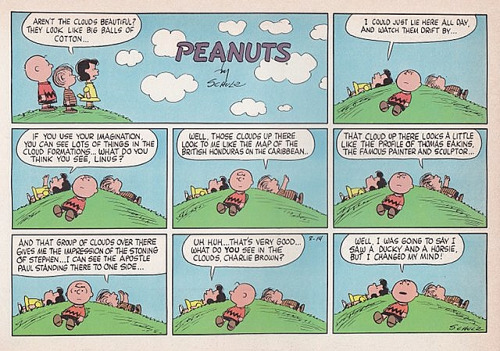
No way was I going to join that game of intellectual one-up. I was feeling too much like Charlie Brown in one of my favorite Peanuts cartoons. Linus and Lucy have been discussing what they see in the clouds: the map of British Honduras, for example, or a profile of the sculptor Thomas Eakins. When they ask Charlie Brown what he sees, he replies, "Well, I was going to say I saw a ducky and a horsie, but I changed my mind!"

Still, I started wondering what my book list would look like, should I be brave enough to post it. It wasn't going to be easy to find out: faced with such a question, my mind goes completely blank. I couldn't peruse my bookshelves, since nearly all my books are in storage (we're getting ready to move). Fortunately--since I have a hard time remembering what book I read last week and therefore can't make intelligent conversation at parties--I've been keeping reading lists since 1997.

So I read all 17 of my lists and was amazed at how many books I've apparently read that I can't recall ever hearing of. I was also amazed to see that a book I discovered just this year--Kate Atkinson's Case Histories--was also on my list from 2005. No wonder I wrote in a review that it "sounded eerily familiar": and here I thought it was because I'd seen it on Masterpiece.

Clearly if a book sticks with me, it must be great. Or not: I do remember Jill Conner Browne's Sweet Potato Queens Big-Ass Cookbook and Financial Planner, but I don't think I'd put it among the all-time greats.

Eventually I came up with a list after all. It's not an entry in the Facebook game. For one thing, it's not off the top of my head, since no books reside there. For another, it includes way more than 10 books. Besides, my list is annotated and has subheads and links!

Fiction and Poetry
Being quite capable of getting depressed without outside assistance, I prefer books (and movies) that make me happy--especially if they involve mythical places and bygone days.
  • Laura Ingalls Wilder, the entire Little House series, discovered when I was 8 and read over and over to myself and eventually to my daughters. I still own a hardcover set and will probably read them again one of these days. I have never analyzed their appeal.
  • L. Frank Baum, The Land of Oz and The Tin Woodman of Oz. My strong-willed Great-Aunt Blanche gave me these books when I was 10 years old. My mother disapproved of fantasy, but she approved of politeness. Besides, she was just slightly afraid of Great-Aunt Blanche. My heart leapt up when I saw the books but instantly subsided at the thought of my mother's likely reaction to them. I looked to her for guidance, and she was vigorously nodding. I accepted the gift with joy, and never feared fantasy thereafter.
  • C.S. Lewis, the entire Narnia series, but especially the first and the last books (though the Bacchanalian feast attended by Aslan in Prince Caspian is hard to beat). Aslan on the stone table, Aslan romping with the Pevensie children through fields of daisies--what more theology does anyone need?
  • J.K. Rowling, the entire Harry Potter series. I want to go to Hogwarts, especially if Slytherin could just be shut down.
  • Elizabeth von Arnim, The Enchanted April (I'm so excited--I just got it free on my Kindle!). I fell in love with the movie before I knew there was a book. The book is better: funnier, and the humor has more bite. Also, it has staying power: it was published 69 years before the film version.
  • Dorothy L. Sayers, Gaudy Night. It's refreshing to read about a woman who is loved more for brains than for beauty.
  • T.S. Eliot, Complete Poems and Plays. To be honest, I haven't read the plays, and I don't understand most of the poems (the Book of Practical Cats being an exception). But I love them and keep coming back to them, and would probably take this book with me if I had to be stranded on that mythical bookless desert island.
Wisdom
My fantasy-averse mother (see comment on the Oz books above) eventually relented and let me read fiction (even if Great-Aunt Blanche wasn't there) as long as I balanced it with an equal number of nonfiction books. The nonfiction category I came to prefer could loosely be called "wisdom literature" (my favorite biblical book is Ecclesiastes). If fiction could take me away from my daily life, nonfiction could help me live more fully in it. Here are some enduring favorites.
  • C.S. Lewis, A Grief Observed. What stayed with me about this book was not its chronicling of Lewis's grief or its wisdom on how to handle grief. It was Lewis's deep, passionate, heart-rending love for a bristly, brilliant woman--a serious version of Lord Peter's passion for Harriet Vane in Gaudy Night. For a gangly girl raised in the 1950s, better at academics than at flirting, this was wonderfully affirming.
  • Josef Pieper, Leisure: The Basis of Culture. This book would make my list if only for its title (I also own a book called The Joy of Not Working). It's not about laziness. It's about making time for what truly matters.
  • Niles Newton, Maternal Emotions. If you want to read this one, you'll have to get it used. It's a 1955 monograph, probably a dissertation, subtitled A Study of Women's Feelings Toward Menstruation, Pregnancy, Childbirth, Breast feeding, Infant Care, and Other Aspects of Their Femininity. I read Newton when I was teaching childbirth classes. She opened my eyes to the important distinction between being female and being culturally feminine.
  • Jacques Ellul, Money and Power. Amazon is mistaken: I didn't edit this book, I translated it. I'm glad I did, because I was forced to pay close attention to what Ellul was saying about the near-demonic power of money as it subverts the kingdom of grace. If you want to know why you can't serve God and Mammon, read this book. Ellul often sounds impractical--but then, so did Jesus.
  • Elton Trueblood, The Common Ventures of Life (another book you'll have to buy used). I first read this when I was 16, reread it when my first child was a baby, reread it again once the kids had left home. In a few years I may have to read it a fourth time: the "common ventures" Quaker philosopher Trueblood discusses are marriage, birth, work, and death. A very grounding book for someone at home in Narnia and Hogwarts.
Back to the ducky and horsie: though these are the books that have stuck with me, my everyday reading doesn't look much like this list. Right now, for example, I'm reading the newest Bridget Jones.

Wednesday, November 28, 2012

'Tis the season to read something relaxing

Renoir, La lectrice, 1874
Thanksgiving down, Christmas coming. Parties to attend. Christmas greetings to send. Gifts to buy. Travel arrangements to make. Groceries to buy. Meals to cook. Guest rooms to get ready. Decorations to display. Checks to write.

Nerves to calm.

I dedicate this blog post to my friend Karen, and to everyone else who needs to pour a comforting drink, sit down, elevate feet, and read a diverting novel--one that engrosses you, makes you smile, lets you relax, does not leave you with the taste of ashes.

Actually, you may need more than one such novel. So despite my inordinate fondness for one-offs like Sarah Dunn's Secrets to Happiness and Helen Simonson's Major Pettigrew's Last Stand, I'm going to give you a list of novels any one of which can lead you to four or a hundred similar delectable books.
My rules for series fiction:
1. Start with whatever book grabs your attention. It doesn't have to be the first in the series.
2. If you don't like it, don't bother with the rest of the series unless at least three of your friends have recommended it--in which case, try a second book.
3. If you like either the first or second book reasonably well, read two more books in the same series. By then, you'll either be in love with the series or you'll be ready to try something else.
Here are ten of my favorite authors of series fiction. The links will take you to reviews I've written either on this blog or in magazines.
  • Michael Connelly, The Reversal (and others). Detective Harry Bosch is the best in the business. Connelly has written 25 books, 18 about Harry. Newest, The Black Box, came out two days ago. Not a bad place to start. But if you'd rather start with a legal thriller, go for The Lincoln Lawyer.
  • Margaret Frazer, The Apostate's Tale. The indomitable nun Dame Frevisse gets involved with a lot of 15th-century mayhem. I like Ellis Peters's Brother Cadfael books, but I got even more attached to Dame Frevisse.
  • Sue Grafton, V Is for Vengeance. Start with A Is for Alibi. If the fourth sentence doesn't grab you, nothing will: "The day before yesterday I killed someone and the fact weighs heavily on my mind." W-Z are still to come, but you have 22 books to read before you run out.
  • P.D. James, Talking About Detective Fiction. First, read P.D. James's mysteries. They're all good, and you don't have to read them in order. Or just watch the TV adaptations starring Roy Marsden. Talking About Detective Fiction is Dame James's discussion of great mystery writers--dozens of them. Follow her leads and you'll have enough to read until you retire.
  • Donna Leon, Death and Judgment. Oh, just start with Death at La Fenice and read all of Leon's Venetian mysteries featuring Commissario Guido Brunetti. He's a lovable cop, and the Italian ambiance is a treat.
  • Peter Lovesey, Cop to Corpse. Detective Superintendent Peter Diamond presides grumpily over the Avon and Somerset murder squad. You may not care for him at first--his coworkers certainly don't--but he grows on you.
  • Alexander McCall Smith, The Forgotten Affairs of Youth. I find Scottish author McCall Smith more relaxing than a wee dram of single malt. His characters are quirky, funny, and fundamentally good. My review mentions several of his series; fortunately for his fans, he tends to write three books a year.
  • Spencer Quinn, To Fetch a Thief. Chet the dog narrates, but these stories are rarely cutesie. They can be pretty darn funny, though--especially to those of us who live with dogs. And there's always an interesting plot.
  • C.J. Sansom, Dissolution. Sansom is writing a series of fantastic 16th-century (think Henry VIII) mysteries. These are large books, a bit more serious than some on this list, but utterly engrossing. You can have Wolf Hall and its sequel: I'll take Sansom any day.
  • Jennifer Weiner, Good in Bed / Certain Girls. Bright and sassy chick lit. Weiner is a Princeton grad with a rowdy sense of humor. Not to be sexist or anything, but I'm guessing these aren't for guys.
And there are others ... so many others. Laurie R. King is a delight. She's been turning out a lot of books in the Mary Russell (Mrs. Sherlock Holmes) series as well as several stand-alone volumes, but my favorites are her Kate Martinelli books. Jane Langton, who is about to turn 90, wrote a lot of gently humorous New England-based books about ex-cop/current Harvard professor Homer Kelly and his brilliant wife, Mary.

And if you're feeling really, really tired--as I was after open-heart surgery last year--M.C. Beaton's Agatha Raisin and Hamish Macbeth series are silly fun. I read 30 of them while convalescing, and I'm feeling fine, thanks!

Please, readers, add comments (here, and not just on Facebook) about series fiction you've enjoyed...

Wednesday, August 1, 2012

A GOOD MAN by Mark K. Shriver

In June my husband, who gets lots of review copies unbidden, asked me if I wanted to read Mark Shriver's memoir about his father, Sargent Shriver, who passed away in 2011 at age 95. "Since you're a fan of all things Kennedy," he said, "I thought you might want to see it." I didn't.

True, a high point in my adolescent life was standing in back of St. Matthew's Cathedral one December morning in 1963 waiting for mass to begin when suddenly a very tall, very disheveled, very pregnant Eunice Kennedy Shriver pushed past me, wearing smudged red lipstick and a full-length fur coat. But sons are not necessarily good biographers, and anyway, I had a stack of mysteries awaiting my attention.

But then in July a Facebook friend pointed me to Reeve Lindbergh's review of A Good Man in the Washington Post, suggesting that this was a book I might want to read. Lindbergh--herself the daughter of two famous parents, Charles and Anne Morrow Lindbergh--called it "a moving and thoughtful book." Maybe I'll read this after all, I said to myself. And then a week or two later, my friend Estelle sent me a copy of the book as an early birthday present, telling me she thought I'd connect with it on many levels. I must be supposed to read this one, I thought.

Estelle was right. This is a delightful book for lovers of Camelot--those of us who lived through the suddenly shattered dream of the Kennedy administration. Mark Shriver never saw his uncle Jack--as it happens, Mark was the baby bump under Mrs. Shriver's fur coat at that mass nearly 50 years ago, exactly one month after President Kennedy's assassination--and he was only four when his uncle Bobby was shot. But he grew up with a father who founded the Peace Corps and ran for vice-president, a mother who founded the Special Olympics, four rambunctious siblings, and twenty-some cousins, most of whom were unusually energetic and competitive. Mark's childhood home often hosted the rich and the famous, and he recognizes the privilege of growing up well connected. At the same time, he is refreshingly candid about the self-doubts such an environment fostered.

The book, though, isn't about Mark. It's about Sarge, the good man of the title, the father he adored. And Mark's portrayal of Sarge's goodness is what I liked best about the book (and what Estelle knew I'd most appreciate). See, my father was a good man too. Shriver was an extroverted, energetic, Catholic politician while my dad was an introverted, often tired, Protestant professor; but at core the two men were surprisingly similar. Both were quietly but unalterably faithful Christians. Both adored their wives and children. Both, though they worked hard and accomplished much, put their families ahead of their jobs. Neither one tooted his own horn, and neither one was bothered when others moved past him into the limelight or up the career ladder. Both men were brilliant, and, sadly, both spent their final years moving into the oblivion of Alzheimer's Disease.

Mark tells a story about his father that made me gasp in recognition. The two men were in the car together. Sarge "was having one of those lucid moments that make you ... forget for a minute or two that this is all really happening." Mark seized the moment to ask his father a blunt question.
"Dad," I said, "you are losing your mind. You know that. How does that make you feel? How are you doing with that?"

"I'm doing the best I can with what God has given me," he said.
Sixteen years ago I wrote an article for U.S. Catholic magazine about my father's decline and death from Alzheimer's. Here are some lines from that article:
"Are you afraid of dying?" I asked my father several months before he died.

"Dying?" he said, considering. "No, not of dying. I live an abbreviated life."

I asked him what he meant. "A little taken away here. A little taken away there," he explained patiently, as if to a student needing help. "I do the best I can with what's left."
Sargent Shriver was born in 1915; my father, in 1910. Their age cohort is sometimes called the Greatest Generation. Both men were great. Both were exceptionally good. And I believe both had found the secret of happiness.
______________________________________
A Good Man is also available as a CD audiobook (unabridged) and as an audible.com download (abridged). To listen to a five-minute excerpt read by Mark Shriver, click here.

Monday, June 18, 2012

THE BEGINNER'S GOODBYE by Anne Tyler

Dorothy keeps popping up unexpectedly. Aaron, her husband, first sees her at the house the oak tree fell on. She then starts joining him at random times and places: in the grocery store check-out line, in the street near his office, in Belvedere Square. One day she appears just outside his office window, by the trash cans.

The odd thing is, Dorothy has been dead for nearly a year.

Aaron is neither romantic nor religious. He's the dutiful, unimaginative editor at the family-owned vanity press, publishers of a Beginner's series--"something on the order of the Dummies books, but without the cheerleader tone of voice," thin books to get you started:
Anything is manageable if it's divided into small enough increments, was the theory; even life's most complicated lessons. Not The Beginner's Cookbook but The Beginner's Soups.... Not The Beginner's Child Care but The Beginner's Colicky Baby.
But how can Aaron apply this wisdom to grieving? How can he begin to say goodbye to Dorothy, his wife of ten years?

The Beginner's Goodbye includes everything you'd expect in an Anne Tyler novel (it's her 19th): Lovable, socially awkward characters. Family ties that sometimes bind. Writing that is at once accessible and literary, comic and profound. Baltimore.

It's not as rich as Tyler's magnificent Dinner at the Homesick Restaurant, but then a Beginner's guide is just meant to get you started. This one could start a lot of conversations, not only about grief but also about communication in marriage, and how we sabotage our own happiness, and whether marriage partners can ever really know one another.

Thursday, June 14, 2012

Why old dogs NEED new tricks

"Retirement should involve re-tiring, or putting on new tires and doing even more than before."
--Rabbi Shmuley Boteach, who gives credit for this thought to Rabbi Menachem Schneerson
A friend posted this on Facebook recently. He, like my husband and me, is rushing headlong toward what Social Security calls  "full (normal) retirement age." No doubt his mailbox, like ours, is regularly replenished with offers for hearing aids, Medigap insurance, and free lunches sponsored by financial planners. No doubt he too has seen those chirpy birthday cards asking "How old would you be if you didn't know how old you are?" or assuring us that "Age is just a number" or, heaven help us, promising us that "The best is yet to be."

I suppose that depends on how you define "best."

Muffin and Tiggy contemplate retirement
In any case, let me tell you about my two little dogs, Mrs Tiggy-Winkle and Muffin. They do not know how old they are. For that matter, I don't know how old they are: both were young adults when they came to live with us 9 or 10 years ago. Both dogs need new tires, but since they don't know where to find them, the best is probably not yet to be.

Yesterday the three of us took a two-mile walk down the Prairie Path to Lincoln Marsh and back. We've been taking this walk for years, and we all love it. Sometimes we turn it into a three-mile walk by continuing to Jewell Road before turning around. Once this spring we turned right when we reached Jewell and walked four miles.

Except that yesterday afternoon, which was cool and pleasant, Muffin couldn't keep up. She didn't complain, but she started dragging behind Tiggy and me. She looked like she was working hard. Eventually I picked her up and carried her. Her heart was beating very fast.

Muffin looks great. Her health is good. She still enjoys a game of tug-a-toy with Tiggy, and she still wants to take walks. She's not an ancient dog, but she's nearing full retirement age. According to this chart that correlates a dog's age in human years with her size, she's probably between 60 and 68. In other words, she's my age.

I would like to point out that Rabbi Boteach, who believes in "doing more than before" in retirement, is 45 years old. When Robert Browning wrote "Grow old along with me! / The best is yet to be," he was, at most, 52. I don't know about you, but I'm tired of youngsters - or even rare oldsters, like my 91-year-old friend who cross-country skis around her 15-acre farm - setting the bar for the rest of us.

Fact: Muffin can't do today what she could do last year, and this is not because she's depressed or lazy or conforming to society's low expectations for aging dogs. It's because most dogs, like most people, quite naturally slow down as the years go by, and no matter how strenuous our denial, we will not be puppies again.

A lot of us silly boomers think we're going to reinvent old age (and why not? didn't we invent sex back in the 1960s?), when all we're really doing is lapsing into nostalgia. Afraid to enter a new phase of life, we double down on what we already know: overwork, multitasking, constant activity. Those were the days, my friend, / We thought they'd never end.

But maybe we should be thinking forward, not backward. Maybe we should be looking at new ways of living, ways we haven't yet had time to try, ways uniquely suited to people with more life experience than health and vigor.

For Muffin, whose life purpose is to sit on laps and hang around her peeps, the future looks bright. Especially if she can persuade me to buy her a doggy jogger...

Thursday, October 6, 2011

THE DOG WHO CAME IN FROM THE COLD by Alexander McCall Smith

When I was in high school, Frito-Lay introduced a slogan that became famous: "Betcha can't eat just one." I took that as a challenge, an easy bet to win since I didn't care for Fritos.

However, I cannot - cannot - read just one book a year by Alexander McCall Smith, and I'm so glad I don't have to. This year saw the release (in the U.S., which tends to lag) of The Saturday Big Tent Wedding Party (No. 1 Ladies' Detective Agency, 12) and The Dog Who Came In from the Cold (Corduroy Mansions Series, 2). Today my public library, bless them, ordered The Forgotten Affairs of Youth (Isabel Dalhousie Series, 8), slated for December.

I have the first hold on the first copy received.

The Corduroy Mansions series, like the earlier and ongoing (in the U.K.) 44 Scotland Street Series, are serial novels à la Dickens, but delivered at a far more frenetic pace. The Dog Who Came In from the Cold's 78 very short chapters began life as an online novel  (you can read its sequel here, at the Telegraph website) and were then turned into a book. As you read, you get the feeling that McCall Smith has no idea what his characters are going to do next, and the book has nothing resembling a linear plot. It doesn't matter. Surprises are good. And you know everything will more or less come together by the last page.

Which is amazing, considering all the interwoven stories centering on Corduroy Mansions, a yet-to-be-rehabbed apartment building in Pimlico, central London.

  • Should William French, wine merchant, allow MI6 (the British Secret Intelligence Service) to use his Pimlico terrier ("an unusual breed obtained through the judicious crossing of an Airedale with a Border Collie, and perhaps just a touch of something else about which the breeders themselves were now hazy"), Freddie de la Hay, as a spy?
  • Can Caroline and James, art history students, find happiness without germs?
  • Will Dee, owner of the Pimlico Vitamin and Supplement Agency and proponent of colonic irrigation, lose all her money if she invests in an attractive marketing scheme?
  • Can Barbara Ragg and Rupert Porter, literary agents, resolve their dispute over an inherited apartment?
  • Can Berthea Snark, psychiatrist, stop her loony brother Terence Moongrove from making a very foolish decision?
  • Is an abominable snowman really shopping at Fortnum and Mason?
If it sounds confusing, it isn't. McCall Smith somehow keeps you anchored, and by the time quite a few of the characters gather at William's place for a party, you love them all - just as McCall Smith does - and maybe you even feel a little more love for some of your odder family members.
[William] looked down at Freddie de la Hay, who was lying in a corner, one eye open, watching the human comedy, or that small part of it that was playing out in the room. Dear Freddie, loyal Freddie; for whom there were no great existential questions because he knew at all times, and in all places, what he had to do - which was to do William's bidding and make him happy. That was Freddie's world-view, his Weltanschauung, it it was as good as any world-view, thought William. We had to love somebody, and we had to want the best for that person. Freddie knew as much because it was in his nature to do so.
Part of the delight of reading McCall Smith, who is a retired bioethicist, is that he scatters such observations throughout his stories: his characters are constantly pondering the human condition. But I don't read these books for their ethical weight. I read them because the characters are wildly eccentric and lovable, because the situations they get into are hilariously improbable, and because - at the end of a tiring day - McCall Smith makes me smile.

Sunday, June 26, 2011

THE SATURDAY BIG TENT WEDDING PARTY by Alexander McCall Smith

I'm hopelessly in love with anything Alexander McCall Smith writes, so of course I enjoyed every minute of The Saturday Big Tent Wedding Party, his 12th book about Mma Ramotswe, the detective from Botswana.

It's not the book to start with. You don't necessarily have to read the series in strict order, but you should definitely begin with The No. 1 Ladies Detective Agency  (the link will take you to a boxed set of the first five books, because you can't stop with just one). If you're like me, you'll fall in love with the characters, and you'll love the way McCall Smith gets into their minds, and you'll appreciate books that feature really good people who are not the least bit sappy.

In this latest installment, Mma Ramotswe investigates a feud between neighboring cattle ranchers (who killed the cows? and why?); Mma Makutsi prepares for her wedding to Phuti Radiphuti (what shoes will she wear? and why is Phuti so bashful about kissing her?); and Charlie, Mr J.L.B. Matekoni's apprentice, panics when he learns a former girlfriend has had twins.

I don't read these books for the plot, however. I love them for their gentle humor, as in this paragraph about the delightfully obsessive Mma Makutsi:
She set off a few minutes after Mma Ramotswe, locking the office door behind her and leaving a notice pinned to it saying, Temporarily closed for investigations. She had been rather proud of this notice, which informed any prospective client that the detectives were somewhere else on unspecified but important-sounding investigate work. But as she pinned the sign into position, it suddenly occurred to her that a quite different impression might be created, namely that the No. 1 Ladies' Detective Agency was itself under investigation, and consequently had been closed down by the authorities. That would never do, so she reopened the office and carefully typed out a new sign. The wording this time was far better, and, she hoped, quite unambiguous: Temporarily closed while detective personnel are engaged elsewhere. That was much better ... or was it?  Could it be read as suggesting that the entire staff of the No. 1 Ladies' Detective Agency was, in fact, working for some other concern? That was certainly not the message she wished to convey, so she inserted a third sheet of paper into the typewriter and typed: Back soon. There was no room for misunderstanding there, although there might be some people who demanded, "And what does 'soon' mean, may we ask? How soon is that?" Such people, however, would never be satisfied with whatever one said, and would always be picking holes in even the simplest notice. No, you did not need to worry about people like that.
I also love these books for their insights into good relationships, as in this conversation between Mma Ramotswe and her husband:
"What would you do if I did something that you thought was a very bad idea, but that I really wanted to do? What if that thing was a thing that made me very happy, but looked ridiculous to you?'

He frowned. "Something your heart was set on?"

"Yes," she said. "Something that my heart said I just had to do."

"In that case, I would say to myself: It is an odd thing that Mma Ramotswe has done, but if that is what makes her happy, then I am happy too."

She looked at him fondly; that he had been sent to her, when there were so many other, lesser men who might have been sent, was a source of constant gratitude. That we have the people we have in this life, rather than others, is miraculous, she thought: a miraculous gift.
And I love them for their philosophizing (which is also one reason I love McCall Smith's Isabel Dalhousie series, whose protagonist philosophizes a good deal more than Mma Ramotswe does):
She did not think that people now were any worse than they used to be, but it was very clear to her that they had less time. In the old days Botswana people were rarely in a rush to get somewhere else - why should they be? Nowadays, people were always thinking of getting somewhere - they travelled around far more, rushing from here to there and then back again. She would never let her life go that way; she would always take the time to drink tea, to look at the sky, and to talk. What else was there to do? Make money? Why? Did money bring any greater happiness than that furnished by a well-made cup of red bush tea and a moment or two with a good friend? She thought not.
Add to her list: Does money bring any greater happiness than a couple of hours reading the latest Alexander McCall Smith novel? I think not.
--------------------------------
To read more of my reviews of books by Alexander McCall Smith, scroll up, click on "Fiction/Poetry," and click on the links.

Monday, March 14, 2011

THE SOCIAL ANIMAL by David Brooks

Last December a couple of magazine editors asked me to read a galley of David Brooks's then-forthcoming book, The Social Animal: A Story of Love, Character, and Achievement, and consider reviewing it. After reading the galley, I declined.

I didn't hate the book as much as P.Z. Myers does in his hilarious Salon review, "David Brooks' Dream World for the Trust Fund Set," though you might want to read Myers before tackling Brooks. Equally dismissive but more analytical is Will Wilkinson's "Scornful Review" on his Forbes blog. And while philosopher Thomas Nagel, who analyzes "David Brooks's Theory of Human Nature" in the New York Times, is not dismissive, he too seems less than impressed by Brooks's argument and presentation.

I sent one of the editors a lengthy e-mail explaining why I didn't want to review the book, which was published last week. Here's what I told him:
... I’m less enthusiastic about it than I hoped I’d be. Brooks is writing about the primacy of the unconscious over the conscious mind, and secondarily (I think) the primacy of interpersonal relationships over rational constructs. Basically he’s synthesizing a lot of books he’s read, and he’s presenting the findings in more-or-less story form as he follows the lives of two imaginary characters, Harold and Erica. Weirdly, he has his characters living in the eternal present, as he warns us up front—at every stage of their life, they seem to be living in about 2010.

This framework allows Brooks to pontificate on lots of things that are dear to his heart, especially in the chapter “The Soft Side” in which Harold joins a think tank and ruminates on everything that Brooks thinks about (“He spent those years writing his essays, peppering the world with his policy proposals. Not many people seemed to agree with him. There was a New York Times columnist whose views were remarkably similar to his own, and a few others. Still, he plugged away, feeling that he was mostly right about things and that someday others would reach the conclusions he had reached.”)

The book also includes a great deal of typical Brooks humor. Unlike some reviewers of his previous books, I generally enjoyed the humor, though it sometimes seemed discordant with his sociological musings.

Summary: the book put a lot of interesting research together, but it did not break any new ground. Harold and Erica kept my attention, but I didn’t identify with either of them – and I’m not sure that many other readers would either. Erica is a driven over-achiever from an underprivileged background who ends up in the halls of power, partly thanks to Harold’s support and occasional wisdom. Harold doesn’t really seem to be anybody, though he has good people skills. They have quite a lot of money and no kids. When they retire, they lead overseas tours three times a year until they can’t do that anymore, and then they buy a second home in Aspen. Who are these people, and could they exist anywhere but inside the Beltway?

Anyway, I do plan to comment on the book on The Neff Review, though I won’t publish my comments until March, when the book is published. But I’ve lost my enthusiasm for writing a review for [your magazine]. This is by no means to say that it shouldn’t be reviewed. Brooks says some fine things about relationships and the unconscious and why we need to get past mechanistic Enlightenment reasoning, or at least move from the French to the English Enlightenment. Another of your authors may be perfectly suited to review it.
I loved Brooks's first book, Bobos in Paradise. I liked his second, On Paradise Drive. I managed to finish reading his third, The Social Animal. I appreciate the irenic tone of his op-ed pieces, and I wish him well. I hope he takes a refreshing sabbatical before starting another book.

Saturday, March 5, 2011

Food bullies

Back in the 70s, a little truck-stop restaurant in the wilds of Eastern Washington became locally famous because its French patronne did not mind insulting her clients. Order wrongly, and she would refuse to grant your request. Salt before tasting, and she would angrily remove the salt shaker from your table.

When Mr Neff and I finally worked up enough courage to go to her restaurant, which was reputed to have excellent food despite the neon Pepsi sign in its front window, I decided to hedge my bets by talking to the dragon lady en français, which I spoke rather well at the time. Predictably, she was thrilled - finally someone who might understand her cooking!

When it was time for dessert, we ordered the small cup of ice cream that came with our prix fixe meal. La patronne vehemently disagreed. "You must have the tarte aux framboises," she told us.

"Oh, but Madame," we protested, "the meal was so satisfying that we couldn't possibly. All we want is a small dessert."

"No," she insisted. "You must have the raspberry tart. The people in the booth behind you wanted it, and I told them they couldn't have it. There are only two pieces left, and they are yours."

We had no choice. She brought the tart.

I have never, before or since, eaten anything like it. Each slice was a perfect triangle of raspberries arranged like a dry-stone wall with no visible mortar. Each raspberry was small and bursting with flavor (I suspect the raspberries came out of her garden). The crust was light and sweet and perfect. The first bite was exquisite, and every subsequent mouthful was even better, pleasure layering on pleasure.

So I am somewhat sympathetic to the chefs I read about in Diane Cardwell's article, "Have It Your Way? Purist Chefs Won't Have It," in yesterday's New York Times:
New York has spawned a breed of hard-line restaurants and cafes that are saying no. No to pouring takeout espressos, or grinding more than a pound of coffee at a time. No to taming the intensity of a magma-spicy dish. And most of all, no to the 21st-century conviction that everything can be accessorized to the customer’s taste.
If you want excellent food, why mess with the recommendations of experts?

On the other hand, if you know what you like, why let experts bully you into eating or drinking what you don't want?

OK, there are several good reasons: (1) to learn to like something new (isn't this what we tell our children when we offer them, say, their first bite of avocado?), (2) to learn why we like what we like so we're more sure of getting it next time, (3) to discover that food we don't think we like, prepared brilliantly, is actually quite good ... well, all the reasons seem to come back to learning.

And learning is why I checked out Dara Moskowitz Grumdahl's Drink This: Wine Made Simple when I saw it on the new-books shelves at the public library - and why, after reading a couple of chapters, I actually bought my own copy. Grumdahl is hilarious. She knows wine. She explains things well. She has devised a clever system to help wine novices have fun while learning much more than they're likely to learn from more exhaustive books.

And yet, bless her, she doesn't suffer bullies gladly. From her "Wine Drinker's Bill of Rights":
Your whole life has been one cumulative process adding up to your own taste. No person, critic, wine shop clerk, or anyone else has a right to disparage or discount it. If you want to drink Bordeaux with your oysters, Port with your burger, or Chardonnay with your fried chicken, it is no one's business but your own. No one lives with your taste buds but you, so no one really knows what you are experiencing except you. It's your taste!
Right on, Ms. Grumdahl. Life is too short to drink wine you don't like because it's popular or snobby or expensive, or even because the server raised one eyebrow when you started to order a different wine. In fact, despite wine's popularity, why drink it at all if you don't like it? As Grumdahl advises,
If wine can't provide happiness, it should get out of the way and let something else do it, like chocolate.
Or like that heavenly raspberry tart - even though I allowed a stubborn restauratrice to bully me into eating it.

Tuesday, December 14, 2010

WERE YOU BORN ON THE WRONG CONTINENT? by Thomas Geoghegan

Front
Back
Was I born on the wrong continent? Well, if you're talking bread, I'll definitely opt for the baguette. But Geoghegan (rhymes with "Reagan") says little about food, alas, in this comparison between American and Western European - mostly German - lifestyles. Instead, he looks at work, leisure, taxes, benefits, labor, management, social policy...

Don't let your eyes glaze over just yet. Geoghegan is a delightfully quirky writer who manages to convey a lot of information while making you think you're reading a chatty and often humorous travel book. Indeed, travel writing inspires him:
For years I read the front page [of the New York Times] about European unemployment, the collapse of social democracy, etc. But then I'd flip to the travel page and get the real news, the news that they don't dare put on page one, that every year in Europe, the whole place keeps getting nicer.
Geoghegan, a Chicago labor lawyer, made several extended trips to France, Switzerland, and Germany to study European socialism. He gives his conclusion in the preface:
The cover of the February 16, 2009, Newsweek announced: "WE ARE ALL SOCIALISTS NOW." The argument is that U.S. government spending is nearly as high as Europe's. A decade ago, the U.S. government was spending 34.3 percent of GDP, compared with 48.2 percent in the "euro-zone," which is Europe without the UK. Now, while the Continent is at 47 percent, we have gone up to 40.

And, in fact, I think the U.S. will close the gap. But in a sense, the more we spend, the less socialist we become. For whether it is health care or education, we use the private market to pay for the distribution of public goods. In other words, we pay socialist-type taxes so that the private insurance companies, drug companies, and, yes, doctors can profiteer.

That's the crisis of our time: we're paying for European-type socialism, without getting the equivalent payback.
Much of the rest of the book describes the European payback (and this will be counter-intuitive to a lot of American readers): Fewer poverty-stricken seniors and children. Six weeks' vacation time plus more paid holidays. Cheaper higher education, health care, day care, concerts. Paid maternity and paternity leave. Higher old-age pensions. Nursing-home benefits. Cleaner, faster, more readily available public transportation. More efficient land-use planning. Lower unemployment. More successful small businesses.

The only area in which the U.S. outshines its European counterparts is GDP - and Geoghegan offers fascinating observations as to why that actually may be making American lives more frantic and yes, even more expensive than the lives of European socialists.

Ironically, some of the structures that make German socialism work were developed by Americans during the occupation after World War II. Rather than the authoritarian, top-down socialism of the Nazis, the occupiers insisted on a bottom-up socialism where the workers themselves would have a big influence in organizational management. As a result, German businesses are much more democratically run than American businesses, who never adopted the practices themselves.

And some of the German bureaucratic regulation that Americans love to mock, says Geoghegan, has enabled Germany to become a major exporter of durable goods - really durable ones like Mercedes and BMWs - even as the U.S. has been ramping up its trade deficit. In fact, while the U.S. is increasing its debt by $1 trillion a year, Germany has no net external debt - and in fact vies with China for first place in world exports, an amazing feat for a country that has 82 million people compared with China's 1.3 billion. And yet "Americans still seem unaware that it's not just East Asia but the socialist Europeans who have outcompeted us in global markets as we sink deeper into debt."

So was Geoghegan born on the wrong continent? I don't think so. Like T.R. Reid, author of The Healing of America (a wonderfully enlightening book comparing health-care systems in various developed nations), Geoghehan wants us Americans to stop thinking we're best at everything, to start paying attention to how other countries handle vexing problems similar to our own, and to adapt their best solutions to our situation in ways that will give us happier, healthier lives. Our house is on fire, there's a fire station across the street, yet we're trying to fight the fire with buckets of water - or oil. "I know on the right and even in the center I am dismissed as a European-style liberal," he writes. "But my question for those on the right is as follows: do they care about the sovereignty of our country? Then they better start taking seriously what the Europeans do."

Tuesday, July 20, 2010

THE BIRD IN THE TREE by Elizabeth Goudge

What I find most interesting about The Bird in the Tree (1940), Book One of The Eliot Chronicles, is the fact that it was set in 1938. England, still suffering the aftermath of war and financial chaos, was about to plunge into a second great war. Elizabeth Goudge's more serious contemporaries were examining sin (Greene) and loss (Waugh) and politics (Auden), while the general public were enjoying detective fiction's golden age.

By contrast, Elizabeth Goudge (1900 - 1984) harks back to Victorian conventions: Abundant descriptions of nature, lengthy and lyrical. Storms arising as needed for dramatic effect. A large country house with a history. Gardens where children play and faerie folk are imagined if not actually spotted. Doomed lovers who unite in soul but never in body. And above all, exhortations to faithfulness and duty.

Modernity, however, is also evident. The matriarch Lucilla reigns over her family but, short of funds, is down to two servants plus a couple of helpers from the village. Her daughter-in-law Nadine has divorced her son George. Some of the young adults believe it is more important to be true to oneself (a later generation would call this "authenticity") than to sacrifice for the needs of others. Grandson David roars around the countryside in a silver-grey Lincoln.

Fortunately, older and wiser folk are available to set the young ones straight. The 78-year-old grandmother speaks of her own thwarted romance. The 80-year-old housekeeper launches a frontal attack against one of the miscreants. Lucilla's stodgy son Hilary, a country parson with war wounds, states his position and prays.
What in the world, thought David, could Hilary be praying about or for? He hoped it wasn't for him. He disliked being prayed for. He didn't think it was fair. For all you knew, under the compulsion of it, you might find yourself doing something heroic that you didn't in the least want or intend to do.
It would be easy to dismiss Goudge's tale as sentimental (about the natural world) and moralistic (about people). But despite her romantic leanings, she is not saccharine. Her characters are well drawn.  I especially like the irrepressible 8-year-old Tommy and the dogs, Pooh Bah and the Bastard. Lucilla is a force of nature: Dame Joan Plowright would play her well. Her grandson David's pervasive cynicism allows the author to contrast contemporary wisdom with eternal verities.

Goudge's age was as politically tense as our own, and selfishness is endemic to every age. Why not escape into a story where individual desires give way to the common good, where people choose to do right even at the expense of personal happiness, and where God is worshiped and family is valued? That is, if you don't mind long descriptions of marshes and tides and flowers and cornfields and birds and trees ...
------------
The Bird in the Tree is out of print but available from sellers of used books.

Monday, July 5, 2010

Review: "Slow Love" by Dominique Browning

She had me at the subtitle. Dominique Browning lost her job as editor in chief of House and Garden when the magazine abruptly ceased publication; I quit my job as editorial director with a book publisher when I decided life is too short to spend three and a half hours every day commuting. She put on her pajamas and found happiness in less than three years; more than ten years later I - though grateful to be able to wear pajamas as late in the day as I please - am still working on contentment. I thought maybe Browning could lift my mood.

And indeed Slow Love was a cheering book, though not quite in the way I expected. Browning is very funny, even when she's writing about physical and emotional pain. Not many writers can make you smile or even laugh out loud when you're reading about, say, kidney stones, cancer, depression, eating disorders, and apparently unalterable codependency. Not that she gives her doomed love affair that name, but she doesn't need to.

Browning does not offer cheap cheer by telling how to overcome obstacles and achieve serenity in six easy steps (come to think of it, that kind of book isn't very cheering anyway). Serenity comes through toward the end of the book, after she has moved to her house by the ocean, in some wonderfully evocative nature writing; though I suspect Browning is better at writing about serenity than actually experiencing it.

She certainly does not give pointers that would help the average unemployed person, as a customer reviewer on Amazon seemed to think she should have done ("Except for recently unemployed New York media executives, who can really relate to her position?"). Yes, her financial concerns were minor compared to those of most people who lose their jobs, though the disgruntled reviewer should realize that a full-time writer is self-employed, not jobless. But this isn't a memoir about unemployment.

Instead, it's a memoir about values. Browning looks at our culture's image of the good life - a well-paid, high-status career, a beautiful home near New York City, designer clothes, meals in fine restaurants - and says : These things are less important than we think. Work is not the whole purpose of life. Financial security does not guarantee against depression. Status is fleeting and essentially meaningless. There are worse things than being alone.

I find these insights very helpful, though they have not yet lodged permanently in my brain. I need to hear them over and over.

As someone who has never made much money or achieved much status; who has always lived in small houses, bought clothes on sale, and cooked at home because it's cheaper; and who every now and then gets really tired of simple living and turns to her husband and says, "Let's get rich" - I appreciated reading about Browning's journey. It made me feel a lot more grateful for the good life I already have, and especially grateful for the good man I married over 42 years ago when we were both too young to have any idea what we were doing.

By contrast, Browning's pseudonymous lover, "Stroller," is a real jerk, and everyone but Browning knows this. Stroller is legally separated from his wife, but  he refuses to divorce her and is in frequent contact with her.
Every time he decided to let go of his ambivalence, he began throwing up new barricades against me. It is obvious to me, now, that our problems weren't coming from his inability to make a clean break from his marriage; they were symbolic of a larger inability to relax into a peaceful, loving relationship, one that didn't include shoving me away with stunning regularity. The mere proximity to a vital, unambiguous attachment triggered calamity in his heart.
"The situation with Stroller is not at all normal," her therapist tells her. "Why don't you think you are worth the effort?"

That's what I wondered over and over again as Browning keeps accepting, forgiving, or overlooking reprehensible behavior on the part of this clearly unstable and selfish man, who shows up (and disappears) so often that the book becomes as much about the author's doomed relationship as about her lost job. Finally, several months after Stroller leaves her alone in the hospital and goes off to London on a trip they had intended to take together, she seems to get it. "I was startled to realize that I had been using my fight with Stroller to avoid all the fights I should have been having with myself," she writes on page 219 (of 267). "I suddenly realized I didn't care any longer why he was wedded to ambivalence. Why was I so mired in it? ... Suddenly I realized that I couldn't change him. I could only change myself."

Whew. Now Browning can stop stuffing herself with giant cookies and piles of muffins. Now she can pay attention to her new house, her new garden, her new life. And indeed at this point her writing becomes more lyrical, and the book starts to match the summary of it on her blog: "SLOW LOVE means engaging with the world in a deeper, more meaningful way, learning to appreciate the beauty of everyday moments, and taking time to share them with one another - in the midst of our busy, productive lives."

Slow love is a great concept, even better than slow food. I hope she's practicing it. I hope she's gotten rid of Stroller, once and for all. But I wonder. Here's the third sentence in her Acknowledgments: "Many thanks to Stroller for reading this manuscript with care and concern, and for taking the time to comb through the pages, pointing out distortion and delight alike."

Earth to Dominique: It no longer matters what Stroller thinks. You don't have to check your memories or opinions with him. Stop already! You're worthwhile, all by yourself. And if you must hang your self-worth on personal accomplishment rather than simple existence, then take this : you're a brilliant writer. And as for happiness - well, you know what you need to do.

Monday, April 26, 2010

Review of Anne Tyler: "Noah's Compass"

Ever since I discovered Dinner at the Homesick Restaurant, I've loved Anne Tyler's Baltimore, her offbeat people, her insights into what makes individuals - and families - tick. Most of all, I enjoy her ability to evoke a character in a few deft and often funny lines. Take this exchange, for example, from her newest novel, Noah's Compass:
He said, "The divorce was Barbara's idea, not mine. I don't even believe in divorce; I've always felt marriages are meant to be permanent. If it were up to me, we'd still be together."

"What was she unhappy about?" Eunice asked.

"Oh," he said, "I guess she felt I wasn't, um, forthcoming."

Eunice went on looking at him expectantly.

He turned his palms up. What more could he say?
 I began reading Noah's Compass, not only because I enjoy Anne Tyler, but also because the dust-jacket description looked promising: " ... a wise, gently humorous, and deeply compassionate novel about a schoolteacher, who has been forced to retire at sixty-one, coming to terms with the final phase of his life."

I realize that people who write marketing copy rarely have time to read the whole book, but they should get beyond the first page - and editors should check their work. Liam Pennywell is "in the sixty-first year of his life," which makes him 60, not 61, as Tyler mentions at least eight times. He has been teaching but is not, at heart, a schoolteacher. He has lost his job, but this does not mean he has to retire. He is not in the final phase of his life (though he seems willing to go there) - his health is good, and his father is still alive and strong. And, most important, he doesn't really come to terms with anything.

The copywriter is right, however, about the book's wisdom, humor, and compassion.

Liam Pennywell is widowed, divorced, newly laid off, and, by chapter two, convalescent. He has a sister, a father, a stepmother, a friendly ex-wife, three daughters, and a grandson, but he lives alone and has little to do with any of his family members. A sudden crisis brings them all back into his life. His bossy sister brings dinner (beef stew, and he eats no red meat); his youngest daughter moves in with him; his middle daughter expects him to baby-sit; and Eunice ... well, she's about as opposite from him as a person could be, and she's amazingly persistent. His life, which had become as stark as his new apartment, seems suddenly richer.

But that's an outsider's opinion. Mine, and probably Tyler's. For Liam, life just seems messier and noisier. This is a man, after all, who "really enjoyed a good movie. He found it restful to watch people's conversations without being expected to join in." This a man who looks forward to being alone on Christmas Day.

If I were discussing Noah's Compass in a book group, I'd point out that the end of the book sounds a lot like its beginning. I'd like to hear what others think will happen next in Liam's life. Have six tumultuous months changed him in any essential way? Or is he going to give in to senescence well before he's even eligible for Medicare?

As for the title, you'll figure it out in chapter 11. If you're impatient, just ask yourself : Did Noah have a compass? Did he need one? Why or why not?

Wednesday, March 24, 2010

Oh Happy Days - 15,330 of them so far

Forty-two years ago today, Mr Neff and I publicly vowed to love and cherish one another "for better for worse, for richer for poorer, in sickness and in health, till death us do part." At dinner last Saturday night we joked about what we'd be doing in another 42 years, when he's 104 and I'm 103. In spite of the fact that his grandmother and several of my great-aunts made it past 100, we decided to plan our really big celebration for our 75th anniversary, just in case we're too tired on our 84th.

But then we learned about Herbert and Zelmyra Fisher. He's 104 and she's 102, and on May 13--the day after our daughter Molly and son-in-law Byron celebrate their 20th anniversary--Mr and Mrs Fisher will celebrate their 86th. Theirs is not yet the world's longest recorded marriage--three or four other couples are ahead of them--but they are the longest married of any living couple. And they are certainly the hippest. On Valentine's Day they answered questions about their enduring marriage on their Twitter account.

Stay married long enough, and people start asking about the secret of your lengthy marriage. I'll defer to the Fishers, who are 44 years ahead of us.

How did they know they were right for each other? "We grew up together and were best friends before we married. A friend is for life - our marriage has lasted a lifetime."

What was their marriage like? "With each day that passed, our relationship was more solid and secure. Divorce was NEVER an option - or even a thought."

There you have it. A good marriage begins with friendship, is based on commitment, and grows stronger as the years go by.

Yes it does. As the Fishers pointed out, "The children are grown, so we talk more now." Also, we eat more interesting food, and we have more time to spend with adult friends. Last night while chatting with friends before dinner we discovered that all of us love the song "Oh Happy Day." Apparently based on an 18th-century hymn sung to the tune of "How Dry I Am," it took on new life as a gospel song in 1969 performed by the Edwin Hawkins Singers (and may have been the inspiration for George Harrison's "My Sweet Lord").

My very favorite version of "Oh Happy Day," though, is the 1987 cover by Aretha Franklin and Mavis Staples. Never have I heard so much gutsy joy packed into eight sweet minutes. Theirs is the happiness of a mature faith or a ripe old marriage, an ecstasy greater than newlyweds can imagine, a truly aspirational ardor. So of course I immediately played the CD for our friends, and then this morning I linked to it on You Tube as part of my Facebook update.

And then I discovered another version of the song that I offer to people who are new to commitment, people who aren't sure if they're going to make it, and people who are friends of those people. It's from Sister Act 2, and unless your boss is in the next cubicle, go ahead and watch it now. See the kid grow in confidence and enthusiasm. Notice the huge supporting cast--Sister Whoopi, of course, and also the choir, the nuns, the congregation. That boy can sing "Oh Happy Day" because he's part of a community that wants him to succeed.

Mr and Mrs Fisher know how that goes. “Everyone who plants a seed and harvests the crop celebrates together,” they twittered. "We are individuals, but accomplish more together."

Mr Neff and I know how that goes too. Thanks to our friends, families, and communities that have been and continue to be our supporting cast. Today is our happy day because of you.

And Mr Neff, try not to work late tonight.

Wednesday, January 13, 2010

50 years of inflated expectations: part 2

(Part 1 is here.)

I have no idea how the United States will or can get out of the economic mess we've spent the last 50 years getting ourselves into. As individuals, though, we can take steps to avoid disaster.

1. It's time to stop thinking that rescue is on the way. The government doesn't have the will to do it: our elected representatives are afraid that facing the facts would mean losing elections and losing lobbyists' dollars. The "invisible hand" of the market won't do it: the all-too-visible hand of greed is too busy sending more wealth to the already wealthy. The magic of compounding can't do it: inflation, brokers' fees, cyclical bear markets, and investor panic conspire to keep most of us from getting ahead of inflation.

2. We need to stop thinking that the last 10 years are an exception, and that happy days will soon be here again. There is little reason for optimism in a nation that is, corporately and individually, leveraged way beyond its resources, producing little in the way of hard goods, rapidly aging,and responsible for over half of the entire world's military expenditures.

3. It's important to be realistic: most of us are not going to be able to work forever, and we are probably going to have to provide for a major part of our financial needs in retirement. Use the magic of compounding interest to counteract the dark magic of inflation. Sock away as much money as you can in accounts that are likely to outpace inflation. Every year, save every dollar that the government allows you to save tax free. In 2010, you can put $16,500 in your 401(k) if you're under 50, $22,000 if you're 50 or older. If you can, add a Roth IRA for each adult, employed or not, and save another $5,000 or $6,000 apiece each year.

4. We've got to start being rigorously honest with ourselves about wants vs needs. This much saving may be impossible, and if you haven't got a ha'penny, then God bless you. But when we're looking for housing, for example, it helps to remember those two- or three-bedroom, one-bath, 1200 square foot houses of 1960. When we're looking for cars, we might remember days when one-car garages were standard and teenagers walked to school. When we're looking for higher education for our kids, we might consider community or state colleges. And on a smaller scale, we might question the wisdom of buying restaurant meals, expensive cable TV subscriptions, gym memberships, fine wines, and other luxuries unknown to our parents and grandparents.

Many years ago in a town far away, we lived two doors down from one of those modest houses. Its owners were a lovely young couple, both professors. When they discovered they were going to have a baby, they decided they needed more space. They sold their little house to another lovely young couple--with four small children. The new owners were very happy with it.


I'm thinking about happiness, space, and things because Mr Neff and I are in our 60s, and when we retire we are probably going to have to downsize even though we've been living frugally and saving maniacally for several decades. This is going to be interesting, since people move into our townhouse neighborhood in order to downsize. But hey--people pay big bucks to live in New York apartments the size of closets. People in other countries get along in smaller quarters. The average home in France is 112.5 square meters (1211 square feet); in Italy, only 81.5 square meters (877 square feet)--and the French and the Italians have a well-deserved reputation for enjoying life.

Which brings me right back to the prescription I gave several days ago: Save like hell, and figure out how to arrange your furniture attractively in a one-bedroom apartment. I think this is realistic. Is it pessimistic? Not necessarily. Money is nice, but it doesn't buy happiness. And if you end up saving more than you need, you can always endow a charitable or educational or cultural institution.