Showing posts with label lists. Show all posts

Tuesday, December 17, 2013

This is not the Facebook-mediated list of books that have "stayed with you"

If you're on Facebook and if you devour books, you have undoubtedly been asked to list 10 books that have "stayed with you" - and then to ask 10 of your friends to do the same. I got a barrage of requests all in one afternoon, accompanied by formidable book lists heavy on theologians and literary novelists.

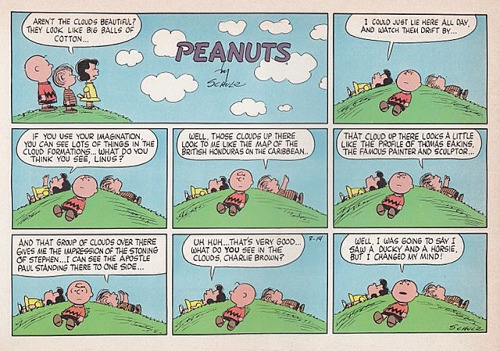
No way was I going to join that game of intellectual one-up. I was feeling too much like Charlie Brown in one of my favorite Peanuts cartoons. Linus and Lucy have been discussing what they see in the clouds: the map of British Honduras, for example, or a profile of the sculptor Thomas Eakins. When they ask Charlie Brown what he sees, he replies, "Well, I was going to say I saw a ducky and a horsie, but I changed my mind!"

Still, I started wondering what my book list would look like, should I be brave enough to post it. It wasn't going to be easy to find out: faced with such a question, my mind goes completely blank. I couldn't peruse my bookshelves, since nearly all my books are in storage (we're getting ready to move). Fortunately--since I have a hard time remembering what book I read last week and therefore can't make intelligent conversation at parties--I've been keeping reading lists since 1997.

So I read all 17 of my lists and was amazed at how many books I've apparently read that I can't recall ever hearing of. I was also amazed to see that a book I discovered just this year--Kate Atkinson's Case Histories--was also on my list from 2005. No wonder I wrote in a review that it "sounded eerily familiar": and here I thought it was because I'd seen it on Masterpiece.

Clearly if a book sticks with me, it must be great. Or not: I do remember Jill Conner Browne's Sweet Potato Queens Big-Ass Cookbook and Financial Planner, but I don't think I'd put it among the all-time greats.

Eventually I came up with a list after all. It's not an entry in the Facebook game. For one thing, it's not off the top of my head, since no books reside there. For another, it includes way more than 10 books. Besides, my list is annotated and has subheads and links!

Fiction and Poetry
Being quite capable of getting depressed without outside assistance, I prefer books (and movies) that make me happy--especially if they involve mythical places and bygone days.
  • Laura Ingalls Wilder, the entire Little House series, discovered when I was 8 and read over and over to myself and eventually to my daughters. I still own a hardcover set and will probably read them again one of these days. I have never analyzed their appeal.
  • L. Frank Baum, The Land of Oz and The Tin Woodman of Oz. My strong-willed Great-Aunt Blanche gave me these books when I was 10 years old. My mother disapproved of fantasy, but she approved of politeness. Besides, she was just slightly afraid of Great-Aunt Blanche. My heart leapt up when I saw the books but instantly subsided at the thought of my mother's likely reaction to them. I looked to her for guidance, and she was vigorously nodding. I accepted the gift with joy, and never feared fantasy thereafter.
  • C.S. Lewis, the entire Narnia series, but especially the first and the last books (though the Bacchanalian feast attended by Aslan in Prince Caspian is hard to beat). Aslan on the stone table, Aslan romping with the Pevensie children through fields of daisies--what more theology does anyone need?
  • J.K. Rowling, the entire Harry Potter series. I want to go to Hogwarts, especially if Slytherin could just be shut down.
  • Elizabeth von Arnim, The Enchanted April (I'm so excited--I just got it free on my Kindle!). I fell in love with the movie before I knew there was a book. The book is better: funnier, and the humor has more bite. Also, it has staying power: it was published 69 years before the film version.
  • Dorothy L. Sayers, Gaudy Night. It's refreshing to read about a woman who is loved more for brains than for beauty.
  • T.S. Eliot, Complete Poems and Plays. To be honest, I haven't read the plays, and I don't understand most of the poems (the Book of Practical Cats being an exception). But I love them and keep coming back to them, and would probably take this book with me if I had to be stranded on that mythical bookless desert island.
Wisdom
My fantasy-averse mother (see comment on the Oz books above) eventually relented and let me read fiction (even if Great-Aunt Blanche wasn't there) as long as I balanced it with an equal number of nonfiction books. The nonfiction category I came to prefer could loosely be called "wisdom literature" (my favorite biblical book is Ecclesiastes). If fiction could take me away from my daily life, nonfiction could help me live more fully in it. Here are some enduring favorites.
  • C.S. Lewis, A Grief Observed. What stayed with me about this book was not its chronicling of Lewis's grief or its wisdom on how to handle grief. It was Lewis's deep, passionate, heart-rending love for a bristly, brilliant woman--a serious version of Lord Peter's passion for Harriet Vane in Gaudy Night. For a gangly girl raised in the 1950s, better at academics than at flirting, this was wonderfully affirming.
  • Josef Pieper, Leisure: The Basis of Culture. This book would make my list if only for its title (I also own a book called The Joy of Not Working). It's not about laziness. It's about making time for what truly matters.
  • Niles Newton, Maternal Emotions. If you want to read this one, you'll have to get it used. It's a 1955 monograph, probably a dissertation, subtitled A Study of Women's Feelings Toward Menstruation, Pregnancy, Childbirth, Breast feeding, Infant Care, and Other Aspects of Their Femininity. I read Newton when I was teaching childbirth classes. She opened my eyes to the important distinction between being female and being culturally feminine.
  • Jacques Ellul, Money and Power. Amazon is mistaken: I didn't edit this book, I translated it. I'm glad I did, because I was forced to pay close attention to what Ellul was saying about the near-demonic power of money as it subverts the kingdom of grace. If you want to know why you can't serve God and Mammon, read this book. Ellul often sounds impractical--but then, so did Jesus.
  • Elton Trueblood, The Common Ventures of Life (another book you'll have to buy used). I first read this when I was 16, reread it when my first child was a baby, reread it again once the kids had left home. In a few years I may have to read it a fourth time: the "common ventures" Quaker philosopher Trueblood discusses are marriage, birth, work, and death. A very grounding book for someone at home in Narnia and Hogwarts.
Back to the ducky and horsie: though these are the books that have stuck with me, my everyday reading doesn't look much like this list. Right now, for example, I'm reading the newest Bridget Jones.

Wednesday, January 2, 2013

2012: My year of series fiction

[Me, reading a nonfiction book
 approved by my mother]
In 1997, faced with a daunting commute, I decided to devote train time to reading for pleasure. At the same time, I began keeping a list of books I'd read. My mind goes blank whenever anyone asks, "Read any good books lately?" The list helps me access my hard drive. Sometimes I consult it before going to parties, just in case.

At the end of each year, I tally the books I've read. First, out of curiosity, I count how many are fiction and how many nonfiction. When I was a child, my mother, who was a serious and responsible woman, tried to keep me from reading fiction. She soon learned that she could not take me to libraries and expect me to refrain from reading stories, so she relented - but for every fiction book, I had to read a nonfiction book as well. Mothers are powerful: for maybe 10 years, even without trying, I read about an equal amount of fiction and nonfiction.

And then I fell in love with several mystery series.

In 2011, I read great stacks of M.C. Beaton (creator of Agatha Raisin and Hamish Macbeth). They are very lightweight, predictable, funny, and excellent for people who are recovering from major surgery.

In 2012, nearly half the books I read were from one series or another:
Just one book each by Sue Grafton and Michael Connelly because they are two of my favorites and I had already read all 40-some of their previous books. Four books by Alexander McCall Smith and two by M.C. Beaton - I was caught up with them too, but that's how many they published last year. One each by Janet Evanovich (her Stephanie Plum series: I probably won't read the other 18) and the late Michael Dibdin (I may go back and pick up some I've missed), two out of five by Martin Walker, and three out of fifteen by Andrea Camilleri. If you want to see my reviews of some of these books, click here or click the Mysteries tab at the top of this page.

My discovery last year was British writer Peter Lovesey's series about Bath detective Peter Diamond. Books & Culture asked me to review his 12th book, Cop to Corpse, and I ended up compulsively reading the first 11, with increasing satisfaction.

The series I most enjoyed was the Venice-based Commissario Guido Brunetti series by Donna Leon, an American who has lived in Venice for 30 years and who, at least according to an American-Italian friend of mine who has lived in Florence for nearly 40 years, really gets Italy. I had read her first book, Death at la Fenice, in 2009 and was only moderately impressed. Friends urged me to keep going. Last year I read books 2 through 21, and I just put book 22, published last October, on hold at the library - along with the new Alexander McCall Smith and the new Sue Grafton.

Maybe I'll develop a more serious mind in 2013 and read more nonfiction. I'll let you know ...

-------------------------------------------------
For more series fiction recommendations, see "'Tis the season to read something relaxing."

Wednesday, November 28, 2012

'Tis the season to read something relaxing

Renoir, La lectrice, 1874
Thanksgiving down, Christmas coming. Parties to attend. Christmas greetings to send. Gifts to buy. Travel arrangements to make. Groceries to buy. Meals to cook. Guest rooms to get ready. Decorations to display. Checks to write.

Nerves to calm.

I dedicate this blog post to my friend Karen, and to everyone else who needs to pour a comforting drink, sit down, elevate feet, and read a diverting novel--one that engrosses you, makes you smile, lets you relax, does not leave you with the taste of ashes.

Actually, you may need more than one such novel. So despite my inordinate fondness for one-offs like Sarah Dunn's Secrets to Happiness and Helen Simonson's Major Pettigrew's Last Stand, I'm going to give you a list of novels any one of which can lead you to four or a hundred similar delectable books.
My rules for series fiction:
1. Start with whatever book grabs your attention. It doesn't have to be the first in the series.
2. If you don't like it, don't bother with the rest of the series unless at least three of your friends have recommended it--in which case, try a second book.
3. If you like either the first or second book reasonably well, read two more books in the same series. By then, you'll either be in love with the series or you'll be ready to try something else.
Here are ten of my favorite authors of series fiction. The links will take you to reviews I've written either on this blog or in magazines.
  • Michael ConnellyThe Reversal (and others). Detective Harry Bosch is the best in the business. Connelly has written 25 books, 18 about Harry. Newest, The Black Box, came out two days ago. Not a bad place to start. But if you'd rather start with a legal thriller, go for The Lincoln Lawyer.
  • Margaret FrazerThe Apostate's Tale. The indomitable nun Dame Frevisse gets involved with a lot of 15th-century mayhem. I like Ellis Peters's Brother Cadfael books, but I got even more attached to Dame Frevisse.
  • Sue GraftonV Is for Vengeance. Start with A Is for Alibi. If the fourth sentence doesn't grab you, nothing will: "The day before yesterday I killed someone and the fact weighs heavily on my mind." W-Z are still to come, but you have 22 books to read before you run out.
  • P.D. JamesTalking About Detective Fiction. First, read P.D. James's mysteries. They're all good, and you don't have to read them in order. Or just watch the TV adaptations starring Roy Marsden. Talking About Detective Fiction is Dame James's discussion of great mystery writers--dozens of them. Follow her leads and you'll have enough to read until you retire.
  • Donna Leon, Death and Judgment. Oh, just start with Death at La Fenice and read all of Leon's Venetian mysteries featuring Commissario Guido Brunetti. He's a lovable cop, and the Italian ambiance is a treat.
  • Peter Lovesey, Cop to Corpse. Detective Superintendent Peter Diamond presides grumpily over the Avon and Somerset murder squad. You may not care for him at first--his coworkers certainly don't--but he grows on you.
  • Alexander McCall Smith, The Forgotten Affairs of Youth. I find Scottish author McCall Smith more relaxing than a wee dram of single malt. His characters are quirky, funny, and fundamentally good. My review mentions several of his series; fortunately for his fans, he tends to write three books a year.
  • Spencer Quinn, To Fetch a Thief. Chet the dog narrates, but these stories are rarely cutesie. They can be pretty darn funny, though--especially to those of us who live with dogs. And there's always an interesting plot.
  • C.J. Sansom, Dissolution. Sansom is writing a series of fantastic 16th-century (think Henry VIII) mysteries. These are large books, a bit more serious than some on this list, but utterly engrossing. You can have Wolf Hall and its sequel: I'll take Sansom any day.
  • Jennifer Weiner, Good in Bed / Certain Girls. Bright and sassy chick lit. Weiner is a Princeton grad with a rowdy sense of humor. Not to be sexist or anything, but I'm guessing these aren't for guys.
And there are others ... so many others. Laurie R. King is a delight. She's been turning out a lot of books in the Mary Russell (Mrs. Sherlock Holmes) series as well as several stand-alone volumes, but my favorites are her Kate Martinelli books. Jane Langton, who is about to turn 90, wrote a lot of gently humorous New England-based books about ex-cop/current Harvard professor Homer Kelly and his brilliant wife, Mary.

And if you're feeling really, really tired--as I was after open-heart surgery last year--M.C. Beaton's Agatha Raisin and Hamish Macbeth series are silly fun. I read 30 of them while convalescing, and I'm feeling fine, thanks!

Please, readers, add comments (here, and not just on Facebook) about series fiction you've enjoyed...

Thursday, October 13, 2011

Opposites attract - Agatha Raisin and Hamish Macbeth

22nd Agatha, 2011
26th Hamish, 2011
Agatha Raisin is one of my favorite fictional sleuths (read my Books & Culture online review of her just-published adventure, As the Pig Turns, here).

A close second is Hamish Macbeth, a doughty if lazy policeman from the Scottish Highlands whose 26th story, Death of a Chimney Sweep, was published in February.

Both Agatha and Hamish are the creations of M.C. Beaton, author of maybe 100 books in addition to the nearly 50 in these two series (I apparently vastly underestimated her output in my B&C article; check out the scary-long list here).

Beaton, one of many pen names used by Marion Chesney, was born in Glasgow, Scotland, some two or three hundred miles south of Hamish Macbeth's fictional town, Lochdubh, in the real county of Sutherland. Now 75, she divides her time between Paris and the English Cotswolds, where Agatha Raisin holds forth in the fictional town of Carsely. If you get the feeling Beaton knows the eccentric characters who people her mysteries - well, she probably does.

If you're already a fan of Agatha or Hamish, you know that Beaton's mysteries are gentle, funny, relaxing, and delightfully anti-authoritarian. And yet, apart from their unorthodox methods of crime-solving, Agatha and Hamish could not be more different from one another:
  • Agatha comes from a dysfunctional family; Hamish's family is warm and supportive.
  • Agatha has few friends; Hamish is a friend to his whole village.
  • Agatha has extremely poor people skills; Hamish spends much of his time schmoozing with villagers.
  • Agatha is ambitious; Hamish is lazy.
  • Agatha takes credit for others' work; Hamish lets others take credit for his work.
  • Agatha funds village projects (but earns no love); Hamish is known as a moocher (but they love him anyway).
  • Agatha often blunders her way to solving a crime; Hamish's skills are based on hearsay, deduction, and chutzpah.
  • Agatha is short and stout; Hamish is tall and lanky.
  • Agatha is an amateur (who gains expertise along the way); Hamish is a professional.
  • Agatha has cats; Hamish has dogs.
  • Agatha's love life would improve if she were less pushy; Hamish's would improve if he were more assertive.
  • Agatha is comically fussy about her appearance; Hamish is comically negligent of his.
But just because Agatha and Hamish are polar opposites does not mean they attract different sets of readers. If you like one series, I can almost guarantee you'll like the other.

Which leads me to wonder - will Agatha and Hamish ever meet? Could they stand being in the same room? Could they work on a case together? And if they did, would their chief nemeses, Detective Chief Inspectors Wilkes and Blair, go completely berserk?

Tuesday, December 28, 2010

2010: Not necessarily the year's best books

For you who can't resist every newspaper's or blogger's "best books of 2010" list - and for you who find such lists overwhelming and discouraging - here's a very short list of ten new books I enjoyed this year. I can't claim they're the best, because I didn't read all that many of the approximately 1,000,000 books published worldwide. I didn't even read many of the nearly 300,000 published in the United States (if 2010 figures are close to those of 2009).

To be perfectly honest, I read only one book that made it onto Publishers Weekly's and the New York Times's top ten lists, and I wasn't wild about it. Interestingly, those two lists agreed about only three titles. My list, which is even more fallible than theirs, is at least different : it doesn't include a single book they liked.

The books on my list are not scholarly or even intellectual. My favorite novels (this year and every year) are books that tell stories, that let me peek into other people's minds and hearts, and that are funny or at least upbeat enough not to leave me clinically depressed. The nonfiction books on my list either interested me in topics I knew little about or deepened my understanding of topics that already interested me. They did this through excellent journalism, human interest stories, and just the right amount of authorial involvement with the topic.

Eight of these books were first published in 2010. The other two were published in the U.S. in 2009 and came out in paperback this year. I've reviewed or commented on all of them on this blog or elsewhere. To read my review, click on the pound sign. To see what Amazon has to say about a book, click on its title.

Fiction
# Cleave, Chris: Little Bee (pb)
# Connelly, Michael: The Reversal
# Freitas, Donna: This Gorgeous Game
# Lamott, Anne: Imperfect Birds
# Tyler, Anne: Noah's Compass

Nonfiction
# Carr, Nicholas: The Shallows: What the Internet is Doing to Our Brains
# French, Thomas: Zoo Story: Life in the Garden of Captives
# Kaye, Jeffrey: Moving Millions: How Coyote Capitalism Fuels Global Immigration
# Safran Foer, Jonathan: Eating Animals (pb)
# Shulevitz, Judith: The Sabbath World: Glimpses of a Different Order of Time

My favorites? Probably Little Bee and The Sabbath World. Of course, the year isn't finished yet.

Happy New Year, and happy reading!

Tuesday, September 14, 2010

When to quit reading a book

A friend gave me this useful formula : Subtract your age from the number 100, and the answer is the number of pages you have to read before giving up on a book you're not enjoying.* Her advice came to mind the other day as I was preparing to return yet another partially read book to the library. Oops, I thought : am I dangerously deficient in perseverance?

No, I said to myself. Life is short - why spend it with books I don't really want to read?

Here's a list of the books I've quit reading (or listening to) since June. Every one of them, by the way, is worth reading.

  • Animal Factory by David Kirby. Important discussion of how factory farms damage the earth. I had recently read several books on the topic and decided after several chapters that I wasn't in the mood to read more - but I recommend the book.
  • March Violets by Philip Kerr. Friends swear by this author, and I thought I'd like a thriller set in pre-war Berlin. Somehow, I didn't. Maybe I'm just not a hard-boiled girl.
  • Au Début d'un bel été by Jacques Duquesne. Looked like a fun fluffy read that would help my French fluency. In the event, my French fluency didn't want to be helped.
  • Between the Assassinations by Aravind Adiga. I loved his White Tiger. This is good too, but I wanted a novel and not a book of short stories, so I read the first one and quit.
  • Extremely Loud and Incredibly Close by Jonathan Safran Foer. Love his daffyness. Didn't want quite that much of it. Was listening to the audiobook, and I understand the actual book includes a fair amount of visual humor. Maybe I'll try it.
  • The Jungle by Upton Sinclair. Very impressed by first 50 pages or so. This is the book that inspired the U.S. to pass the Pure Food and Drug Act of 1906. Was amazed at how many of the abuses are still happening today: exploited immigrant labor, careless inspections, vertical ownership of industry, inhumane treatment of animals... But decided to quit listening to the audiobook because I was getting depressed.
  • 36 Arguments for the Existence of God by Rebecca Goldstein. Amusing send-up of academic and philosophic pomposity. PW gave it a starred review, and I was pleased that a good friend thought I'd like it. But I passed it on to a philosophy major who, I thought, would enjoy it more than I did.
  • The Hunger Games by Suzanne Collins. One granddaughter described the YA series (of which this is Book 1) thus: "they are soooooooo good." The other granddaughter wrote, "i read like the last page or so and i didnt like it. nor the plot. too scary." After reading a few chapters, I agree with both girls. Really well done. If you like dystopic fiction.

Not reading those books gave me time to read (or listen to) 34 others. One of the best was The Shallows: What the Internet Is Doing to Our Brains. Uh oh. Is a mild Internet addiction to blame for my willingness to abandon so many fine books?

Or have I just wisely given up my youthful doggedness?

Whatever. In any case, I well remember a day maybe 20 years ago when I took a deep breath and spoke to a bookcase full of unread books. "I don't have to read you," I announced. And felt much better.

-------------------------

I don't know the source of my friend's formula, but Nancy Pearl's "Rule of Fifty" is similar - and very good.

Saturday, September 11, 2010

Books about dogs

The United States has more pet dogs and more dogs per family than any other country in the world. According to the Humane Society, 39% of our households include at least one dog, and nearly 80 million dogs live within our borders. Two of those dogs belong to us. We are desperately in love with them.

So I suppose we are the intended market for the flood of dog books that followed John Grogan's phenomenal publishing success, Marley and Me. When it sold 5 million copies and was made into a major motion picture, lots of publishers sat up and wagged. Whole litters of dog memoirs followed, most with appealing pups on their covers. Most were quickly remaindered, for good reason. Copy-cat books, even if they're about dogs, seldom appeal.

Let me recommend instead some excellent dog books that were published before Marley and are still available. All of these authors have written other good books too.
Time was, dogs earned their keep by herding, hunting, maiming intruders, or even fighting other animals. Some dogs still do - but most have quite a different job description nowadays. "The new work of dogs," says Katz, "is attending to the emotional lives of Americans, many of whom feel increasingly disconnected from one another." This insightful book highlights the dog-human relationship through stories about new dogs and their people.
McConnell, who is an adjunct associate professor in zoology at the University of Wisconsin-Madison, an animal behaviorist, and a dog trainer, helps us understand how our dogs think and helps us communicate so that our dogs will understand us. Who knew, for example, that you can get a dog to stop pestering you by gently patting it on the head? Unlike the ever-popular but controversial Cesar Milan, McConnell favors benevolence over dominance.
This is memoir as it should be written: a delicate interplay between the author's emotions and the world beyond herself. Knapp adopted Lucille, a German shepherd mix, when she was recovering from 20 years of alcoholism, the death of both her parents, and a failed relationship. Using her relationship with the dog as a springboard, she explores many facets of the human-animal bond.
Pick up this book if you love Mayle's Provence books, or if you simply want to spend a delightful evening or two curled up with a laugh-out-loud story. Boy, a large French dog of uncertain ancestry, is the narrator. After a brutal childhood and adolescence ("a lesser dog might have despaired"), he is rescued from the side of the road by Madame. "The other half" grudgingly agrees that the dog may stay, and a series of hilarious adventures follow. Illustrated throughout by New Yorker cartoonist Edward Koren, this book would make a great gift for all the francophilic book lovers on your list. Me, for example.
Thomas had a rich career as an anthropologist and novelist before turning her observant eye on dogs. The result is a fascinating study of how dogs think, what they want, and why they act the way they do. Warning: dog lovers and dog trainers protested her hands-off approach to dog care, and scholars hated her anthropomorphizing (which she cheerfully admits and defends). Nevertheless, the book became a bestseller because - hey - it's really interesting!
Ackerley spent his life looking for what he called an "Ideal Friend," finally finding it in an Alsatian bitch (U.S. translation: German shepherd female). This is his paean to a dog that was probably worse than Marley - so bad, in fact, that most of Ackerley's human acquaintances stopped visiting. He didn't care. In their absence he got a lot of writing done - and anyway, he had the dog. Now a minor motion picture starring the voices of Christopher Plummer, the late Lynn Redgrave, and Isabella Rossellini, My Dog Tulip is unlikely ever to play at a theater near me. It's touring a few cities between now and November, though, so click on the link to see if one of them is near you. Or buy the book, which Truman Capote called "one of the greatest books ever written by anybody in the world."