Showing posts with label fiction. Show all posts

Thursday, January 3, 2019

5 favorites from my 2018 reading list

The dreaded question: "So, what are you reading?"

The panicked response: [totally blank mind, even if I put down a book just minutes before]

The workaround: Mentioning one of my favorite authors of detective fiction (Louise Penny, Michael Connelly, Donna Leon).

The somewhat more effective solution: Keeping a list of books read; reviewing it before social engagements where the dreaded question might be asked.

So for each of the last 22 years, I've kept such a list. At the end of each year, I look at the list, cringe at my lowbrow tastes, and marvel at how few of the books were memorable. In fact, some of the titles always look so unfamiliar that I have to google them to make sure there's no mistake.

But some books are outstanding, and here are my favorites of 2018 ... apart from those already mentioned detective series by Penny, Connelly, and Leon. And also Alexander McCall Smith, Martin Walker, Ian Rankin, Laura Lippman, Ann Cleeves, Peter Lovesey... 

As I look at my favorites, I realize that each one--in spite of their stories of pain, suffering, and downright evil--is ultimately hopeful.

Two favorite novels:


Stephen McCauley, My Ex-Life, 2018

A comedy of manners that is not Jane Austen, though I also adore Jane. Funny, wistful, compassionate.


Octavia E. Butler, Kindred, 2004

Two parallel stories, maybe 150 years apart, with some of the same characters. Suspend disbelief: it's worth it.


Three favorite books of nonfiction:


Kate Bowler, Everything Happens for a Reason: And Other Lies I've Loved, 2018

An excellent memoir by a youngish professor of religion who is living with stage 4 cancer. The book was published in February; she wrote this op-ed piece in the New York Times last week.


Isabel Wilkerson, The Warmth of Other Suns: The Epic Story of America's Great Migration, 2010

A classic. Big. Full of stories. So interesting you might not notice how much you're learning.


Michelle Obama, Becoming, 2018

Fascinating on so many levels, and not only because she's America's most admired woman this year. And hey, this is President Obama's favorite book of 2018!


Enjoy! There are still 362 reading days in 2019. 

Thursday, September 3, 2015

Love stories for literati: romances my book-loving friends admit reading

[Forget stereotypical bodice-rippers.
This is the book that got the most
votes from my friends.]
If you wanted to read a romance novel, my friends might not be the first people you'd turn to for recommendations. I've been an English teacher and a book editor, and the people I know tend to have high brows (considerably higher than mine); many of them actually enjoy literary fiction.

Yet when I--inspired by romance novelist Kristan Higgins's eloquent defense of her chosen genre in Publishers Weekly--wanted to branch out and read a romance, I asked my Facebook friends anyway, even though I feared they would limit their suggestions to Jane Austen and the Brontë sisters.

They didn't.

Here is a list of romances, mostly series, recommended by an assortment of bibliophiles including several published writers, some editors, a publisher, a linguist, a bookstore assistant and other dedicated bookworms. "I read them with NO apology," wrote a multilingual physician.
Contemporary
Martin, Deirdre: New York Blades series (Hip Check)
Nicholls, David: One Day
Phillips, Susan Elizabeth: Chicago Star series
Roberts, Nora: Bride Quartet series

Fantasy
Harkness, Deborah: All Souls trilogy

Historical
Bourne, Joanna: Spymaster series (The Spymaster’s Lady or The Forbidden Rose)
Gabaldon, Diana: Outlander series, Lord John Grey series
Heyer, Georgette: Regency Romances series (Frederica or The Corinthian)
James, Eloisa: Desperate Duchesses series (Three Weeks with Lady X)
MacKenzie, Sally: The Naked … series (The Naked Earl)
Quinn, Julia: Bridgerton series

Inspirational
Heitzmann, Kristen: A Rush of Wings Series (The Still of Night)
Marshall, Catherine: Christy

Suspense
Brockmann, Suzanne: Troubleshooters series (The Defiant Hero)
If you'd like a longer list that includes some of these books as well as Pride and Prejudice and Jane Eyre, a retired English teacher recommends that you check out NPR's "Happily Ever After: 100 Swoon-Worthy Romances."

Friday, August 28, 2015

THE BEST MAN by Kristan Higgins

Last week I read an article by romance novelist Kristan Higgins, who is understandably tired of people rejecting her chosen genre without having read a single example of it.

"The categorical dismissal of the most-read genre in the world reveals ignorance, not intellectual superiority," she wrote. "This is a billion-dollar industry, and it’s not built on vapidity and cliché. It exists and thrives because romance authors offer readers an emotional experience that mirrors an elemental desire in life: to find a constant and loving companion; to become our best selves; to forgive our mistakes of the past and learn from them."

I stood convicted: I had never read a romance novel, at least not of the Harlequin variety, and I had no interest in doing so. And yet romance novels, in her description, sounded a lot like the kind of books I'm always looking for. "Our books have happy endings, yes," she wrote. "Our books affirm faith in humanity and preach the goodness and courage of the ordinary heart. We make our readers laugh, we make them cry, and we affirm our belief in the enduring, uplifting power of love. I fail to see the problem here."

I decided to read a romance.

So of course I asked my hundreds of Facebook friends to help me find a good one, and they cheerfully provided an avalanche of recommendations (I've listed them here)--so many, in fact, that I had no idea where to start.

Until it occurred to me that the obvious place to start was with Kristan Higgins herself. Her books' covers looked less embarrassing than most, and she has a series about a winery. I picked The Best Man, book 1 of the Blue Heron winery series, a genuine Harlequin romance.

It wasn't bad.

Faith Holland, spectacularly jilted at the altar, flees upstate New York for San Francisco and makes a career for herself (in an improbably short time) as a landscape designer. But her sister, worried about their father's girlfriend, summons her home, and she suddenly comes face to face with the man who had a lot to do with spoiling her wedding.

OK, you already know how it's going to end, don't you. But if (like me) you are unfamiliar with contemporary romances, you may be surprised (as I was) by the narrator's kicky style, by the abundant laugh-out-loud scenes, and by the numerous chapters told from the guy's viewpoint. In addition, there are a number of mostly funny subplots involving squabbling octogenarians, a sexting middle-aged couple, feckless adolescents, neurotic inhabitants of Faith's home town, totally unsuitable romantic interests... Hey, this book is almost chick-lit, and I'm a big fan of Jennifer Weiner.

But it isn't quite chick-lit. 

Like Weiner's heroines, Faith is a bit overweight, or at least thinks she is. She's about 30 years old, and her romantic life is a mess. Her pajamas are festooned with tiny Dalmatians. Those touches of realism are a plus for Higgins's readers, who can no doubt identify with Faith more easily than with, say, Wonder Woman.

But Higgins also adheres to what I assume are romance conventions that most chick-lit authors mercifully avoid. Her hero, for example, emanates conventional masculinity--washboard abs, hard muscles, a career in both the military (Afghanistan!) and the police force--and Higgins has a hard time not mentioning this every time he walks into a room (this man has "tanned, smooth, muscular forearm[s]" with "little golden hairs" that catch the light!).

There's no graphic sex, but every encounter between hero and heroine ends in either bickering (think Katharine Hepburn movies) or in tingling body parts ("the hot golden feeling was stronger now, pulsing hard"). The hero is obsessed with Faith's gorgeous or mighty "rack," as he frequently refers to her abundant endowment (she, on the other hand, calls it her "boobage"). The attraction between these two is more sexual than romantic, and they are so busy avoiding or sleeping with each other that it's hard to tell if they have common interests.

Unfortunately, the ending isn't likely to be happy.

Oh yes, the girl gets the guy. But this marriage, I'm afraid, is not going to work out. Our hero suffers from various emotional traumas that he does not want to talk about. He opens up slightly, since that seems to be a requirement for keeping Faith; but once they're married, she can probably forget about further revelations. He's not the kind of guy who prizes vulnerability.

Her ex, however, is exactly that kind of guy, and our hero may get jealous if Faith starts spending her evenings with him.

On the other hand, will he even know? Faith has a rather magical career that seems not to require either her physical presence or a great deal of her time, though she's always getting high-level commissions. But as Gilbert & Sullivan pointed out, "When constabulary's duty's to be done, / A policeman's lot is not a happy one." Our hero will continue to work around the clock, which may have something to do with why his first marriage broke up (even if Higgins makes it appear to have been entirely the ex-wife's fault).

When it occurs to Faith that she's married to a guy who is rarely home and refuses to share his feelings, she may stop experiencing the "rush of molten gold [flowing] through her limbs, heavy and electric." And if, as it seems, they have little else in common, what happens to the marriage then?
_____________________________

I enjoyed this book more than I thought I would, though I'm in no hurry to read another romance: the passages intended to be erotic were often unintentionally funny, and the flowing molten gold tended to disrupt the story's flow. I'm glad Higgins spared us the details of the nightly lovefests, but I wish there had been some indication that the man who used to bonk the town slut donned a condom for subsequent couplings, and that the woman who hadn't had any sex for several years was nevertheless using an effective contraceptive.

I was just a little worried that a powerfully built man with four tours of duty in Afghanistan (that he didn't like to talk about), several years as a policeman, and a predilection for "doing" Faith against the wall just might snap someday and abuse his wife or kids.

And, being a retired editor, I really wished Higgins's human characters would stop barking.

Still, finding a life companion, becoming our best selves, learning from mistakes, believing in human goodness and courage and "the enduring, uplifting power of love"--these are indeed good things. Maybe some of Higgins's 13 other books feature characters who achieve these ends without risking their physical or emotional health. Whether or not I ever find out, I wish the fictional Faith Holland the best, and I hope her talented, award-winning, oft-translated, and very popular author will soon break out of the romance mold and write a first-rate, life-affirming novel.

Not because romances are bad, but because Higgins could do better.

Thursday, July 9, 2015

A SPOOL OF BLUE THREAD by Anne Tyler

My review of A Spool of Blue Thread was published in the April 29, 2015, issue of The Christian Century. I especially enjoyed that novel because I read it just a few months after moving to a Baltimore house only a few minutes' drive from the house in the story. I also enjoyed it because it is about aging parents and their adult children; over the last 25 years I have mysteriously shifted from one category to the other. And, of course, I enjoyed it because it is by Anne Tyler.

The review is behind a paywall, so I'm reproducing it here. If you want to read more of my Christian Century reviews, some 15 or 20 are available (to subscribers only, alas) at their website. My most recent review, of The Anchoress by Robyn Cadwallader, appeared in the June 29 issue. Try the link--it may not be hidden behind the paywall yet.


________________________________________

Anne Tyler’s 20th novel is, like her previous 19, about a mildly dysfunctional Baltimore family of loyal yet infuriating people who love one another, but not always helpfully. It is about youth and age, parents and children, brothers and sisters, ambitions and disappointments. It is about four generations of the Whitshank family and the house they inhabit for some 70 years. Most of all it is about home.

 In the opening scene, Red Whitshank is on the phone with his third child and elder son, Denny, who has just announced that he is gay. A few weeks later Red and his wife, Abby, learn—not from Denny—that he has withdrawn from college.
Denny . . . had withdrawn from the family years ago. What other middle-class American teenager lived the way he did—flitting around the country like a vagrant, completely out of his parents’ control, getting in touch just sporadically and neglecting whenever possible to give them any means of getting in touch with him? How had things come to such a pass? They certainly hadn’t allowed the other children to behave this way. Red and Abby looked at each other for a long, despairing moment.
Fast forward a couple of decades. The other children still live close to home. Amanda is an attorney; Jeanne and Stem work in their father’s construction business. All three are married with children. Denny, on the other hand, has had a succession of short-lived jobs. Apparently not gay after all—his parents can’t bring themselves to inquire—he has a failed marriage and a daughter who only occasionally joins family get-togethers in Baltimore. Red and Abby are still fretting about him.

And then the family dynamics begin to shift. Red, now in his midseventies, has a heart attack. His hearing deteriorates. Abby sometimes blanks out. She starts calling the dog Clarence after a dog that died long ago. At one point she wanders outside in her nightgown and gets lost. The children aren’t sure how to respond: after all, “Abby’s ‘usual’ was fairly scatty. Who could say how much of this behavior was simply Abby being Abby?”

Yet clearly something is amiss, and something must be done. Should Abby and Red downsize? Should they hire help with their daily tasks? Should one of the children move in with them—and if so, which one? And is anybody paying attention to what Abby and Red themselves want?

The caregiving dilemma allows festering resentments to surface. The long-standing push-pull relationship between Abby, “so intrusive, so sure of her welcome, so utterly lacking in self-consciousness,” and Denny, her beloved but baffling prodigal son, has set the stage for intense sibling rivalry to erupt whenever major decisions must be made. Over and over, the two older sisters and the younger brother wonder: Why, when we have stayed nearby and minded the family business, does Denny get all the attention? Why does nobody kill a fatted calf for us? At the same time Denny feels unwanted and disrespected, not only by his siblings but also by his parents. And then tragedy strikes.

A Spool of Blue Thread could have been a novel about the trials of the sandwich generation or the loneliness of old age. Tyler, however, inserts lengthy backstories that distract from what appears to be the main story. “In the Whitshank family, two stories had traveled down through the generations. These stories were viewed as quintessential—as defining, in some way.”

The first story is about how Red’s sister, Merrick, contrived to marry her best friend’s very wealthy fiancé. The second is about how Red and Merrick’s father, Junior, bootstrapped his way out of a three-room cabin in West Virginia, eventually building a thriving business and the house of his dreams in one of Baltimore’s most prestigious neighborhoods. Patience, Tyler writes, “was what the Whitshanks imagined to be the theme of their two stories—patiently lying in wait for what they believed should come to them.” Envy, she suggests, might be a more accurate theme. Or disappointment, because neither Merrick nor Junior finds lasting happiness in what they have acquired.

Abby tells a third story, about the day she fell in love with Red. She tells the story often, always beginning with the same words: “It was a beautiful, breezy, yellow-and-green morning.” Her story is not about patience or envy, but rather about seeing the goodness in an ordinary young man she has known for years. Her story leads to many complications, but never to disappointment: Abby is fundamentally happy. For some reason the Whitshank family does not see her story, along with the two others, as defining.

In Tyler’s books, character is always more important than plot. That doesn’t mean that A Spool of Blue Thread has no plot. Each chapter could, with minor adaptation, be a well-plotted short story on its own, and by the end of the book the longest story—that of the aging parents and their children—is pretty well wrapped up, though book groups will still have plenty of opportunity to debate what’s likely to happen next.

Still, the sudden shift two-thirds of the way through the book from story to backstory, and then to even further backstory, is jarring. At first I thought the book would have been stronger without those interjections, interesting though they were. And then I realized that the book is not just about the Whitshank family; it is also about the house on Bouton Road. Lovingly built by Junior, loved by Abby, inherited by Red, lived in or visited by every Whitshank since 1942, the house becomes a metaphor for the family it shelters. It is a sacramental house, an outward and visible sign of the home within—a place that makes home real, even though each family member has a vision of home that differs from or even conflicts with the vision of other family members.

It is at the end of chapter 4 that Abby begins telling her familiar love story:
On the porch, everybody relaxed. Their faces grew smooth, and their hands loosened in their laps. It was so restful to be sitting here with family, with the birds talking in the trees and the crosscut-sawing of the crickets and the dog snoring at their feet and children calling, “Safe! I’m safe!”
In spite of misunderstandings, irritations, rivalries, and even grief, they are—for a time at least—safe at home.

Wednesday, December 31, 2014

2014: My Year in Books

[A wall in my office]
I started keeping a reading list in 1997 when I began commuting by train to work. I've been keeping a list ever since.

Because I rarely remember what I've been reading once I've gone on to the next book, the list comes in handy whenever someone asks, "So, have you read any good books lately?"

Yes, of course. Here is a short list of my favorites from this year, in order from the ridiculous to the sublime:

What I read

Jeanne Ray, Calling Invisible Women, is a delightful comic novel in which a middle-aged woman becomes literally invisible, and her family doesn't notice. The author, a retired nurse, is author Ann Patchett's mother. She was in her 60s when she wrote her first novel, Julie and Romeo. I love Patchett's novels, but Ray's are more fun.

Gabrielle Zevin, The Storied Life of A.J. Fikry (newly published in paperback) is a comic novel likely to appeal to my friends in the book business and other bibliophiles. It features a curmudgeonly bookstore owner, a publisher's sales rep, a book tour that goes hilariously wrong, and a precocious child who loves to read.

Laura Lippman has written a slew of detective stories based in Baltimore, my new home. I began reading her in Illinois in preparation for my move and kept on reading her once I got here. Lippman's detective, like Lippman herself, formerly wrote for the Baltimore Sun; her books might appeal to readers of Sue Grafton's alphabet series.

When a new Baltimore friend told me Lippman is married to David Simon, creator of The Wire, I ordered a copy of his nonfiction book Homicide: A Year on the Killing Streets. First published in 1991, Homicide reads like fast-paced detective fiction. This means I do a double-take whenever I hear the name of Jay Landsman, my local police captain, the real-life son and namesake of one of the book's main characters who was transmuted into a fictional character in The Wire.

If you are planning to visit me, however, and want to bone up on Baltimore, it might be more reassuring to skip Lippman and Simon and go directly to Anne Tyler. Before moving here, I reread my old favorite Dinner at the Homesick Restaurant. Once installed in Baltimore, I got a review copy of Tyler's forthcoming novel, A Spool of Blue Thread, which takes place in a Baltimore neighborhood only 10 minutes from my house. I love Tyler for her unsentimental yet kindly way of describing family life. And even though all her books are set in Baltimore, her characters do not generally get murdered.

Ellen Harmon White: American Prophet, edited by Terrie Dopp Aamodt, Gary Land, and Ronald L. Numbers, is a fascinating collection of articles about probably the most important female 19th-century religious leader and reformer you've barely heard of--unless, like me, you were raised Seventh-day Adventist. Here's my review in the September/October issue of Books and Culture.

Finally, here's the book I've recommended to more people this year than any other: Atul Gawande's Being Mortal: Medicine and What Matters in the End. Gawande, a surgeon, has written an impassioned plea for how end-of-life medicine and end-of-life care in general should be practiced. Gawande is also a regular contributor to New Yorker magazine, which tells you something about the quality of his writing.

Why I read

Like everyone else I read Marilynne Robinson's Lila, just as in earlier years I read Housekeeping and Gilead and Home. Robinson is brilliant at character portrayal, and she knows how to turn a phrase. She's also gifted at stuffing her books with Christian theology and still gathering accolades from the New York Times (by Diane Johnson, author of Le Divorce, no less). I recommend her to all my friends whose brows are higher than mine.

But I guess this year I was just more interested in invisible middle-aged women and the floundering publishing industry and my present life in Baltimore and my past life as a Seventh-day Adventist and my future life as it winds down. Which leads me to think about the books I've loved at any given time.

2014 was stressful: I sold a house I'd lived in for 26 years, moved into an apartment, bought a house, moved into it, and lived through renovations. In the midst of all that change, I preferred books that closely connected to some aspect of my life--past, present, or future.

In more humdrum years, I've chosen books that took me out of my environment and introduced me to new times, places, and ideas. Three years ago when recovering from open-heart surgery, I read dozens of completely mindless but diverting mysteries.

I thought I just liked to read, but apparently I also use books as therapy. (I'm sure there's a reason that no matter what kind of year I've had, I adore Harry Potter.) What books did you read this year? Do your selections say anything about the kind of year you had?

Tuesday, December 17, 2013

This is not the Facebook-mediated list of books that have "stayed with you"

If you're on Facebook and if you devour books, you have undoubtedly been asked to list 10 books that have "stayed with you" - and then to ask 10 of your friends to do the same. I got a barrage of requests all in one afternoon, accompanied by formidable book lists heavy on theologians and literary novelists.

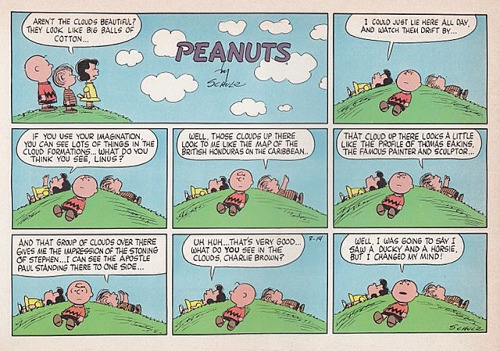
No way was I going to join that game of intellectual one-up. I was feeling too much like Charlie Brown in one of my favorite Peanuts cartoons. Linus and Lucy have been discussing what they see in the clouds: the map of British Honduras, for example, or a profile of the sculptor Thomas Eakins. When they ask Charlie Brown what he sees, he replies, "Well, I was going to say I saw a ducky and a horsie, but I changed my mind!"

Still, I started wondering what my book list would look like, should I be brave enough to post it. It wasn't going to be easy to find out: faced with such a question, my mind goes completely blank. I couldn't peruse my bookshelves, since nearly all my books are in storage (we're getting ready to move). Fortunately--since I have a hard time remembering what book I read last week and therefore can't make intelligent conversation at parties--I've been keeping reading lists since 1997.

So I read all 17 of my lists and was amazed at how many books I've apparently read that I can't recall ever hearing of. I was also amazed to see that a book I discovered just this year--Kate Atkinson's Case Histories--was also on my list from 2005. No wonder I wrote in a review that it "sounded eerily familiar": and here I thought it was because I'd seen it on Masterpiece.

Clearly if a book sticks with me, it must be great. Or not: I do remember Jill Conner Browne's Sweet Potato Queens Big-Ass Cookbook and Financial Planner, but I don't think I'd put it among the all-time greats.

Eventually I came up with a list after all. It's not an entry in the Facebook game. For one thing, it's not off the top of my head, since no books reside there. For another, it includes way more than 10 books. Besides, my list is annotated and has subheads and links!

Fiction and Poetry
Being quite capable of getting depressed without outside assistance, I prefer books (and movies) that make me happy--especially if they involve mythical places and bygone days.
  • Laura Ingalls Wilder, the entire Little House series, discovered when I was 8 and read over and over to myself and eventually to my daughters. I still own a hardcover set and will probably read them again one of these days. I have never analyzed their appeal.
  • L. Frank Baum, The Land of Oz and The Tin Woodman of Oz. My strong-willed Great-Aunt Blanche gave me these books when I was 10 years old. My mother disapproved of fantasy, but she approved of politeness. Besides, she was just slightly afraid of Great-Aunt Blanche. My heart leapt up when I saw the books but instantly subsided at the thought of my mother's likely reaction to them. I looked to her for guidance, and she was vigorously nodding. I accepted the gift with joy, and never feared fantasy thereafter.
  • C.S. Lewis, the entire Narnia series, but especially the first and the last books (though the Bacchanalian feast attended by Aslan in Prince Caspian is hard to beat). Aslan on the stone table, Aslan romping with the Pevensie children through fields of daisies--what more theology does anyone need?
  • J.K. Rowling, the entire Harry Potter series. I want to go to Hogwarts, especially if Slytherin could just be shut down.
  • Elizabeth von Arnim, The Enchanted April (I'm so excited--I just got it free on my Kindle!). I fell in love with the movie before I knew there was a book. The book is better: funnier, and the humor has more bite. Also, it has staying power: it was published 69 years before the film version.
  • Dorothy L. Sayers, Gaudy Night. It's refreshing to read about a woman who is loved more for brains than for beauty.
  • T.S. Eliot, Complete Poems and Plays. To be honest, I haven't read the plays, and I don't understand most of the poems (the Book of Practical Cats being an exception). But I love them and keep coming back to them, and would probably take this book with me if I had to be stranded on that mythical bookless desert island.
Wisdom
My fantasy-averse mother (see comment on the Oz books above) eventually relented and let me read fiction (even if Great-Aunt Blanche wasn't there) as long as I balanced it with an equal number of nonfiction books. The nonfiction category I came to prefer could loosely be called "wisdom literature" (my favorite biblical book is Ecclesiastes). If fiction could take me away from my daily life, nonfiction could help me live more fully in it. Here are some enduring favorites.
  • C.S. Lewis, A Grief Observed. What stayed with me about this book was not its chronicling of Lewis's grief or its wisdom on how to handle grief. It was Lewis's deep, passionate, heart-rending love for a bristly, brilliant woman--a serious version of Lord Peter's passion for Harriet Vane in Gaudy Night. For a gangly girl raised in the 1950s, better at academics than at flirting, this was wonderfully affirming.
  • Josef Pieper, Leisure: The Basis of Culture. This book would make my list if only for its title (I also own a book called The Joy of Not Working). It's not about laziness. It's about making time for what truly matters.
  • Niles Newton, Maternal Emotions. If you want to read this one, you'll have to get it used. It's a 1955 monograph, probably a dissertation, subtitled A Study of Women's Feelings Toward Menstruation, Pregnancy, Childbirth, Breast feeding, Infant Care, and Other Aspects of Their Femininity. I read Newton when I was teaching childbirth classes. She opened my eyes to the important distinction between being female and being culturally feminine.
  • Jacques Ellul, Money and Power. Amazon is mistaken: I didn't edit this book, I translated it. I'm glad I did, because I was forced to pay close attention to what Ellul was saying about the near-demonic power of money as it subverts the kingdom of grace. If you want to know why you can't serve God and Mammon, read this book. Ellul often sounds impractical--but then, so did Jesus.
  • Elton Trueblood, The Common Ventures of Life (another book you'll have to buy used). I first read this when I was 16, reread it when my first child was a baby, reread it again once the kids had left home. In a few years I may have to read it a fourth time: the "common ventures" Quaker philosopher Trueblood discusses are marriage, birth, work, and death. A very grounding book for someone at home in Narnia and Hogwarts.
Back to the ducky and horsie: though these are the books that have stuck with me, my everyday reading doesn't look much like this list. Right now, for example, I'm reading the newest Bridget Jones.

Friday, July 26, 2013

ONE GOOD TURN by Kate Atkinson

Two years after the windfall in Case Histories that left Jackson Brodie a wealthy man, he's in Scotland with his girlfriend, who's involved with Edinburgh's Fringe Festival.

A shady character who calls himself Paul Bradley--sometimes--is there too, driving through a crowded street, when suddenly a scruffy actor steps out in front of his rented Peugeot. Bradley brakes and swerves, a blue Honda Civic bumps him from behind, the driver gets out and comes after him with a baseball bat, and a laptop computer sails out from the onlookers and clips the Honda driver on the shoulder.

The Honda driver disappears. Nobody can remember what he looked like. Only one person took note of his car's license number: Jackson Brodie.

Enough said. Detective stories are meant to be read, not summarized. Kate Atkinson's plots are intricate and full of surprises. Her characters are nearly believable and usually hilarious. I'm not sure whom I liked better, Gloria the moralist ("If it had been up to her she would have summarily executed a great many people by now--people who dropped litter in the street, for example, they would certainly think twice about the discarded sweet wrapper if it resulted in being strung up from the nearest lamppost") or Martin the feckless crime writer (his current novel "felt even more trite and formulaic ... than his previous books, something to be read and immediately forgotten in beds and hospitals, on trains, planes, beaches").

Not to mention Tatiana the dominatrix, Archie and Hamish the teenaged thieves, Louise the frazzled detective, Richard the insufferable guest, Graham the mob-connected builder...

If it weren't for the fact that Atkinson tells a great story and keeps the pace brisk, I'd probably classify One Good Turn with literary fiction, not only for her witty style but also for the way she deftly probes her characters' motivations. I just wish she were bothered by comma splices. After all, as she herself pointed out, "Gloria liked rules, rules were Good Things."

But that's a forgivable flaw, even for this former English teacher and editor. Atkinson ranks right up there with P.D. James and Donna Leon as an author I love to spend my evenings with. James, who has written 16 mysteries, will turn 93 next week. Leon, who has written 22 Commissario Brunetti mysteries, is almost 71. Atkinson, with only 4 Jackson Brodie mysteries so far (© 2004, 2006, 2008 2011), is a mere 62. Ms. Atkinson, it's time for another one!
________________

The publisher figured One Good Turn would be a good title for book clubs, so there are a couple of pages of rather tedious questions at the end. I agree that book clubs could enjoy this book, and I in no way blame Ms. Akinson for the questions.

Friday, July 12, 2013

CASE HISTORIES by Kate Atkinson

Having run out of mysteries by Donna Leon and Michael Connelly and C.J. Sansom and P.D. James and Peter Lovesey, I am deeply grateful to whichever of my bibliophilic friends recommended Case Histories (2004). As Stephen King gushes in his front-cover blurb, "Not just the best novel I read this year, but the best mystery of the decade."

From the start, the story sounded eerily familiar: a child gone missing over 30 years before; three feuding sisters; a weird cat lady next door. About halfway through the book, I finally Googled Jackson Brodie, the private eye who was working this case along with several others.

Oh right - a year or two ago, my husband had recommended a Masterpiece Mystery episode because it starred Jason Isaacs, known to Harry Potter fans as Lucius Malfoy. David thought I would want to see how he looked with dark brown hair. (Stunning!)

It was a good show, and I plan to watch more episodes now that I've read the book. I also plan to read the next three Jackson Brodie books, and no doubt some of Kate Atkinson's other novels as well. The woman can write!

Jackson is a typically depressed private detective -  divorced, bitterly at odds with his ex, absent-mindedly devoted to their eight-year-old daughter, trying (but not too hard) to give up smoking, taking on jobs that are "either irksome or dull" because he needs the money. Originally from the north of England, he now works in Cambridge, where for 12 years he was on the police force. He's attractive (and attracted) to women, but there's no love in his life.
He was currently seeing more of his dentist than he had of his wife in the last year of their marriage. His dentist was called Sharon and was what his father used to refer to as "stacked." She was thirty-six and drove a BMW Z3, which was a bit of a hairdresser's car in Jackson's opinion, but nonetheless he found her very attractive. Unfortunately, there was no possibility of having a relationship with someone who had to put on a mask, protective glasses, and gloves to touch you.

He wishes he could throw it all over and escape to France.

Jackson doesn't show up until page 45, however. Up to that point we learn about three case histories - the missing child (1970), a murdered 18-year-old girl (1994), a young mother who goes berserk and - does what? (1979) - with which he will eventually be involved. We suspect the stories are somehow intertwined.

When it comes to detective stories, I have a couple of pet peeves. One is overcomplexity: I like to be able to follow a story without taking extensive notes (I eventually quit reading Elizabeth George, who is a fine novelist, for just that reason). My other pet peeve is shifting viewpoints. Very few novelists are able to switch from the mind of God to that of the detective to that of the criminal without sounding like poorly edited amateurs.

Kate Atkinson managed a complex plot and over half a dozen viewpoints without ever causing my pet-peeve alarm to buzz.

Because so many viewpoints are represented, Case Histories is not a procedural, though a certain amount of detective work is involved. Neither is it a thriller, though it includes a few fights and one big explosion. It would be misleading to call it a psychological novel: though it's literary, it's by no means a navel-gazer. There are many puzzles in the multiple stories, but the emphasis isn't on whodunit. I guess I'd just call it a brilliant detective story and resist adding subclassifications.

Atkinson's characters, like most people we know, are simultaneously tragic and comic. I suspect that she, like Jackson, believes that her job is "to help people be good rather than punishing them for being bad."

And maybe that's why - apart from the author's obvious skills in plotting, characterization, and literary style - I really liked this book. Despite all the human frailty and downright evil portrayed in it, the underlying tone is optimistic. Sometimes it's even laugh-out-loud funny.
__________________________________

Warning: There's enough sex in this book - most of it pretty amusing - that you might not want to read it aloud to intergenerational family groups.

Wednesday, May 22, 2013

MIDNIGHT AT MARBLE ARCH by Anne Perry

Some 20 years ago a friend lent me a stack of Anne Perry novels--all in the Charlotte and Thomas Pitt series, as I recall--which I eagerly devoured.

At the time I had no idea that Perry at age 15 conspired with a friend to murder the friend's mother, or that she at age 30 became a Mormon because of her commitment to morality. Until today I didn't know that since 1979 she has published more than 60 novels and novellas--almost two a year. No wonder, as her biographer points out, Perry's books deal with the themes of "miscarriages of justice, family secrets exposed, punishment, redemption and forgiveness."

Her newest book, Midnight at Marble Arch (number 28 in the Charlotte and Thomas Pitt series), is especially strong in the first two themes. The year is 1896. Thomas Pitt is now in charge of Special Branch, similar to the U.S. Department of Homeland Security. No longer a policeman, he does not normally get involved in assault cases, even when he learns that a prominent businessman's wife has died after being brutally raped.

But when it appears that the 16-year-old daughter of the Portuguese ambassador has been raped by a sociopathic but exceedingly rich young man, Pitt decides to act. His reason may be to satisfy his wife's sense of justice, but his excuse is that Britain's international relations will be endangered if foreign diplomats fear to bring their families to London--and whoever the rapist is, he is likely to strike again.

Meanwhile, the widowed businessman has asked Pitt's former superior, Lord Victor Narraway, to help him find the man who raped his wife. Narraway eagerly takes the case, partly to make himself feel useful in retirement, and partly because he is very fond of Charlotte Pitt's formidable great-aunt-by-marriage, Lady Vespasia Cumming-Gould.

And then a couple more women are raped, and Pitt and Narraway find themselves working together once again.

Perry adeptly portrays late 19th-century society with its fancy dress, incessant parties, and suffocating superficiality. She chillingly shows how most Victorians regarded rape, how it ruined women, and why it was rarely prosecuted. Somehow, however, the four sleuths at the center of the story--Thomas and Charlotte, Narramore and Vespasia--have escaped the attitudes of most of their contemporaries, which somewhat strains the story's credibility. But as long as you can handle 21st-century consciences in a few 19th-century people, you will likely enjoy this addition to the Charlotte and Thomas Pitt collection.

In fact, I think Midnight at Marble Arch might make a good movie.

Perry's plotting is full of surprises, and yet not too complex to follow easily. In a film, action and conversation would replace the book's incessant and sometimes tiresome inner questioning ("How many men feared for their sons?... What would Pitt do if Daniel ... should be wrongly accused of such a violent and repulsive crime?... How would Pitt know what Daniel thought of women who perhaps teased him, provoked him, with little or no idea of what tigers they were awakening?... How would he prevent Daniel from becoming a young man who treated women as something he had the right to use, to hurt, even to destroy? Where did such beliefs begin?... How would he ever make certain his son could lose an competition with the same grace as when he won?... Would it be Pitt's fault if Daniel grew up arrogant, brutal?"--and all of these questions come from just one page). With its faster pace and--minus the internal monologues--reduced opportunity for anachronism, the film might be even better than the book.

I haven't figured out who should play three of the four good guys, but Lady Vespasia Cumming-Gould, with her elegance, steel-trap mind, and late-life sexual allure, is Helen Mirren.

Wednesday, May 15, 2013

THE GOLDEN EGG by Donna Leon

If you're already a Donna Leon fan, all I need to tell you is that the 22nd Commissario Guido Brunetti mystery was published March 26.

If you're not already addicted to the Brunetti books, you can check out a complete, chronological, annotated list of each book in the series here.

Or you can read a perceptive short review of The Golden Egg in the New York Times's April 5 crime column by Marilyn Stasio. In fact, even if you are a fan, I recommend this review. Stasio highlights the important theme running through this book:
“If the Brunettis had a religion,” Leon tells us, “it was language.” And so this thoughtful policeman is also led to brood over the debasement of language by the politicians and bureaucrats who cynically confuse, misdirect and misinform the public.
In The Golden Egg, language
  • is the basis for hilarious dinner-table games at the Brunetti household.
  • obfuscates the police bribes Brunetti is asked to investigate.
  • is oddly absent from everything connected with the life of the slain dry-cleaner assistant. 
  • becomes an important tool in Brunetti's investigations (should he speak Italian or Veneziano? Will his Neopolitan assistant be able to relate, since she doesn't speak the local dialect?).
Language is also the subject of Brunetti's extended meditation in the closing chapter. Here's a sample:
He drank a glass of wine, left the second one unfinished, drunk with the words that crossed the table, their different meanings, the fact that they indicated time: future and past; that they indicated whether something had been done or was still to do; that they expressed people's feelings: anger was not a blow, regret was not tears. At one point, Paola expressed a wish and used the subjunctive, and Brunetti felt himself close to tears at the beauty of the intellectual complexity of it: she could speak about what was not, could invent an alternative reality.
Language is probably why so many of my friends - many of whom are writers, editors, or publishers, and most of whom love words - are hooked on Leon's mysteries. Language, and food. Brunetti's wife, Paola Falier, seems to have few responsibilities at the university where she teaches English literature; she is nearly always home in time to prepare magnificent meals. Fritto misto. Baked finocchio with rosemary. A salad of carpaccio of red beet, ruccola, and parmigiano. Involtini of chicken breast. Cake with fresh black currants and whipped cream. I can't imagine why Brunetti's Cookbook, aka A Taste of Venice, is no longer in print. Maybe it should have been called, more accurately, Paola Falier's Cookbook.

To be sure, readers of detective fiction don't always appreciate the Guido Brunetti series. Some of the books are police procedurals, while others, like this one, focus almost entirely on Brunetti's deductions. There may be violence, but it is usually offstage. It may take awhile to get to the murder - if indeed a murder has occurred. It's often not too hard to figure out whodunnit. Brunetti's wife and children are as important as his coworkers at the questura. And Leon keeps tossing in Italian words, as I just did, without translating them.

Those are all reasons that I love the series, but I don't want to take you there on false pretenses. If the subjunctive, used correctly over a bowl of risotto, never brings you close to tears, perhaps you should read a different series instead.

P.S. If you hate spoilers, don't pay any attention to this book's title.

Monday, May 13, 2013

THE TOOTH TATTOO by Peter Lovesey

It seemed appropriate last week, when my dentist was replacing five fillings, to show him the book I was reading: The Tooth Tattoo by British writer Peter Lovesey (published April 30).

Like Lovesey's Detective Chief Superintendent Peter Diamond, I had never heard of tooth tattoos, but my dentist told me he had done some. He then hauled out a handful of photos to show me the possibilities. My favorite showed a Canada goose on the upper molar and a bullet on the corresponding lower molar.

In Lovesey's latest novel - the thirteenth in the Peter Diamond series - an almost unidentifiable corpse is discovered in a canal. The one distinguishing feature, so faint that it was missed by the first medical examiner, is a tattoo on one of the corpse's teeth. It appears to be a quaver, or an eighth note. Diamond and his team spring into action.

But all is not well at the Bath CID. Diamond's coworkers fear that, due to the economic crisis and government cutbacks, their jobs may be on the line. Diamond's churlish behavior, even more extreme than usual, seems to confirm their fears: they have no way of knowing that he is in the midst of a crisis of his own.

When I read the first 12 Peter Diamond books last year (for a review in Books and Culture magazine, "A Rough Diamond"), I grew increasingly enamored of the burly Bath detective's exploits. The Tooth Tattoo, I think, is one of Lovesey's best. Like the others, it's a procedural puzzle, but here Lovesey pays more than usual attention to Diamond's personal life. In addition, much of the novel focuses on the relationships among the members of a world famous string quartet. (If you like music-themed mysteries too, see my reviews of Morag Joss's Sara Selkirk series and Donna Leon's The Jewels of Paradise.)

You don't need to have read the rest of the series to enjoy this book. After you've read it, though, you may want to go back and check out the others. Here's a list of all the titles.

Tuesday, April 9, 2013

KNOTS & CROSSES by Ian Rankin


The test of a really good mystery: you can read it more than once and still get caught up in the story, even if you remember whodunnit.

To be honest, I didn't mean to reread Ian Rankin's first Inspector Rebus novel, Knots and Crosses, a second time. I knew I'd checked it out of the library some time back, but I thought I'd read the first chapter and quit. That must have been some other novel. As I read it this time, I kept realizing what was going to happen, and not because the plot was thin (it wasn't). Finally I googled my book lists and discovered that indeed I had read the entire book less than a year and a half ago.

I liked it even better the second time (and am likely to remember that I read it). Now I'm ready to follow in the footsteps of my husband, who, I believe, has read every one of the Rebus books and has seen some of the TV adaptations too.

Knots and Crosses, published in 1987 when Rankin was 27 years old, introduces Edinburgh Detective Sergeant John Rebus and immediately throws him into an investigation of a serial killer who targets young girls. Rebus has an 11-year-old daughter, and some secrets from his past that he can't bear to face, and ... well, the story turns into a thriller in which he's very personally involved.

Rankin's plotting is great: neither so complex as to require note-taking on the part of the reader, nor so simple as to be obvious (though the killer keeps taunting Rebus by sending him clues that, he says, should reveal his identity). He knows how to evoke emotions, from compassion to terror. Best of all, he makes Rebus fully human: on the one hand, a hard-drinking loner with a penchant for petty theft and fornication; on the other, a caring father and a praying, Bible-reading Christian who keeps wishing for better treatment from his vengeful personal god.

I've checked my library's holdings against Rankin's book list and am delighted that they stock most of them including the newest Rebus novel, Standing in Another Man's Grave (January 2013 in US). I've put in for an interlibrary loan on a couple of the early titles that they don't have. It's going to be a good spring.

Oh, by the way, if you're wondering about the title, "noughts and crosses" is the British term for what Americans call tic-tac-toe.

Monday, January 28, 2013

FUNERAL MUSIC by Morag Joss

Thanks to my friend Anne Buchanan, who recommended Morag Joss's Sara Selkirk mysteries.

Anne knows the kind of mysteries I like best. I'd rather the murder(s) happened offstage. I want the characters to be more than plot devices--I like to read about their friends and families, what annoys them at work, what brings them joy, what they like to eat. I love a writer who knows how to develop a sense of place. And it helps if the writer can make me laugh every now and then.

I was delighted with Funeral Music.

Sara Selkirk is a concert cellist of international renown who has been suffering from "musician's block" for a year or so. Originally from Scotland but now a resident of Bath, England, Sara has agreed to play a short concert at the Pump Room in order to raise funds for the Bath Festival. Not long afterward she discovers a corpse.

Fortunately she is well connected. One of her cello students is a police inspector. A friend is a colleague of the murder victim. Another friend takes her to an alternative healing fair, where she happens to observe the eventual murder victim talking with a large man who, it turns out, badly wants a job they both are applying for. This friend's landlady, as it turns out, is the large man's girlfriend (Bath's population is only about 80,000). And then there is Paul, who is good with women and knives; and James, who has a rotten alibi; and George, the prejudiced museum guard, and ...

The puzzle is fun, with several healthy red herrings. Even more fun are Joss's descriptions--short ones, like "his face had the faraway, otherworldly look of a defecating Labrador," and dazzling longer ones, like her evocation of Bach's Trio Sonata in C Major, which
splashed out and down in a shower of weightless drops into the open lap of the abbey nave.... Only Bach could do this, make you feel you had been only half alive until this moment, pull you into the dance, lift you and take you as high as the roof, right up to where you could drink from the music's spring and be filled with a few bubbles of his crazy joy.... It flowed on, the little sounds dancing out across the transept like drops of light, darting through the melodic web that the organist's feet and fingers were spinning to and fro on which to catch them. Sara had the sensation that she had unknowingly been suffering from some sort of deafness and that with this glorious noise she had suddenly woken up to find that her ears were working properly.
Joss spices up the story with a number of complicated relationships: Paul and Sue (or Olivia?), Andrew and Valerie (or Sara?), Derek and Cecily (or Pauline?), James and Tom (or Graham?). One of the funniest scenes I've ever read in a mystery is between  Derek and his wife, Pauline, after she has learned about Cecily--but you'll have to read the book if you want to know more.

Publishers Weekly gave Funeral Music a starred review and P.D. James gave it a laudatory blurb. I'd call it a clever combination of Peter Lovesey and Jane Austen. I can't imagine why the Wheaton Public Library doesn't have the Sara Selkirk mysteries on its shelves, but they got it for me quickly through interlibrary loan. Or you can get a used copy for less than $4 from Amazon.

Tuesday, January 22, 2013

FLIGHT BEHAVIOR by Barbara Kingsolver

Barbara Kingsolver's newest novel, Flight Behavior (November 2012), may be just the book you're looking for for your next book group meeting.

The main character, Dellarobia Turnbow, is a 27-year-old mother of two who for years has felt like flying from her nest. Just as she is about to do something definitive, she encounters about a million Monarch butterflies who, for reasons unknown, have flown from theirs. Complications ensue.

Here are some reasons Flight Behavior is so suitable for book groups:
  • Dellarobia may be an Appalachian farm wife, but all kinds of readers will identify with her if they've ever married, raised children, or wondered what a completely different life would be like.
  • You could spend hours talking about marriage as portrayed in this book: what makes it real, what constitutes infidelity, whether Dellarobia should stay in hers or leave.
  • Or you might prefer to discuss climate change: what it's doing to the earth right now, whether the events in this book could actually happen, and how to  deal with it (deny? study? protest?).
  • Even more interesting, to me anyway--you could look at the culture clash represented by Dellarobia's neighbors, on the one hand, and the various visitors to her neighborhood, on the other. Are Kingsolver's portrayals accurate? Do you know people like these? Are they doomed to misunderstand each other forever?
  • Or you might try going beyond the story itself to predict what Dellarobia is going to do next, and to imagine how her actions are going to affect the other characters in the book. What should she do?
I enjoyed the story from start to finish. Kingsolver has a great sense of humor. She is gentle with all her characters: even the less lovable ones surprise us with good traits. She is a keen observer of people as well as of nature. It's not surprising to learn (from her website) that she lives in Southern Appalachia and raises sheep. As someone who identifies with conservationists more readily than with rednecks, I was especially delighted whenever she turned the tables on me and my prejudices and showed me just how wrong I can be.

The paperback isn't due until June, but the hardcover is inexpensive from Amazon right now. Or you could make this a summer selection.

Wednesday, January 9, 2013

THE JEWELS OF PARADISE by Donna Leon

After writing 21 detective novels featuring Commissario Guido Brunetti, it's not surprising that author Donna Leon needed a break.

Still, having read all 21 of the Brunetti books, I was expecting Jewels of Paradise to be book 22 in the series. It is not, and I was disappointed.

Disappointed because by now the characters - the lovable detective from Venice; his wife, Paola, and their two young adult children; his sidekick, Sgt. Vianello; his insufferable boss, Vice-Questore Patti; and the indomitable Signorina Elettra - all seem as familiar as Facebook friends, and I wanted to stay involved in their lives.

But my nostalgia is no reason to keep Ms. Leon from expanding her horizons. I was more disappointed because Leon's new book simply didn't hold my interest.

A lot of the book has to do with biographical material concerning Agostino Steffani (1654-1728), churchman, diplomat, and nearly forgotten composer. (Hint: Leon's plot will be easier to follow if you read the Wikipedia article first. Want to hear some of his music? Cecilia Bartoli has a new album, Mission, devoted to his work [you can listen to the NPR program about it here].)

But don't come to this book thinking it's historical fiction. It's closer to historical research as done by a high-school student - and there's no afterword telling us which parts of the story are historical and which invented.

The main character, Caterina, does not seem to have much of a life outside the library. We learn even less about the other characters (though her sister, Cristina the Religious, might be worth a book of her own someday, or at least a bit part in a Brunetti novel).

The plot is thin. Somehow two 300-year-old trunks have been found, and two cousins each claim inheritance rights. Caterina, a musicologist, is charged with reading all the documents in the trunks and figuring out which, if either, has claim to the material.

There aren't many scary parts. At one point, you think scariness is developing, but (spoiler alert) it doesn't.

There isn't even much good food - but I suppose without Guido's ever-cooking scholar-wife, Paola, in the kitchen, there wouldn't be.

And when all is said and done, I know what was in those trunks, but I'm still wondering who the trunks belonged to, and how they came to Venice, and what Opus Dei had to do with the whole situation. Maybe my mind was wandering when all that was explained ...

Why I kept reading: (1) I'm loyal to Donna Leon. Up till now, she's been one of my favorite detective story authors. (2) I appreciate her wry observations about Italian culture and the Catholic Church. (3) I kept thinking the plot would heat up.

If you are a diehard Donna Leon fan like me, you should read it too - and please let me know what you think. I confess that I began skimming the historical parts; maybe I missed something important. If you have not yet become a Leon addict, however, don't start here.

Wednesday, January 2, 2013

2012: My year of series fiction

[Me, reading a nonfiction book
 approved by my mother]
In 1997, faced with a daunting commute, I decided to devote train time to reading for pleasure. At the same time, I began keeping a list of books I'd read. My mind goes blank whenever anyone asks, "Read any good books lately?" The list helps me access my hard drive. Sometimes I consult it before going to parties, just in case.

At the end of each year, I tally the books I've read. First, out of curiosity, I count how many are fiction and how many nonfiction. When I was a child, my mother, who was a serious and responsible woman, tried to keep me from reading fiction. She soon learned that she could not take me to libraries and expect me to refrain from reading stories, so she relented - but for every fiction book, I had to read a nonfiction book as well. Mothers are powerful: for maybe 10 years, even without trying, I read about an equal amount of fiction and nonfiction.

And then I fell in love with several mystery series.

In 2011, I read great stacks of M.C. Beaton (creator of Agatha Raisin and Hamish Macbeth). They are very lightweight, predictable, funny, and excellent for people who are recovering from major surgery.

In 2012, nearly half the books I read were from one series or another:
Just one book each by Sue Grafton and Michael Connelly because they are two of my favorites and I had already read all 40-some of their previous books. Four books by Alexander McCall Smith and two by M.C. Beaton - I was caught up with them too, but that's how many they published last year. One each by Janet Evanovich (her Stephanie Plum series: I probably won't read the other 18) and the late Michael Dibdin (I may go back and pick up some I've missed), two out of five by Martin Walker, and three out of fifteen by Andrea Camilleri. If you want to see my reviews of some of these books, click here or click the Mysteries tab at the top of this page.

My discovery last year was British writer Peter Lovesey's series about Bath detective Peter Diamond. Books & Culture asked me to review his 12th book, Cop to Corpse, and I ended up compulsively reading the first 11, with increasing satisfaction.

The series I most enjoyed was the Venice-based Commissario Guido Brunetti series by Donna Leon, an American who has lived in Venice for 30 years and who, at least according to an American-Italian friend of mine who has lived in Florence for nearly 40 years, really gets Italy. I had read her first book, Death at la Fenice, in 2009 and was only moderately impressed. Friends urged me to keep going. Last year I read books 2 through 21, and I just put book 22, published last October, on hold at the library - along with the new Alexander McCall Smith and the new Sue Grafton.

Maybe I'll develop a more serious mind in 2013 and read more nonfiction. I'll let you know ...

-------------------------------------------------
For more series fiction recommendations, see "'Tis the season to read something relaxing."

Friday, November 30, 2012

THE BLACK BOX by Michael Connelly

Harry Bosch fans, it's time to pour yourself a Fat Tire (one of Bosch's favorites), put Art Pepper's "Patricia" (Bosch's birthday gift from his 16-year-old daughter, Maddie) on your iPod, and settle down for an engrossing read. If you haven't yet read any of the Harry Bosch books, that's OK too. You can start with this one and pick up the others later.

--from my review of The Black Box, now up on the Books and Culture website.
Click here to read it.

Wednesday, November 28, 2012

'Tis the season to read something relaxing

Renoir, La lectrice, 1874
Thanksgiving down, Christmas coming. Parties to attend. Christmas greetings to send. Gifts to buy. Travel arrangements to make. Groceries to buy. Meals to cook. Guest rooms to get ready. Decorations to display. Checks to write.

Nerves to calm.

I dedicate this blog post to my friend Karen, and to everyone else who needs to pour a comforting drink, sit down, elevate feet, and read a diverting novel--one that engrosses you, makes you smile, lets you relax, does not leave you with the taste of ashes.

Actually, you may need more than one such novel. So despite my inordinate fondness for one-offs like Sarah Dunn's Secrets to Happiness and Helen Simonson's Major Pettigrew's Last Stand, I'm going to give you a list of novels any one of which can lead you to four or a hundred similar delectable books.
My rules for series fiction:
1. Start with whatever book grabs your attention. It doesn't have to be the first in the series.
2. If you don't like it, don't bother with the rest of the series unless at least three of your friends have recommended it--in which case, try a second book.
3. If you like either the first or second book reasonably well, read two more books in the same series. By then, you'll either be in love with the series or you'll be ready to try something else.
Here are ten of my favorite authors of series fiction. The links will take you to reviews I've written either on this blog or in magazines.
  • Michael ConnellyThe Reversal (and others). Detective Harry Bosch is the best in the business. Connelly has written 25 books, 18 about Harry. Newest, The Black Box, came out two days ago. Not a bad place to start. But if you'd rather start with a legal thriller, go for The Lincoln Lawyer.
  • Margaret FrazerThe Apostate's Tale. The indomitable nun Dame Frevisse gets involved with a lot of 15th-century mayhem. I like Ellis Peters's Brother Cadfael books, but I got even more attached to Dame Frevisse.
  • Sue GraftonV Is for Vengeance. Start with A Is for Alibi. If the fourth sentence doesn't grab you, nothing will: "The day before yesterday I killed someone and the fact weighs heavily on my mind." W-Z are still to come, but you have 22 books to read before you run out.
  • P.D. JamesTalking About Detective Fiction. First, read P.D. James's mysteries. They're all good, and you don't have to read them in order. Or just watch the TV adaptations starring Roy Marsden. Talking About Detective Fiction is Dame James's discussion of great mystery writers--dozens of them. Follow her leads and you'll have enough to read until you retire.
  • Donna Leon, Death and Judgment. Oh, just start with Death at La Fenice and read all of Leon's Venetian mysteries featuring Commissario Guido Brunetti. He's a lovable cop, and the Italian ambiance is a treat.
  • Peter Lovesey, Cop to Corpse. Detective Superintendent Peter Diamond presides grumpily over the Avon and Somerset murder squad. You may not care for him at first--his coworkers certainly don't--but he grows on you.
  • Alexander McCall Smith, The Forgotten Affairs of Youth. I find Scottish author McCall Smith more relaxing than a wee dram of single malt. His characters are quirky, funny, and fundamentally good. My review mentions several of his series; fortunately for his fans, he tends to write three books a year.
  • Spencer Quinn, To Fetch a Thief. Chet the dog narrates, but these stories are rarely cutesie. They can be pretty darn funny, though--especially to those of us who live with dogs. And there's always an interesting plot.
  • C.J. Sansom, Dissolution. Sansom is writing a series of fantastic 16th-century (think Henry VIII) mysteries. These are large books, a bit more serious than some on this list, but utterly engrossing. You can have Wolf Hall and its sequel: I'll take Sansom any day.
  • Jennifer Weiner, Good in Bed / Certain Girls. Bright and sassy chick lit. Weiner is a Princeton grad with a rowdy sense of humor. Not to be sexist or anything, but I'm guessing these aren't for guys.
And there are others ... so many others. Laurie R. King is a delight. She's been turning out a lot of books in the Mary Russell (Mrs. Sherlock Holmes) series as well as several stand-alone volumes, but my favorites are her Kate Martinelli books. Jane Langton, who is about to turn 90, wrote a lot of gently humorous New England-based books about ex-cop/current Harvard professor Homer Kelly and his brilliant wife, Mary.

And if you're feeling really, really tired--as I was after open-heart surgery last year--M.C. Beaton's Agatha Raisin and Hamish Macbeth series are silly fun. I read 30 of them while convalescing, and I'm feeling fine, thanks!

Please, readers, add comments (here, and not just on Facebook) about series fiction you've enjoyed...

Wednesday, November 21, 2012

A JANE AUSTEN EDUCATION by William Deresiewicz

I loved William Deresiewicz's op-ed piece "A Matter of Taste?", a look at how "foodism has taken on the sociological characteristics of what used to be known — in the days of the rising postwar middle class, when Mortimer Adler was peddling the Great Books and Leonard Bernstein was on television — as culture." If you didn't read it, now's a good time.

Be sure to read the author's bio at the end. If you're like me, the next thing you'll do is buy or borrow his 2011 book, A Jane Austen Education: How Six Novels Taught Me About Love, Friendship, and the Things That Really Matter.

The book is part memoir, part literary interpretation, part wisdom literature. The three parts aren't seamlessly integrated, and that bothered some reviewers. I enjoy all three genres and appreciated the author's - let's call him Bill - self-deprecating humor, so I wasn't bothered.

Here's the plot: Bill recounts how he moved from disdaining Jane Austen to adoring her and eventually writing his Ph.D. dissertation about her. In the process, he also moved from being a (self-described) dumb 26-year-old with daddy issues and a dismal romantic life, to being a grown-up guy with an apartment, a job, good friends, and a wife.

Jane Austen, it turns out, was his life coach.

If you already like Jane Austen, you'll probably enjoy Bill's ideas about the messages underlying her six novels.

If you read Jane Austen a long time ago - or just saw the movies and TV miniseries -  don't hesitate to pick up this book. Bill gives enough context that you'll know exactly what's going on.

If you don't like Jane Austen (but have to read her for class), or if you've never tried her at all, go ahead and see if Bill can get you interested. His book is at least as much about "the things that really matter" as about Jane.

Thanks to Bill, I'm now rereading - well, listening to an audiobook of - Northanger Abbey, Jane Austen's hilarious send-up of gothic fiction. It's read by one of my favorite narrators, Wanda McCaddon, under the name of Nadia May (she is also widely known as Donada Peters).