Showing posts with label nonfiction. Show all posts

Thursday, January 3, 2019

5 favorites from my 2018 reading list

The dreaded question: "So, what are you reading?"

The panicked response: [totally blank mind, even if I put down a book just minutes before]

The workaround: Mentioning one of my favorite authors of detective fiction (Louise Penny, Michael Connelly, Donna Leon).

The somewhat more effective solution: Keeping a list of books read; reviewing it before social engagements where the dreaded question might be asked.

So for each of the last 22 years, I've kept such a list. At the end of each year, I look at the list, cringe at my lowbrow tastes, and marvel at how few of the books were memorable. In fact, some of the titles always look so unfamiliar that I have to google them to make sure there's no mistake.

But some books are outstanding, and here are my favorites of 2018 ... apart from those already mentioned detective series by Penny, Connelly, and Leon. And also Alexander McCall Smith, Martin Walker, Ian Rankin, Laura Lippman, Ann Cleeves, Peter Lovesey... 

As I look at my favorites, I realize that each one--in spite of their stories of pain, suffering, and downright evil--is ultimately hopeful.

Two favorite novels:


Stephen McCauley, My Ex-Life, 2018

A comedy of manners that is not Jane Austen, though I also adore Jane. Funny, wistful, compassionate.


Octavia E. Butler, Kindred, 2004

Two parallel stories, maybe 150 years apart, with some of the same characters. Suspend disbelief: it's worth it.


Three favorite books of nonfiction:


Kate Bowler, Everything Happens for a Reason: And Other Lies I've Loved, 2018

An excellent memoir by a youngish professor of religion who is living with stage 4 cancer. The book was published in February; she wrote this op-ed piece in the New York Times last week.


Isabel Wilkerson, The Warmth of Other Suns: The Epic Story of America's Great Migration, 2010

A classic. Big. Full of stories. So interesting you might not notice how much you're learning.


Michelle Obama, Becoming, 2018

Fascinating on so many levels, and not only because she's America's most admired woman this year. And hey, this is President Obama's favorite book of 2018!


Enjoy! There are still 362 reading days in 2019. 

Wednesday, December 31, 2014

2014: My Year in Books

[A wall in my office]
I started keeping a reading list in 1997 when I began commuting by train to work. I've been keeping a list ever since.

Because I rarely remember what I've been reading once I've gone on to the next book, the list comes in handy whenever someone asks, "So, have you read any good books lately?"

Yes, of course. Here is a short list of my favorites from this year, in order from the ridiculous to the sublime:

What I read

Jeanne Ray, Calling Invisible Women, is a delightful comic novel in which a middle-aged woman becomes literally invisible, and her family doesn't notice. The author, a retired nurse, is author Ann Patchett's mother. She was in her 60s when she wrote her first novel, Julie and Romeo. I love Patchett's novels, but Ray's are more fun.

Gabrielle Zevin, The Storied Life of A.J. Fikry (newly published in paperback) is a comic novel likely to appeal to my friends in the book business and other bibliophiles. It features a curmudgeonly bookstore owner, a publisher's sales rep, a book tour that goes hilariously wrong, and a precocious child who loves to read.

Laura Lippman has written a slew of detective stories based in Baltimore, my new home. I began reading her in Illinois in preparation for my move and kept on reading her once I got here. Lippman's detective, like Lippman herself, formerly wrote for the Baltimore Sun; her books might appeal to readers of Sue Grafton's alphabet series.

When a new Baltimore friend told me Lippman is married to David Simon, creator of The Wire, I ordered a copy of his nonfiction book Homicide: A Year on the Killing Streets. First published in 1991, Homicide reads like fast-paced detective fiction. This means I do a double-take whenever I hear the name of Jay Landsman, my local police captain, the real-life son and namesake of one of the book's main characters who was transmuted into a fictional character in The Wire.

If you are planning to visit me, however, and want to bone up on Baltimore, it might be more reassuring to skip Lippman and Simon and go directly to Anne Tyler. Before moving here, I reread my old favorite Dinner at the Homesick Restaurant. Once installed in Baltimore, I got a review copy of Tyler's forthcoming novel, A Spool of Blue Thread, which takes place in a Baltimore neighborhood only 10 minutes from my house. I love Tyler for her unsentimental yet kindly way of describing family life. And even though all her books are set in Baltimore, her characters do not generally get murdered.

Ellen Harmon White: American Prophet, edited by Terrie Dopp Aamodt, Gary Land, and Ronald L. Numbers, is a fascinating collection of articles about probably the most important female 19th-century religious leader and reformer you've barely heard of--unless, like me, you were raised Seventh-day Adventist. Here's my review in the September/October issue of Books and Culture.

Finally, here's the book I've recommended to more people this year than any other: Atul Gawande's Being Mortal: Medicine and What Matters in the End. Gawande, a surgeon, has written an impassioned plea for how end-of-life medicine and end-of-life care in general should be practiced. Gawande is also a regular contributor to New Yorker magazine, which tells you something about the quality of his writing.

Why I read

Like everyone else I read Marilynne Robinson's Lila, just as in earlier years I read Housekeeping and Gilead and Home. Robinson is brilliant at character portrayal, and she knows how to turn a phrase. She's also gifted at stuffing her books with Christian theology and still gathering accolades from the New York Times (by Diane Johnson, author of Le Divorce, no less). I recommend her to all my friends whose brows are higher than mine.

But I guess this year I was just more interested in invisible middle-aged women and the floundering publishing industry and my present life in Baltimore and my past life as a Seventh-day Adventist and my future life as it winds down. Which leads me to think about the books I've loved at any given time.

2014 was stressful: I sold a house I'd lived in for 26 years, moved into an apartment, bought a house, moved into it, and lived through renovations. In the midst of all that change, I preferred books that closely connected to some aspect of my life--past, present, or future.

In more humdrum years, I've chosen books that took me out of my environment and introduced me to new times, places, and ideas. Three years ago when recovering from open-heart surgery, I read dozens of completely mindless but diverting mysteries.

I thought I just liked to read, but apparently I also use books as therapy. (I'm sure there's a reason that no matter what kind of year I've had, I adore Harry Potter.) What books did you read this year? Do your selections say anything about the kind of year you had?

Tuesday, December 17, 2013

This is not the Facebook-mediated list of books that have "stayed with you"

If you're on Facebook and if you devour books, you have undoubtedly been asked to list 10 books that have "stayed with you" - and then to ask 10 of your friends to do the same. I got a barrage of requests all in one afternoon, accompanied by formidable book lists heavy on theologians and literary novelists.

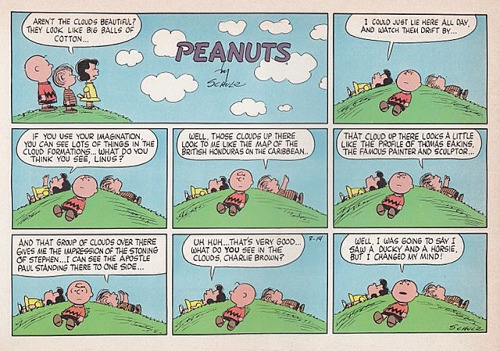
No way was I going to join that game of intellectual one-up. I was feeling too much like Charlie Brown in one of my favorite Peanuts cartoons. Linus and Lucy have been discussing what they see in the clouds: the map of British Honduras, for example, or a profile of the sculptor Thomas Eakins. When they ask Charlie Brown what he sees, he replies, "Well, I was going to say I saw a ducky and a horsie, but I changed my mind!"

Still, I started wondering what my book list would look like, should I be brave enough to post it. It wasn't going to be easy to find out: faced with such a question, my mind goes completely blank. I couldn't peruse my bookshelves, since nearly all my books are in storage (we're getting ready to move). Fortunately--since I have a hard time remembering what book I read last week and therefore can't make intelligent conversation at parties--I've been keeping reading lists since 1997.

So I read all 17 of my lists and was amazed at how many books I've apparently read that I can't recall ever hearing of. I was also amazed to see that a book I discovered just this year--Kate Atkinson's Case Histories--was also on my list from 2005. No wonder I wrote in a review that it "sounded eerily familiar": and here I thought it was because I'd seen it on Masterpiece.

Clearly if a book sticks with me, it must be great. Or not: I do remember Jill Conner Browne's Sweet Potato Queens Big-Ass Cookbook and Financial Planner, but I don't think I'd put it among the all-time greats.

Eventually I came up with a list after all. It's not an entry in the Facebook game. For one thing, it's not off the top of my head, since no books reside there. For another, it includes way more than 10 books. Besides, my list is annotated and has subheads and links!

Fiction and Poetry
Being quite capable of getting depressed without outside assistance, I prefer books (and movies) that make me happy--especially if they involve mythical places and bygone days.
  • Laura Ingalls Wilder, the entire Little House series, discovered when I was 8 and read over and over to myself and eventually to my daughters. I still own a hardcover set and will probably read them again one of these days. I have never analyzed their appeal.
  • L. Frank Baum, The Land of Oz and The Tin Woodman of Oz. My strong-willed Great-Aunt Blanche gave me these books when I was 10 years old. My mother disapproved of fantasy, but she approved of politeness. Besides, she was just slightly afraid of Great-Aunt Blanche. My heart leapt up when I saw the books but instantly subsided at the thought of my mother's likely reaction to them. I looked to her for guidance, and she was vigorously nodding. I accepted the gift with joy, and never feared fantasy thereafter.
  • C.S. Lewis, the entire Narnia series, but especially the first and the last books (though the Bacchanalian feast attended by Aslan in Prince Caspian is hard to beat). Aslan on the stone table, Aslan romping with the Pevensie children through fields of daisies--what more theology does anyone need?
  • J.K. Rowling, the entire Harry Potter series. I want to go to Hogwarts, especially if Slytherin could just be shut down.
  • Elizabeth von Arnim, The Enchanted April (I'm so excited--I just got it free on my Kindle!). I fell in love with the movie before I knew there was a book. The book is better: funnier, and the humor has more bite. Also, it has staying power: it was published 69 years before the film version.
  • Dorothy L. Sayers, Gaudy Night. It's refreshing to read about a woman who is loved more for brains than for beauty.
  • T.S. Eliot, Complete Poems and Plays. To be honest, I haven't read the plays, and I don't understand most of the poems (the Book of Practical Cats being an exception). But I love them and keep coming back to them, and would probably take this book with me if I had to be stranded on that mythical bookless desert island.
Wisdom
My fantasy-averse mother (see comment on the Oz books above) eventually relented and let me read fiction (even if Great-Aunt Blanche wasn't there) as long as I balanced it with an equal number of nonfiction books. The nonfiction category I came to prefer could loosely be called "wisdom literature" (my favorite biblical book is Ecclesiastes). If fiction could take me away from my daily life, nonfiction could help me live more fully in it. Here are some enduring favorites.
  • C.S. Lewis, A Grief Observed. What stayed with me about this book was not its chronicling of Lewis's grief or its wisdom on how to handle grief. It was Lewis's deep, passionate, heart-rending love for a bristly, brilliant woman--a serious version of Lord Peter's passion for Harriet Vane in Gaudy Night. For a gangly girl raised in the 1950s, better at academics than at flirting, this was wonderfully affirming.
  • Josef Pieper, Leisure: The Basis of Culture. This book would make my list if only for its title (I also own a book called The Joy of Not Working). It's not about laziness. It's about making time for what truly matters.
  • Niles Newton, Maternal Emotions. If you want to read this one, you'll have to get it used. It's a 1955 monograph, probably a dissertation, subtitled A Study of Women's Feelings Toward Menstruation, Pregnancy, Childbirth, Breast feeding, Infant Care, and Other Aspects of Their Femininity. I read Newton when I was teaching childbirth classes. She opened my eyes to the important distinction between being female and being culturally feminine.
  • Jacques Ellul, Money and Power. Amazon is mistaken: I didn't edit this book, I translated it. I'm glad I did, because I was forced to pay close attention to what Ellul was saying about the near-demonic power of money as it subverts the kingdom of grace. If you want to know why you can't serve God and Mammon, read this book. Ellul often sounds impractical--but then, so did Jesus.
  • Elton Trueblood, The Common Ventures of Life (another book you'll have to buy used). I first read this when I was 16, reread it when my first child was a baby, reread it again once the kids had left home. In a few years I may have to read it a fourth time: the "common ventures" Quaker philosopher Trueblood discusses are marriage, birth, work, and death. A very grounding book for someone at home in Narnia and Hogwarts.
Back to the ducky and horsie: though these are the books that have stuck with me, my everyday reading doesn't look much like this list. Right now, for example, I'm reading the newest Bridget Jones.

Friday, June 14, 2013

COOKED by Michael Pollan


Eat food.
Not too much.
Mostly plants.

--Michael Pollan, In Defense of Food


In The Omnivore's Dilemma (2006), science journalist Michael Pollan looked at how food is produced. In his next two books, In Defense of Food (2008)and Food Rules (2009), he told us what we should eat (see above). In his most recent book, Cooked (April 2013), he investigates the methods, biology, and philosophy of food preparation.

I loved Omnivore: it's one of those rare books that can get a person fascinated by a topic that previously held no interest whatsoever. The two Food books were thin but full of wise advice, such as Pollan's now-famous seven-word guide to good eating.

Cooked, at 480 pages, should have been thinner.

I enjoyed Pollan's introduction, which is essentially the speech I heard him give at a nearby college a couple of months ago. Cooking, he says, is what separates humans from all other species--or at least so wrote the Scottish biographer Boswell in the 18th century, the French gastronome Brillat-Savarin in the 19th, and the French anthropologist Lévi-Strauss in the 20th. In fact, numerous writers suggest, cooking (rather than hunting and gathering) made civilization possible.

Unfortunately, Americans in the 21st century seem to be devolving: we now spend less time than people of any other nation preparing our meals, though we watch an incredible amount of cooking-related TV. "The premise of this book," Pollan writes, "is that cooking--defined broadly enough to take in the whole spectrum of techniques people have devised for transforming the raw stuff of nature into nutritious and appealing things for us to eat and drink--is one of the most interesting and worthwhile things we human beings do."

Pollan explores four of these techniques in the book's four sections, "Fire" (grilling: barbecue), "Water" (braising: stews), "Air" (baking: bread), and "Earth" (fermenting: sauerkraut, cheese, wine, beer). In each section he observes and often works alongside masters of the particular craft, not only describing each process but also telling how to reproduce the ancient methods today, how they work biologically, what they offer nutritionally, and how the results taste.

Part of the fun of a book by Pollan is the way he interacts with his topic. My favorite story in Cooked is about the night he and his son, Isaac, decided to "cook" a meal using only convenience foods bought at Safeway. It's not exactly a spoiler to let you know the outcome: more time, more expense, and less family time at table than when they cooked meals from scratch. And besides, after the first three bites everything tasted alike.

Still, 480 pages turned out to be more than I wanted to know. I found myself skimming though many descriptive pages that needed to stop circling and come in for a landing. Pollan could have condensed his material into one fantastic magazine article, or maybe even four of them. His book-length treatment, however, seemed excessive.

Besides, I wondered, why was the guy who told us to eat "mostly plants" devoting maybe three-quarters of his book to meat and dairy?

If you haven't yet read a book by Pollan, don't start here: you are more likely to be entranced by The Omnivore's Dilemma. If you already love Pollan's writing (or his frequent commentaries on TV), go ahead and read Cooking. Skim if you need to: just as you're thinking, he does go on, doesn't he, you'll hit a trenchant observation that keeps you reading. Like this, for example, on the role of alcohol in religion:
Alcohol has served religion as a proof of gods' existence, a means of access to sacred realms, and a mode of observance, whether solemn (as in the Eucharist) or ecstatic (as in the worship of Dionysus or, in Judaism, the celebration of Purim). The decidedly peculiar belief that, behind or above or within the physical world available to our senses, there exists a second world of spirits, surely must owe at least a partial debt to the experience of intoxication. Even today, when we raise and clink glasses in a toast, what are we really doing if not invoking a supernatural power? That's why a glass of water or milk just doesn't do the trick.

I'll drink to that.

Saturday, April 27, 2013

FAT CHANCE by Robert H. Lustig and SALT SUGAR FAT by Michael Moss

If you eat food, here are two newish books you should know about.

You may already have met Robert H. Lustig, author of Fat Chance: Beating the Odds Against Sugar, Processed Food, Obesity, and Disease (2012). Lustig is the UCSF professor whose surprisingly riveting 90-minute lecture, "Sugar: The Bitter Truth," has already had nearly 3.5 million hits on YouTube. The thesis of his lecture: it's not dietary fat that's making Americans gain weight, it's sugar. And sugar is doing much worse things than increasing our clothing size. It's setting us up for a whole range of lethal diseases that are almost entirely avoidable.

In Fat Chance Lustig writes about sugar, going into much greater detail about what it does in and to our bodies. He also writes about how various foods cause physical addiction, how the food industry keeps us full of junk, how the government helps the food industry ruin our health, why people gain weight, why diets fail, how people can lose weight--he's all over the map. But if you're not enslaved to linear thinking, you may well enjoy this fascinating collection of data and explanations as well as Lustig's sassy attitude.

Don't be put off by the title, by the way. I think it and the cover illustration are both insulting and misleading, and the subtitle makes the book sound like either an extended scold or a dreary set of rules for would-be ascetics. No, no, no. Lustig goes to great lengths to avoid blaming or shaming people who wish they weighed less. His concern is with keeping people--both convex and concave--in good health, and he'd like all of us to join his battle against the Evil Food Empire that is doing us in.

Once you've read Fat Chance you'll be loaded for bear. Michael Moss to the rescue--he'll tell you where to aim your rifle.

In Salt Sugar Fat: How the Food Giants Hooked Us (2013), Moss, a Pulitzer Prize-winning investigative reporter, tells what the food industry has been up to during the last couple of decades. Food executives, Moss says, are nervous: people are figuring out that convenience foods aren't good for them.

Stripped of nature's nutrients and loaded with fat, sugar, and salt, most of today's grocery-store items are engineered to provide the maximum taste thrill for the minimum price so food companies can make maximum profits and give Wall Street maximum satisfaction.

As engineered foods have gained popularly, however, their consumers have gained weight. At the same time, obesity-related diseases have added billions of dollars to health-care costs.
"Obesity is literally an epidemic in this country, and some people's ideas for addressing this public health issue could directly or indirectly affect the entire agriculture industry, from farm to consumer," a Philip Morris vice president, Jay Poole, warned an agricultural economics group.
Yes, that Philip Morris. The cigarette manufacturer, who once fought any publicity indicating that smoking might be bad for you, owned General Foods and Kraft in 1999 when Poole issued that warning, and they acquired Nabisco the next year. The food giants--including not only Philip Morris affiliates but also Kellogg's, Coke, Oscar Mayer, Cargill, Frito-Lay, and Dr. Pepper--had no intention of letting customers slip away to the produce aisle.

They would fight back with whatever weapons they could muster: the science of addiction, misleading labeling, false claims, selling to less regulated countries, advertising to children, relentless lobbying of legislators and government agencies.

I especially enjoyed Moss's repeated observation, after lunching with one food company executive after another, that the executive looked trim and healthy--and would not eat his company's products. You might not want to either after you've read this book.

Oh, and never fear--Salt Sugar Fat is not a downer (unless you read it while drinking Coke and eating Fritos). It reveals, but it doesn't preach. You'll enjoy the stories Moss tells. He hopes you will find it a useful tool for defending yourself when you walk through the grocery store doors.

Wednesday, April 10, 2013

HOW AN ECONOMY GROWS AND WHY IT CRASHES by Peter D. Schiff and Andrew Schiff

One of my fiscally conservative friends told me I should read this book if I wanted to know why Keynesian economics are a politican's best friend. I interpreted that to mean "why Keynesian economics suck." Oh no, I thought. Booooring. But then she added that the book was funny, and my heart leapt up. I like funny books, even if they're about economics.

Yes, How an Economy Grows is funny. Peter D. Schiff and his brother, Andrew J. (known mostly for his lament about how hard it is for a family to live in Brooklyn on $350,000 a year), explain free-market economics by means of an extended fairy tale enhanced with hilarious cartoon illustrations by Brendan Leach.

The story begins with three men, Able, Baker, and Charlie, who live alone on an island and stay alive on a diet of one fish per person per day. (If it occurs to you that the first man's name should be spelled "Abel," that could mean you're a proofreader, in which case this book will drive you nuts: it is littered with typos.) Many generations later, the island has a brisk fish-based economy, a strong manufacturing sector, and a booming trade with other islands. But then a monsoon hits, and the powers that be (especially Franky Deep) decide to issue Fish Reserve Notes to use in trade instead of actual fish, and Lindy B. funds the Great Society by issuing ever increasing numbers of Fish Reserve Notes (without keeping actual fish in reserve), and Slippery Dickson closes the bank's fish window to foreign depositors, and Roughy Redfin grossly outspends his revenues, and George W. Bass and Barry Ocuda bail out the banks--every one of these leaders egged on by villains such as Ally Greenfin and Ben Barnacle--until eventually the Sinopians, who by this time own most of Usonia, decide to cut bait and keep their fish for themselves.

On the positive side, the Schiffs managed to keep me awake while they explained their economic beliefs. I am impressed by the fact that Peter Schiff accurately predicted the recession of 2008 while many economists were still saying "Don't worry, be happy." As a parsimonious descendant of Puritans, I agree that savings are basic to economic health and that excess debt is perilous. Like the Schiffs, I think we're in trouble when the goods we consume are mostly produced elsewhere and our major export is dollars. I fear that the Schiffs may be right when they say (as David Stockman recently did in the New York Times) that we're in for a big crash in the near future.

But when I look at the kind of government the Schiffs would like to have, I see some really big theological problems. You don't have to be religious to see the problems, however: I suspect they are theological problems because they hurt people.

First, everything in this book's imagined universe is about money (well, fish), and how to get more of it. Oddly, the actual fish that sustain life in the early chapters become means of exchange and even storehouses of reserves in the later ones. Our daily bread (Matthew 6:9-13) transmutes into the rich fool's overstuffed granaries (Luke 12:13-21). People who are poor are barely mentioned in the Schiffs' tale: on their island, the poor do not exist. By contrast, in both the Hebrew Bible and the New Testament, the duty to care for the poor is one of the major themes. "Blessed are you who are poor," said Jesus, "for yours is the kingdom of God" (Luke 6:20). "You cannot serve both God and money" (Luke 16:13).

Obviously the poor are not well served by an economy that crashes, and perhaps the Schiffs would argue that their principles would be better for the poor than is our present precarious situation. Perhaps so, but that brings me to the second theological problem: the system the Schiffs describe might have worked very well before Adam and Eve developed a taste for apples, but in a world where everyone is infected with a touch of greed (see concupiscence), the Schiffs' system  is as dangerous as any other system we might invent. They do a fine job of showing how the government can screw things up--and indeed it can--but they are silent about how businesses can do the same. In their story, "Franky Deep" established disastrous policies in response to a monsoon--a natural disaster. In the real world, the Great Depression happened after decades of industrial monopolies, inhumane labor practices, and wild stock-market speculation--all unrestrained by the government.

I have no illusions about government. On the depravity scale, big government may be just as depraved as big business (though it's getting hard to distinguish between the two, since one buys the other and then uses it to accomplish its purposes). Ideally the two would form some sort of reciprocal deterrence system, checking each other's excesses, though that's not easy to accomplish in our multinational economy. But I think I know enough about greed to suggest that if businesses were left entirely to their own devices, the world's economy would soon consist of an interlocking network of immensely powerful monopolies that would "grind the faces of the poor" to an extent undreamed of by the prophet Isaiah (3:15). Heck, it's happening already.

So what's the answer to our economic woes? Well, if we--as individuals and as a nation--could somehow manage to understand that we need to pay (now, not during the next administration) for what we want, we could probably come up with something, especially if what we want includes concrete ways to lift people out of poverty. And yes, there are politicians (like Bill Clinton) and CEOs (like Bill Gates) who are devoting a lot of time and money to meeting human need.

But most businesses turn a goodly percentage of their profits into marketing whose aim is to persuade us that we always need more now; and most politicians spend vast sums trying to persuade us that if we elect them, we can have something for nothing; and most self-help books tells us that we really need to take care of ourselves better... and the beat goes on, and will go on, until one day it turns into the loudest crash yet, followed by ominous silence.

The Schiffs' ideas will not stave off the evil day, because the Schiffs do not take human nature into account. Politicians who follow their libertarian approach most likely have something other than ideas to sell. As do the Schiffs, for that matter, and they make no secret of it. Peter Schiff owns the brokerage firm Euro Pacific Capital, "an SEC registered investment advisor and full service broker/dealer that seeks to help American investors prepare for a global economy that may no longer be dominated by the U.S. dollar." His brother Andrew--the financially struggling one--is its director of communications and marketing. Peter is also CEO of Euro Pacific Precious Metals: that is, he sells gold.

Their father, Irwin Schiff, whose ideas they develop in this book, is serving a 13-year prison term for tax evasion. His lawyer's contention that he "had been diagnosed with a chronic, severe delusional disorder relating to his beliefs about the federal income tax system" did not sway the judge.

Wednesday, March 6, 2013

MY BELOVED WORLD by Sonia Sotomayor

I was barely awake, and my mother was already screaming. I knew Papi would start yelling in a second. That much was routine, but the substance of their argument was new ...
Sonia was seven years old, and this time her parents were fighting over who was going to give her her newly prescribed daily insulin shot. For a moment she panicked: if giving her the shot was so hard for her parents, surely her grandmother would not be up to the task either--and she'd have to give up her weekly sleepovers at her grandmother's house, her "only escape from the gloom at home." The solution was simple: Sonia would learn to inject herself.

My Beloved World covers some 30 years of Justice Sotomayor's life, from her diabetes diagnosis at age 7 to her appointment as a district court judge at age 37. It is not an account of her more than 20 years on the bench, but rather the backstory of what she had to overcome in order to get there: an alcoholic father who died when she was only 9, a hard-working mother who was rarely at home, a Bronx neighborhood full of junkies and gangs, her inability to speak English fluently until she had been in an English-speaking school for several years, and a serious disease that she expected would kill her before she reached middle age.

How did a penniless Puerto Rican girl from the projects get accepted by Princeton (from which she graduated summa cum laude) and Yale (where she became an editor of the Yale Law Journal), land a couple of good jobs (in which she advanced rapidly), and eventually get appointed to a U.S. District Court, a U.S. Court of Appeals, and the U.S. Supreme Court? Much of her success is due to her own  hard work, competitiveness, and will to succeed. Much is also due to her supportive family and friends. And a significant factor in her career success is the era in which she was born.

A few months before Sonia's 7th birthday, John F. Kennedy signed the executive order that created affirmative action. When she was 11 years old, Lyndon B. Johnson reaffirmed and strengthened the policy. When she was 13, affirmative action was expanded to include women. When she was 17, she was accepted to Princeton.
I had no need to apologize that the look-wider, search-more affirmative action that Princeton and Yale practiced had opened doors for me. That was its purpose: to create the conditions whereby students from disadvantaged backgrounds could be brought to the starting line of a race many were unaware was even being run. I had been admitted to the Ivy League through a special door, and I had more ground than most to make up before I was competing with my classmates on an equal footing. But I worked relentlessly to reach that point, and distinctions such as the Pyne Prize, Phi Beta Kappa, summa cum laude, and a spot on The Yale Law Journal were not given out like so many pats on the back to encourage mediocre students. These were achievements as real as those of anyone around me.
My Beloved World is not a political book. It gives little insight into Sotomayor's legal or judicial philosophy. But with its emphasis not only on success but also on the importance of hard work, of the support of family and friends, and of wide-open doors of opportunity for all, it may give an idea of what kind of justice Sotomajor is likely to be. Fortunately, the treatment for type 1 diabetes has come a long way since Sonia was 7 years old. She's 58 now, still giving herself injections, and likely to wear that black robe for many years to come.

Friday, February 15, 2013

WHAT'S A DOG FOR? by John Homans

When I saw this book's title in a New York Times review last month, I thought it might be similar to Jon Katz's engaging 2003 book, The New Work of Dogs. Katz wrote about how dogs have gone from being diligent farm workers who help us take care of our physical needs to being companions and even substitute children who help us take care of our emotional needs.

What's a Dog For?, it turns out, is wider ranging than Katz's book. It never quite answers its own question; it might have been more accurately if less attractively titled Lots of Stuff about Canines that Dog Lovers Will No Doubt Find Fascinating. For example, Homans, who is executive editor of and a frequent writer for New York magazine, looks at
  • how dogs and wolves are similar and different
  • the history of dogs from Newfoundland
  • what kinds of emotions dogs (may) feel
  • how humans have created dog breeds, mostly recently, and often by fast and reckless selective breeding
  • how the animal rescue movement has both helped and hurt dogs
  • how big dogs adapt to life in New York City
  • how dogs think
  • how Freud and Darwin related to dogs
  • why it's dangerous to be a Pit Bull
--among other things.

I am a dog lover; I have lived at various times with Pepi the Toy Manchester Terrier, Willie the irrepressibly cheerful pound puppy, Baja Humbug the psychotic Chihuahua, Taco Bell the only mildly disturbed Chihuahua, Ladybug the sane but bossy Yorkie/Chihuahua, Maggie the docile but dumb Sheltie, Moose the TV-watching Maltese, and now Tiggy the perpetually distracted Mini Schnauzer mix and Muffin the Havanoodle princess. I enjoyed What's a Dog For?--a question that frequently crosses my mind--though the book may have more words than content. And I wish Homans hadn't focused quite so much on his dog Stella in particular, and on Labrador Retrievers and other big dogs in general.

Little dogs are people too, and mine would not be pleased to learn that Darwin considered them "sports of nature," i.e., spontaneous mutations. At least Homans showed some restraint: he did not descend to the level of a dear though Lab-owning friend who refers to our pups as "kick-its."

Wednesday, November 21, 2012

A JANE AUSTEN EDUCATION by William Deresiewicz

I loved William Deresiewicz's op-ed piece "A Matter of Taste?", a look at how "foodism has taken on the sociological characteristics of what used to be known — in the days of the rising postwar middle class, when Mortimer Adler was peddling the Great Books and Leonard Bernstein was on television — as culture." If you didn't read it, now's a good time.

Be sure to read the author's bio at the end. If you're like me, the next thing you'll do is buy or borrow his 2011 book, A Jane Austen Education: How Six Novels Taught Me About Love, Friendship, and the Things That Really Matter.

The book is part memoir, part literary interpretation, part wisdom literature. The three parts aren't seamlessly integrated, and that bothered some reviewers. I enjoy all three genres and appreciated the author's - let's call him Bill - self-deprecating humor, so I wasn't bothered.

Here's the plot: Bill recounts how he moved from disdaining Jane Austen to adoring her and eventually writing his Ph.D. dissertation about her. In the process, he also moved from being a (self-described) dumb 26-year-old with daddy issues and a dismal romantic life, to being a grown-up guy with an apartment, a job, good friends, and a wife.

Jane Austen, it turns out, was his life coach.

If you already like Jane Austen, you'll probably enjoy Bill's ideas about the messages underlying her six novels.

If you read Jane Austen a long time ago - or just saw the movies and TV miniseries -  don't hesitate to pick up this book. Bill gives enough context that you'll know exactly what's going on.

If you don't like Jane Austen (but have to read her for class), or if you've never tried her at all, go ahead and see if Bill can get you interested. His book is at least as much about "the things that really matter" as about Jane.

Thanks to Bill, I'm now rereading - well, listening to an audiobook of - Northanger Abbey, Jane Austen's hilarious send-up of gothic fiction. It's read by one of my favorite narrators, Wanda McCaddon, under the name of Nadia May (she is also widely known as Donada Peters).

Tuesday, October 30, 2012

CALL THE MIDWIFE by Jennifer Worth

"Call the Midwife," a BBC miniseries about intrepid nuns and nurses in London's East End in the 1950s, was the UK's most popular TV show in 2012, with even more viewers than last year's wildly popular "Downton Abbey."

I had not heard of the TV show three weeks ago when, browsing in a Chicago bookstore, I noticed Jennifer Worth's memoir by the same name. Always on the lookout for cheerful stories, I jotted down its title so I'd remember to look for it at my public library.

The book did not disappoint.

In 1965, my parents and I spent a summer in Bracknell, a middle-class suburb about 35 miles west of central London. Some 10 years earlier, Jennifer Worth had been working as a midwife in the London Docklands, about 6 miles east of central London. Only 10 years and 40 miles separated my comfortable (even though it lacked central heating and had altogether too much cabbage) world from the world Jennifer served:
I often wondered how these women managed, with a family of up to thirteen or fourteen children in a small house, containing only two or three bedrooms. Some families of that size lived in the tenements, which often consisted of only two rooms and a tiny kitchen.... Washing machines were virtually unknown and tumble driers had not been invented.... Most houses had running cold water and a flushing lavatory in the yard outside.
It was an area of bombed-out ruins from World War II air raids. "Knifings were common. Street fights were common. Pub fights and brawls were an everyday event. In the small, overcrowded houses, domestic violence was expected." Certain streets were well known as centers of prostitution.

So why am I calling this book cheerful?

Because Jennifer tells so many stories about people who work hard, who love one another, who survive against incredible odds, who welcome new life, who do their best.

Because even her heart-breaking stories--the teen-aged Irish prostitute, the weird old crone who hangs around when babies are due--reveal sensitive humanity under the off-putting exteriors.

Because her nuns, from bawdy Sister Evangelina to spacey Sister Monica Joan, are a hoot.

Because she's so good at describing all her characters, most notably Camilla Fortescue-Cholmeley-Brown ("just call me Chummy"), drolly played by Miranda Hart in the TV series.

Because she included a 13-page appendix "On the difficulties of writing the Cockney dialect."

Because Jennifer's storytelling shows her living by the philosophy she says she learned from a dying nun: Accept life, the world, Spirit, God, call it what you will, and all else will follow.
_______________________________

 "Call the Midwife" is being shown on PBS stations Sunday evenings from September 30 to November 4, 2012. If you've missed some episodes, you can get them online until December 3. Here's a link to Episode 1.

Friday, September 14, 2012

MORTALITY by Christopher Hitchens

Before yesterday, I had read no books by Christopher Hitchens. I had read about him, to be sure. His name kept popping up everywhere.

 "I wouldn't walk around the block to hear Christopher Hitchens take cheap shots at Christians," writes Stephen Prothero in God Is Not One. Prothero, a professor of religion at Boston University, calls Hitchens one of the "'Four Horsemen' of the angry atheist apocalypse" (along with Sam Harris, Richard Dawkins, and Daniel Dennett)--fundamentalists all, but by another name.

And yet Hitchens's books are extremely popular, as are books by the other Horsemen. "If you want to know why the 'new atheists' ... sell so many books," says theologian and former bishop N.T. Wright in Simply Jesus, "the answer is that they're offering the modernist version of the good old-fashioned theological term 'assurance.' They are assuring anxious ex-believers that the nightmare of small-minded and stultifying 'religion' is gone forever." In other words, they offer to save us from fundamentalism.

Writing Hitchens's obituary in Christianity Today, an evangelical (though not fundamentalist) magazine, Douglas Wilson takes no offense:
This [propensity to attack sacred cows] was all part of Christopher's very public rhetorical strategy, not a function of an inability to domesticate a surly temperament. He was actually an affable and pleasant dinner companion, and fully capable of being the perfect gentleman.
Angry fundamentalist, savior from fundamentalism, nice guy... who was Christopher Hitchens really? In a New York Times review of Mortality, Hitchens's just-published posthumous book about his slow death from cancer, Christopher Buckley muses: "What discrepant parts were in him: the fierce tongue, the tender heart."

It was Buckley's review that prompted me to put Mortality on hold (now there's a great idea...). I won't sum up the book here; you'll do better to click this link and read Buckley's heartfelt appreciation. I'll just say that Mortality, like life, is short. It consists of a Foreword by Graydon Carter,who worked with Hitchens at Vanity Fair; seven essays that Hitchens wrote for that magazine; an eighth chapter of "fragmentary jottings" in the manner of Pascal's Pensées; and an Afterword by Hitchens's wife, Carol Blue. You can read the whole thing in an evening; if you're a fast reader, you can read it twice.

But why read a book about dying at all? Maybe because you're a Hitchens fan (I'm not), or because you love the way he writes (I do), or because you hope to gain wisdom (you may).  I guess I read it because mortality has been much on my mind of late. Stage four cancers, fatal strokes, hospital infections, dementia have attacked family members and friends, some in their 90s, some--like Hitchens, like me--in their 60s. I looked at mortality myself last year (and blogged about it here). I wanted to hear what Hitchens, the gentlemanly curmudgeon, had to say. I wanted to know how he felt, knowing his time was nearly up.

In chapter one, Hitchens reacts to learning he has stage four cancer (as he later notes, "the thing about Stage Four is that there is no such thing as Stage Five"):
I can't see myself smiting my brow with shock or hear myself whining about how it's all so unfair: I have been taunting the Reaper into taking a free scythe in my direction and have now succumbed to something so predictable and banal that it bores even me.
Hitchens never allows his dying, however predictable and banal, to bore his readers.

Friday, August 10, 2012

A TOAST TO BARGAIN WINES by George M. Taber

I like good wine. I don’t like spending money. A Toast to Bargain Wines had me at the title.

George M. Taber likes good wine and knows quite a lot about it. The author of several books about wine including Judgment of Paris and To Cork or Not To Cork, he also knows how to write about wine in a companionable, informative way. His message: there’s a lot of good wine out there for less than $10 a bottle. His attitude (quoting Thomas George Shaw, who wrote in 1863): “In wine-tasting and wine-talk there is an enormous amount of humbug.”

An investigative journalist with a wry sense of humor, Taber debunks wine tastings, wine critics, wine fads, and wine medals (which are worth a lot to wine sellers, but not so much to consumers). Here’s one of my favorite stories. It's about Robin Goldstein, “a leading advocate of inexpensive wines” and founder of Fearless Critic Media:
In 2008, [Goldstein] paid a $250 fee to enter a fictitious Italian restaurant in the Wine Spectator’s Awards of Excellence program for eateries with outstanding wine lists…. He named his fictitious Milan restaurant Osteria l’Intrepido, which translates loosely as Fearless Restaurant. The wine list he submitted with his application included a reserve list consisting largely of wines the publication had previously panned, giving them scores as low as an insulting 58 points. Goldstein says that once the magazine collected his $250, he did not receive any communication from Wine Spectator, until someone from New York City called and left a message on an answering machine asking if he wanted to take out an advertisement in a forthcoming issue that would report on Osteria l’Intrepido’s winning an Award of Excellence.
But Bargain Wines goes way beyond debunking. In three fascinating chapters, Taber profiles the people behind California’s Two Buck Chuck, Australia’s [yellow tail] winery, and China’s first steps into the worldwide wine market. [Did you know that the family who brought us the wallaby label hails from Sicily?]

The first half of this book is the reason I checked it out of my public library: it’s a quick and pleasant read. The second half is the reason I then bought my own copy. Taber provides a 128-page guide to bargain wines that, I suspect, is going to come in very handy.

First he lists readily obtainable bargain wines by varietal, suggesting ten for $10 or less and two “splurge” wines for under $25. I immediately looked up one of my favorites, Sauvignon Blanc. Yes, Monkey Bay made the list, along with a number of others I haven’t tried yet.

Then he lists bargain brands by country or region. OK, let’s check Washington/Oregon. Chateau Ste. Michelle! Columbia Crest! Pacific Rim! and seven others! Plenty of opportunity for further research there.

Finally, he gives us his ten favorite box wines. Yup, you read that right. In fact, he has a whole chapter on box wines (“Thinking Outside the Bottle”) that may revolutionize your dinner hour.

In case you're starting to feel overwhelmed by the dazzling variety of bargain wines (or if you're feeling slightly fearful that the taste mavens won't approve your choices), he even provides a handy quiz. Are you sweet, hypersensitive, sensitive, or tolerant? The answer, it turns out, is in your genes. And--good news!--there's a subsection of bargain wines to match your phenotype.

Wednesday, August 1, 2012

A GOOD MAN by Mark K. Shriver

In June my husband, who gets lots of review copies unbidden, asked me if I wanted to read Mark Shriver's memoir about his father, Sargent Shriver, who passed away in 2011 at age 95. "Since you're a fan of all things Kennedy," he said, "I thought you might want to see it." I didn't.

True, a high point in my adolescent life was standing in back of St. Matthew's Cathedral one December morning in 1963 waiting for mass to begin when suddenly a very tall, very disheveled, very pregnant Eunice Kennedy Shriver pushed past me, wearing smudged red lipstick and a full-length fur coat. But sons are not necessarily good biographers, and anyway, I had a stack of mysteries awaiting my attention.

But then in July a Facebook friend pointed me to Reeve Lindbergh's review of A Good Man in the Washington Post, suggesting that this was a book I might want to read. Lindbergh--herself the daughter of two famous parents, Charles and Anne Morrow Lindbergh--called it "a moving and thoughtful book." Maybe I'll read this after all, I said to myself. And then a week or two later, my friend Estelle sent me a copy of the book as an early birthday present, telling me she thought I'd connect with it on many levels. I must be supposed to read this one, I thought.

Estelle was right. This is a delightful book for lovers of Camelot--those of us who lived through the suddenly shattered dream of the Kennedy administration. Mark Shriver never saw his uncle Jack--as it happens, Mark was the baby bump under Mrs. Shriver's fur coat at that mass nearly 50 years ago, exactly one month after President Kennedy's assassination--and he was only four when his uncle Bobby was shot. But he grew up with a father who founded the Peace Corps and ran for vice-president, a mother who founded the Special Olympics, four rambunctious siblings, and twenty-some cousins, most of whom were unusually energetic and competitive. Mark's childhood home often hosted the rich and the famous, and he recognizes the privilege of growing up well connected. At the same time, he is refreshingly candid about the self-doubts such an environment fostered.

The book, though, isn't about Mark. It's about Sarge, the good man of the title, the father he adored. And Mark's portrayal of Sarge's goodness is what I liked best about the book (and what Estelle knew I'd most appreciate). See, my father was a good man too. Shriver was an extroverted, energetic, Catholic politician while my dad was an introverted, often tired, Protestant professor; but at core the two men were surprisingly similar. Both were quietly but unalterably faithful Christians. Both adored their wives and children. Both, though they worked hard and accomplished much, put their families ahead of their jobs. Neither one tooted his own horn, and neither one was bothered when others moved past him into the limelight or up the career ladder. Both men were brilliant, and, sadly, both spent their final years moving into the oblivion of Alzheimer's Disease.

Mark tells a story about his father that made me gasp in recognition. The two men were in the car together. Sarge "was having one of those lucid moments that make you ... forget for a minute or two that this is all really happening." Mark seized the moment to ask his father a blunt question.
"Dad," I said, "you are losing your mind. You know that. How does that make you feel? How are you doing with that?"

"I'm doing the best I can with what God has given me," he said.
Sixteen years ago I wrote an article for U.S. Catholic magazine about my father's decline and death from Alzheimer's. Here are some lines from that article:
"Are you afraid of dying?" I asked my father several months before he died.

"Dying?" he said, considering. "No, not of dying. I live an abbreviated life."

I asked him what he meant. "A little taken away here. A little taken away there," he explained patiently, as if to a student needing help. "I do the best I can with what's left."
Sargent Shriver was born in 1915; my father, in 1910. Their age cohort is sometimes called the Greatest Generation. Both men were great. Both were exceptionally good. And I believe both had found the secret of happiness.
______________________________________
A Good Man is also available as a CD audiobook (unabridged) and as an audible.com download (abridged). To listen to a five-minute excerpt read by Mark Shriver, click here.

Wednesday, July 18, 2012

NO EASY CHOICE by Ellen Painter Dollar

I bought a car recently, and the dealer just sent me an online survey. It asks a lot of detailed questions and asks for yes-or-no answers. Unfortunately, it's been several weeks since I was in the dealer's showroom, and I have no idea if the salesman offered me a drink, for example, or if he showed me how to work the sound system. So I tried to leave some questions unanswered, but the survey won't allow that. Either I say yes or no, or I don't take the survey at all.

How contemporary, I thought. And how destructive of attempts to tell the truth.

Ellen Painter Dollar does not say yes or no in No Easy Choice: A Story of Disability, Parenthood, and Faith in an Age of Advanced Reproduction, but she tells the truth. In a book that is part memoir, part journalism, she recounts her lifelong struggle with osteogenesis imperfecta (OI)--her own and her daughter's.

OI, she writes, is "a genetic disorder better known as 'brittle-bone disease.' Frequent broken bones, often as the result of little or no trauma, are the hallmark of OI." People with OI will spend a lot of time in emergency rooms. They will have a great deal of pain. They may also have "muscle weakness, hearing loss, fatigue, joint laxity, curved bones, scoliosis, blue sclerae, dentinogenesis imperfecta (brittle teeth), and short stature," says the OI Foundation's website. They may look funny, especially to mean kids in middle school. Because of their frequently broken bones, their parents may be accused of child abuse. And half the kids born to people with OI are likely to have OI too.

Except that nowadays, reproductive technology offers potential parents a choice. For nearly 35 years, it has been possible to fertilize an egg in a test tube ("in-vitro fertilization," or IVF) and then implant it in a woman's womb. For more than 20 years, it has been possible to examine those fertilized eggs for genetic mutations and implant only the healthy ones. This is called "preimplantation genetic diagnosis," or PGD. If Dollar and her husband could come up with the money, they could use PGD to assure that, if they had a second child, it would be born free of the disease she and her daughter shared.

So, should the Dollars have looked for dollars and gone for an OI-free child? Yes or no?

Before saying "No brainer!" or "No way!" you'd do well to read No Easy Choice. If you like things cut and dried, it will drive you nuts. Dollar sees the good and the bad, the right and the wrong, the wise and the foolish in just about every argument. She tells stories that show how solidly she identifies with everyone who's struggling with reproductive issues. But after you've sat down with her and examined dozens of arguments pro and con, and after you've joined her in wrestling with scores of intellectual and emotional questions regarding her own highly charged decisions, you'll have a much better idea of the possible implications of any choice you, or anyone else, might make.

This is a personal story, not a textbook on medical ethics. Dollar is an evangelical Christian, and her conservative faith is the ever-present background of her drama. Don't expect her book to sound like a sermon, however. It is compulsively readable, with a touch of suspense. When you have finished it, you will feel that you and Ellen are friends. You may be surprised by her eventual choices. You may disagree with other readers about whether she made the right decisions. You may, in fact, not be entirely sure about where she stands.

This openness, I think, is one of the strengths of No Easy Choice. Dollar knows that not all questions have yes-or-no answers, and she refuses to check those boxes when a decision requires more nuanced thinking. Instead, she faces the hard questions and their real-life implications, looking at the yeses and the noes and the maybes and the maybe nots. In the end, she does what we all must do, given our human fallibility--she leans on God's grace for wisdom, forgiveness, and courage.

I don't think it will be a spoiler if I quote the last sentences of her book:
The Christian narrative does not provide an obvious answer to whether it's ethically sound for believers to use IVF, PGD, or other assisted reproduction techniques. But it does provide a grounded, hopeful context in which to ponder essential questions about whether and how we will bear children as technology offers us ever-more-sophisticated techniques to do so. Infertility and family legacies of genetic disease inevitably cause substantial pain, but the Christian story invites us, even while we are mired in that pain, to believe in and cling to the extremity of love.

Tuesday, June 26, 2012

DRIFT by Rachel Maddow

This is not a book review. It is a plug. If you are an American, you should read Drift.

At first glance, Drift did not call my name. Its subtitle, The Unmooring of American Military Power, sounded wonky (by the U.S. definition): more than I wanted to know about a topic that didn't grab me. I picked up the book anyway, and by page 2, I was hooked. Maddow leaped nimbly over my highest bar for a nonfiction writer: she got me to care about a topic that previously left me indifferent.

That's fine for a left-coast liberal like LaVonne, some of my friends may be thinking, but I don't read people who have an eponymous show on MSNBC. Hey, we all have the right to our own prejudices, but consider these perhaps surprising facts:
  • Maddow begins by deploring government spending gone awry
  • She frequently appeals to the framers of the Constitution
  • She believes the executive branch has entirely too much power
  • She finds fault with decisions made by Johnson, Clinton, and Obama as well as by Reagan, Bush, and Bush (and plenty of other people of both parties)
Maddow's point? That our founding fathers intended to make waging war difficult.

That is why they authorized Congress, not the President, to declare war: warmongering is just too attractive to Presidents Who Would Be Kings. And that is why, when our American forbears did go to war, they used (mostly) citizen soldiers, not a professional standing military force--men who had to leave their fields, factories, and offices when they put on their uniforms, and who were more than happy to return to them just as soon as the fighting was finished. But since the 1960s, the power to declare war has shifted - unconstitutionally - from the legislative to the executive branch, and waging war has shifted from citizen soldiers to private corporations, and war has gone from being rare to being the dull background of everyday life--a thriving industry, in fact.

Drift answered a question that's been troubling me for years. In books or films set during World War II, the whole nation seems to be involved. Sons, husbands, and lovers leave for the front. Women take over factory jobs and grow victory gardens. Everybody drives less, makes do without coffee and butter, and buys war bonds. Families gather around huge radios to listen to news about the war. Victories inspire ticker-tape parades and dancing in the streets. Born three years after that war ended, I've lived through lots of wars, and they didn't feel a bit like those tales of sacrifice and heroism, loss and jubilation. Have I been seeing World War II through a haze of nostalgia? Or has something fundamentally changed?

Something has definitely changed, says Maddow, who is not only a TV presenter but also a Rhodes Scholar with an Oxford DPhil in political science. There has been no conspiracy, but there has been a lot of secrecy. With good or at least pragmatic intentions, our leaders have put us in a situation that could have unimaginably tragic consequences--and one of these days probably will, unless we inform ourselves and act to restore our founding fathers' vision.

Drift has been heavily discussed elsewhere: Google it and enjoy the reviews. Or just get yourself a copy. Still want to know more? Here, let Maddow explain it:

Saturday, June 16, 2012

SOME ASSEMBLY REQUIRED: A JOURNAL OF MY SON'S FIRST SON by Anne Lamott with Sam Lamott

My 9-month-old grandson is indubitably the cutest, sweetest, smartest, most amazing baby in the whole world. These traits must run in our family: the same adjectives could be (and often are) applied to my three other grandchildren, now extraordinary teenagers. Here, let me show you pictures ...

Well, at least Anne Lamott didn't include photos in this sequel to her 1993 best-seller, Operating Instructions: A Journal of My Son's First Year. Apart from that unaccountable omission, Some Assembly Required is a pure outpouring of grandmotherly fervor, adoration, obsession, and--in Lamott's inimitable (but often parroted) style--neurosis. I first learned of this book in an airport bookstore, en route to see my most recent prodigious grandbaby. How could I resist?

Lamott, who became a single parent in 1989, was startled to learn that her son, Sam, was going to become a parent in 2009, shortly before his 20th birthday. Sam's partner, Amy, was a year older. They were not sure if they were going to stay together.

If you are an Anne Lamott fan, you are no doubt eager to know what happens to this precarious young family. If you have yet to get acquainted with Ms. Lamott's simultaneously self-absorbed and self-deprecating nonfiction, however, don't start here. Opt rather for Operating Instructions or Bird by Bird: Some Instructions on Writing and Life, fine essay-memoirs that lay the necessary groundwork for appreciating Lamott's singular foibles and quirks.

I especially liked two things about Some Assembly Required. First, in an extended aside (pages 126 to 160), Lamott describes her trip to India. It has little to do with baby Jax, but I love the way she depicts how it feels for a relatively privileged introverted Californian (I identify) to plunge into the very different world of Delhi:
People were going about their day: Brahmans, vendors, beggars, rickshaw drivers, schoolchildren in eentsy-beentsy buses. Some people were waking up under blankets: families who lived on the streets in this soft fever dream, with temporary homes built against low walls and fences. A kitchen materializes when the mother produces two bricks and some dung and someone has found pieces of coal or wood from packing crates; they have a rice pot and a minimal amount of grains to cook. In the market stalls were great vats of milk boiling, and clay pots in which yogurt would be made, from warm milk and yesterday's curds. Everywhere, people were doing their daily puja, their offering of flowers, fruit, devotions: in their stalls, on their blankets, in their rickshaws, in their fleeting homes on the street.
The second thing I really liked about the book struck me at first as annoying. Throughout the entire year, Lamott is on a constant cycle of trying to control the lives of Sam, Amy, and Jax; complaining to her friends when things don't go her way; getting told that this isn't about her; and eventually feeling all contrite and wise. But then I realized that she is describing the fundamental task of grandparents and, indeed, of all of us of grandparent age. Unless we're the Queen of England, the time comes when we have to let go and turn the running of the world over to the next generation.

It isn't easy. It takes a lot of practice and plenty of forgiveness on both sides. And even if we think we've left the stage and are now in the audience wildly applauding the current crop of actors, our kids may not see it that way. Here's some of Lamott's wisdom, in a chastened moment:
It is the most difficult Zen practice to leave people to their destiny, even though it's painful--just loving them, and breathing with them, and distracting them in a sweet way, and laughing with them.
    Whose life was I living? I was living Annie's life (and maybe a bit of the dogs'). And it was complex enough. I had enough to wrestle, wrangle, and settle back into, with this one life of mine. Besides, I knew beyond a shadow of doubt that if something was not my problem, I probably did not have the solution.
     There are no words for how much I hate, resent, and resist this.
The fact that Anne's son Sam contributed a great deal to this book tells me she must be doing a  good-enough job of letting go. And anyway, Jax is about to turn three. I suspect he has been asserting his own generational rights for at least a year now.

Thursday, May 10, 2012

MAD WOMEN by Jane Maas

"Was it really like that?"

As soon as people find out I actually worked at an advertising agency in the
Mad Men era, they pepper me with questions. "Was there really that much drinking?" "Were women really treated that badly?" And then they lean in and ask confidentially: "Was there really that much sex?"

The answer is yes. And no.
Mad Men gets a lot of things right, but it gets some things wrong, too. So I thought I'd give you a typical day in my life on Madison Avenue in 1967, three years after I began working at Ogilvy & Mather as a copywriter.

--from Chapter 1, "A Day on Madison Avenue, 1967"

If you enjoy Mad Men, you really should read Mad Women

From a lifetime on Madison Avenue, Jane Maas knows advertising better than anyone, and she cheerfully dishes about the agencies and individuals she worked with. Her portrayal of boozing, tomcatting, money-obsessed ad men is pretty close to what you see on the TV show, and often funnier.

Having been a teenager in the 60s, I especially appreciated her deft evocations of how it felt to be a female in those days. Uncomfortable, actually, what with girdles and garters, nylon stockings with seams, pointy bras, hats, and little white gloves. And uncomfortable in a more serious way, as women were patronized or ignored, passed over for promotion, paid considerably less than their male counterparts, constantly and thoughtlessly harassed, and fired if they got pregnant. (My first full-time job, in 1968, had a three-tiered pay scale: highest for married men, middle for single people, lowest for married women.)

Maas is now about 80, and she's seen a lot of changes in her industry and in women's lives. Though many of the changes are for the better, she's not sure that today's working women have it any easier than their foremothers. Maybe she's right--balancing work and family is extremely difficult in any era. Still, I wouldn't want to turn the clock back 50 years. Reading or watching TV shows about the 60s is fun. But being an ambitious working woman back then--or a traditional housewife, for that matter--was often fun only on TV.